
Spotted bollworm
Earias vittella
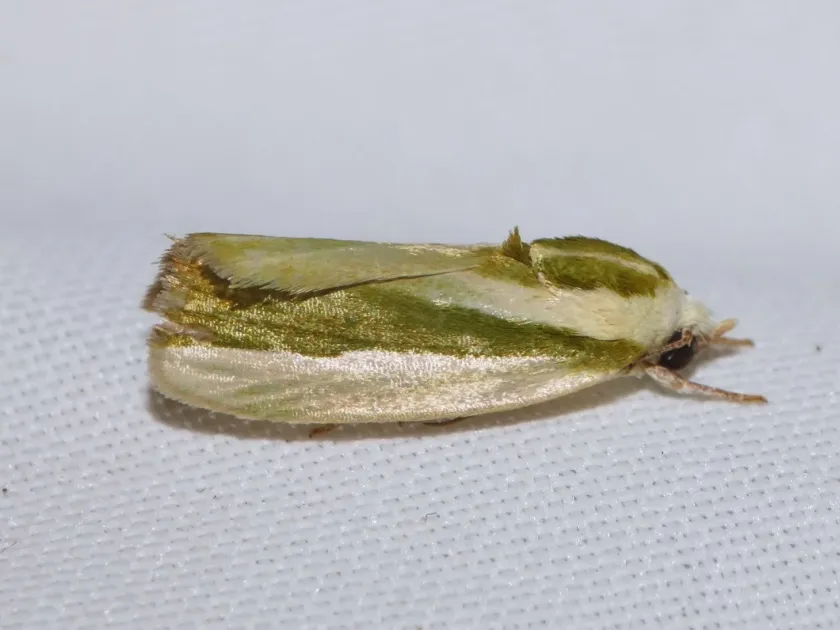
Description
How to identify
The adult spotted bollworm moth has a wingspan of approximately 20-25 mm. The forewings are greenish-yellow with a distinct longitudinal stripe, helping it blend into the foliage of host plants.
Eggs are spherical with a ridged surface, typically displaying a bluish-green hue. They are usually laid singly on the terminal buds, leaves, or young bolls of the host plant.
Larvae pass through five instars, reaching up to 20 mm in length. Their bodies feature prominent, often brightly colored tubercles that make them distinct during the late stages of development.
The pupal stage occurs inside a sturdy, boat-shaped silken cocoon, which is usually brownish or grey, found attached to the underside of leaves or within plant debris.
Adult moths are nocturnal, spending the daylight hours in shaded areas. Monitoring their presence is best achieved through nocturnal light traps or synthetic pheromone lures.
What it damages
The spotted bollworm primarily affects the Malvaceae family, with cotton being the most significant agricultural host. The larvae are responsible for the direct destruction of vegetative and reproductive structures.
They bore into buds, flowers, and developing bolls, causing them to shed prematurely. This loss of reproductive organs directly correlates to a significant reduction in cotton yield.
Beyond cotton, this pest impacts okra (ladies' finger), hibiscus, and other related plants. It can persist throughout the season by moving between alternative host plants.
Damage to the bolls often serves as an entry point for various fungi and bacteria. These secondary infections lead to boll rot, which destroys both the lint and the seeds inside.
The economic impact is double-fold: a decrease in the total number of harvestable units and a severe degradation in the quality and strength of the recovered cotton fibers.
When it appears
The activity of the spotted bollworm is closely tied to the squaring and flowering stages of cotton. High temperatures and humidity levels provide ideal conditions for rapid multiplication.
In many regions, several overlapping generations occur throughout the growing season, necessitating a consistent and long-term monitoring strategy for farmers.
As temperatures drop, the pest enters a state of diapause, typically as a pupa, hiding in soil cracks or leftover plant materials from the previous harvest.
Migration to new fields begins with the rise of spring temperatures. The pest is particularly active when the host crops start developing tender green tissues.
Agro-climatic data suggests that outbreaks are more frequent in years with extended wet seasons, which favor the growth of both host crops and alternative weeds.
Signs of infestation
The most visible sign of infestation is the presence of entry holes on flower buds and bolls. These holes are often surrounded by granular frass (excrement) left by the larvae.
Premature shedding of squares (buds) is a classic symptom. If these fallen squares are opened, one can often find a larva or clear evidence of feeding tunnels.
Webbing may be observed between the flower petals or leaves, as the larvae use silk to protect themselves while feeding on tender plant parts.
Internal rotting of bolls, accompanied by a foul smell or dark discoloration, indicates that the larva has successfully compromised the integrity of the fruit.
- Entry holes in buds and bolls
- Accumulation of larval frass
- Premature fruit shedding
- Internal boll rot and lint discoloration
Control measures
Effective management begins with the destruction of Malvaceae weeds in and around the fields, as these serve as the primary reservoir for the pest population.
Biological control, including the release of egg parasitoids like Trichogramma species, has proven effective in suppressing early-season populations of the pest.
Selective insecticides should be deployed only when economic threshold levels are reached to ensure the preservation of natural predators and parasitoids in the field.
Implementing a strict crop rotation schedule prevents the buildup of the pest population in the soil, which is crucial for sustainable farming practices.
Post-harvest deep plowing is highly recommended to expose pupae to desiccation and natural predators, significantly reducing the survival rate for the next season.
Taxonomy
- Latin name
- Earias vittella
- Order
- Lepidoptera (butterflies)
- Family
- Nolidae
- EPPO code
- EARIVI
Discussion
No discussions yet — be the first.