
Pink bollworm (Earias roseifera)
Earias roseifera
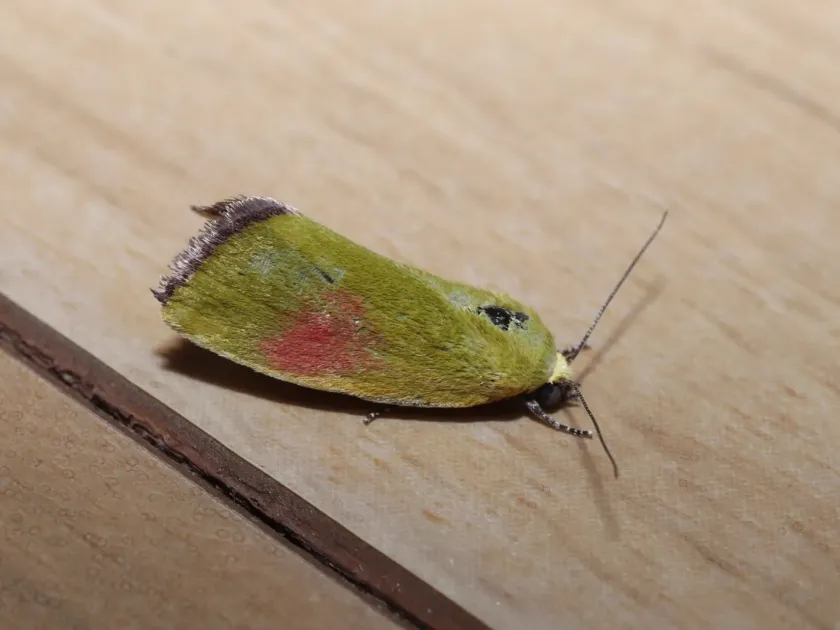
Description
How to identify
Earias roseifera, commonly known as a type of pink bollworm, belongs to the family Noctuidae and the subfamily Eariadinae. These moths are relatively small, with a wingspan typically ranging from 20 to 25 mm.
The forewings are distinguished by a delicate pink or reddish-brown coloration, which gives the species its common name. The hindwings are generally paler, often appearing white or light gray.
The larval stage is characterized by a spindle-shaped body, reaching approximately 20 mm in length when fully grown. They often feature bright spots and tubercles that act as camouflage on the host plant.
Pupation occurs within a firm, boat-shaped silk cocoon. These cocoons are cleverly hidden among the foliage, inside flower buds, or attached to the stems of host plants.
Taxonomically, the species is closely related to other Earias members, and detailed identification sometimes requires examination of genital structures under magnification to ensure accuracy.
What it damages
The primary host of Earias roseifera is cotton, which belongs to the Malvaceae family. This pest can cause substantial economic losses in commercial cotton-growing regions.
Beyond cotton, the larvae are known to infest other Malvaceous plants, including weeds like hollyhock and mallow, as well as various ornamental species such as hibiscus.
The larvae are particularly destructive because they feed on the reproductive organs of the plant. By consuming buds, flowers, and developing bolls, they directly reduce crop yields.
Infested buds frequently drop prematurely, leading to significant yield loss. When the larvae bore into cotton bolls, they destroy the developing fibers, rendering the crop unmarketable.
Furthermore, the entry wounds created by the larvae serve as entry points for secondary pathogens, such as fungi and bacteria, which cause the bolls to rot and decay.
When it appears
Earias roseifera thrives in warm climates, and its life cycle is highly dependent on ambient temperature, allowing for rapid population growth during the peak summer months.
The insect typically overwinters in the pupal stage, protected within its cocoon in the soil or in plant debris, remaining dormant until favorable conditions return.
Adult moths usually emerge as the cotton plants begin to bud. The timing of their emergence is often synchronized with the critical developmental stages of the host crop.
Optimal temperatures between 25 and 30 degrees Celsius significantly shorten the life cycle, sometimes requiring only a few weeks to complete a full generation.
As the season progresses, successive generations occur, leading to a peak in population density during the late summer, posing the greatest threat to late-developing bolls.
Signs of infestation
One of the earliest symptoms of an infestation is the flaring or shedding of cotton buds, which are often found on the ground beneath the plants with visible entry holes.
The presence of larval frass (excrement) around the base of the fruit or in leaf axils is a clear indication that larvae are actively feeding on the plant.
Larvae frequently construct webbing by tying together leaves or petals to protect themselves, which can be observed as tangled clusters of foliage during field inspections.
The bolls themselves may show dark, sunken patches around the site of the bore hole, indicating an internal feeding site that compromises the structural integrity of the fruit.
- Premature shedding of buds and small bolls;
- Visible bore holes on the fruit surface;
- Webbing between plant parts;
- Presence of larval droppings on leaves;
- Wilting of terminal shoots.
Control measures
Effective cultural control starts with deep plowing of fields after harvest to bury and destroy overwintering pupae, thereby reducing the initial population for the following year.
Sanitation is critical; this involves the removal and destruction of alternative weed hosts, such as wild mallow and other Malvaceae, which provide a reservoir for the pest.
Biological control agents, such as egg parasitoids like Trichogramma, can be released at the onset of the season to suppress the pest population without the need for synthetic chemicals.
Chemical control should be applied based on economic injury thresholds. It is essential to target the larvae during their most vulnerable stage, just after hatching and before they enter the bolls.
Integrated Pest Management (IPM) practices, including the rotation of insecticides with different modes of action, are recommended to prevent the development of pesticide resistance in the population.
Taxonomy
- Latin name
- Earias roseifera
- Order
- Lepidoptera (butterflies)
- Family
- Nolidae
- EPPO code
- EARIRO
Discussion
No discussions yet — be the first.