
Earias cupreoviridis
Earias cupreoviridis
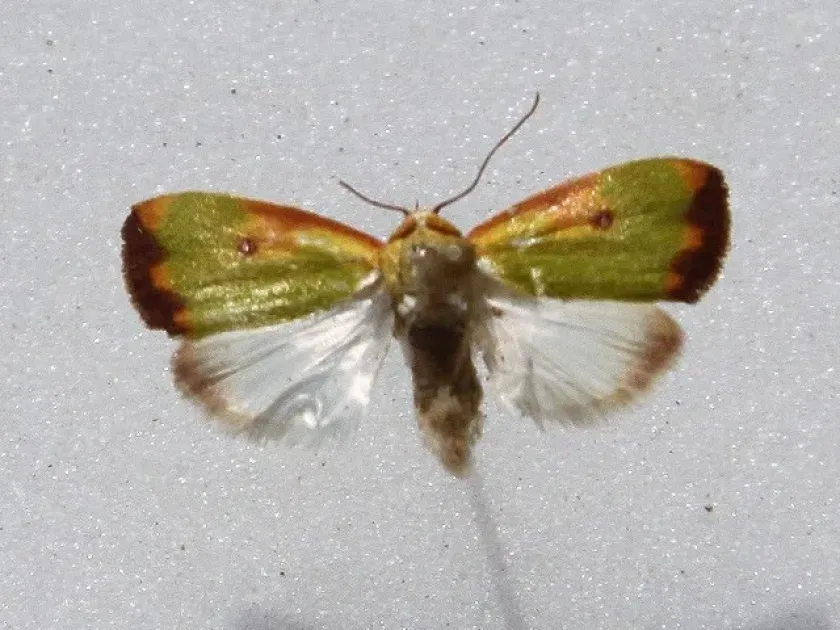
Description
How to identify
Earias cupreoviridis is a moth species belonging to the Noctuidae family, within the order Lepidoptera, and is recognized as a significant agricultural pest.
The adult moth is characterized by a wingspan of approximately 20–25 mm, with forewings displaying a distinctive coppery-green hue.
The life cycle begins with small, spherical eggs, which are typically laid singly on the tender parts of host plants, such as leaves or buds.
Larvae pass through several instars, with their appearance changing from a pale color to a more vibrant green with dark markings as they mature.
The pupal stage occurs within a dense, whitish or brownish cocoon, which the larva constructs on foliage or among plant debris to overwinter.
What it damages
The primary economic host for Earias cupreoviridis is cotton, where the larvae cause substantial damage to the plant's reproductive structures.
Besides cotton, the pest can feed on various malvaceous plants, which act as alternative hosts that maintain the population throughout the season.
Larvae primarily bore into buds, flowers, and young bolls, leading to shedding, fruit deformation, and significant reductions in fiber yield.
Early-stage larvae may also skeletonize leaves, weakening the plant and increasing its susceptibility to secondary infections.
The extent of the damage is highly dependent on the population density of the larvae during the flowering and boll-setting stages of the crop.
When it appears
Adult moth activity typically commences in late spring or early summer, coinciding with the onset of warm, favorable temperatures.
In warm regions, this species can produce multiple generations per year, leading to rapid population growth during the main cropping season.
The peak feeding damage by larvae usually occurs in mid-to-late summer, following the buildup of multiple generations.
Overwintering is accomplished in the pupal stage, with the insects remaining protected in cocoons within the soil or plant residue.
Spring emergence is closely correlated with soil temperature and the availability of early vegetative growth of host plants.
Signs of infestation
The presence of the pest is often identified by the wilting of terminal shoots caused by larval feeding inside the stems.
Small entry holes on cotton squares or bolls are definitive signs that larvae have successfully penetrated and are feeding inside.
The presence of larval frass on leaves or at the base of affected buds provides a clear indication of active feeding sites.
Webbed leaves or clusters of foliage tied together with silk are common hiding places for young larvae during the day.
Premature shedding of squares and bolls is a common field observation that often points to an infestation of this specific moth.
Control measures
Cultural control is essential, focusing on deep autumn plowing to destroy pupating sites and disrupt the pest's life cycle.
Sanitation practices, including the removal of weeds belonging to the Malvaceae family, are critical to reducing localized populations.
Biological control methods, such as the release of Trichogramma wasps, are effective in parasitizing eggs and limiting larval outbreaks.
Chemical control is applied when monitoring suggests that the larval population exceeds the economic threshold, using targeted insecticides.
- Feronome trap monitoring.
- Crop rotation to minimize host availability.
- Application of selective chemical insecticides.
Taxonomy
- Latin name
- Earias cupreoviridis
- Order
- Lepidoptera (butterflies)
- Family
- Nolidae
- EPPO code
- EARICU
Discussion
No discussions yet — be the first.