
Green Silver-lines
Earias clorana
Description
How to identify
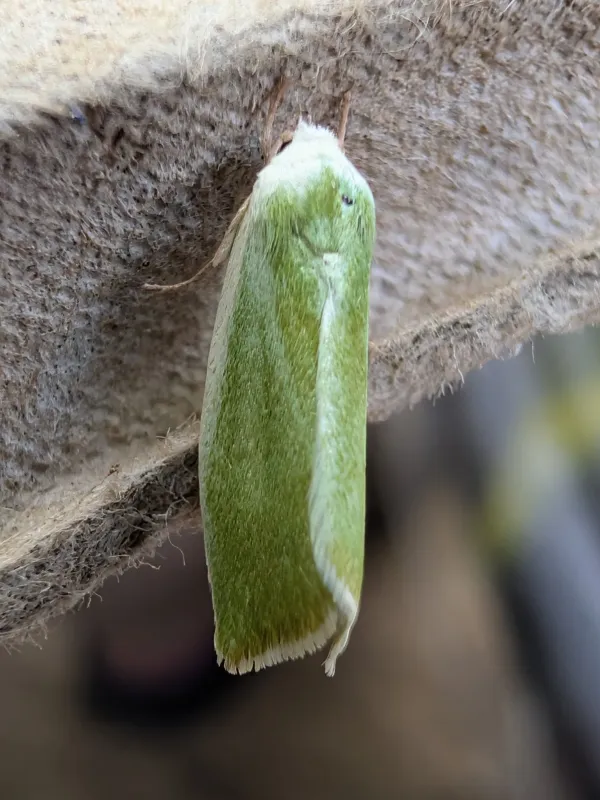
The Green Silver-lines (Earias clorana) is a moth belonging to the Noctuidae family. The adult moth has a wingspan of 18–22 mm, with distinct pale green or yellowish-green forewings.
The larvae are approximately 20 mm long, featuring a grayish-brown to greenish coloration with light longitudinal stripes and sparse hairs along their bodies.
The pupa is protected inside a very characteristic boat-shaped cocoon, which is firmly attached to the bark or leaves of the host plant.
This species undergoes a complete metamorphosis: egg, larva, pupa, and adult. In most regions, it completes two generations throughout the growing season.
Hibernation occurs at the pupal stage, with the pupae overwintering within their silken cocoons in sheltered crevices on the tree trunks or twigs.
What it damages
The primary host plants for Earias clorana are members of the willow genus (Salix). The larvae feed specifically on the young shoots and terminal buds.
Secondary hosts may include certain poplar species (Populus), which can be damaged if grown in close proximity to infested willow plantations.
Significant damage occurs when the larvae destroy the terminal buds of young trees, causing stunted growth and poor architectural development of the plant.
Heavy infestations lead to leaf skeletonization and the curling of leaves, which reduces the photosynthetic capacity of the tree and impacts its overall vigor.
In nurseries and basket willow plantations, the aesthetic and commercial value of the wood is severely compromised by the pest's activity.
When it appears
Adult moths of the first generation typically emerge in May, coinciding with the early growth phase of willow foliage, which is ideal for egg-laying.
A second generation of adults appears in mid-to-late summer, usually in July or August, extending the threat to the plants throughout the season.
Larval activity is most intense during the spring and late summer months, aligning with the periods of active shoot elongation in the host plants.
Development speed is highly temperature-dependent; warm summers can lead to faster life cycles and, consequently, higher population spikes.
By autumn, the larvae complete their feeding and pupate, spending the winter in the pupal stage until the arrival of warmer spring temperatures.
Signs of infestation
The most noticeable sign of infestation is the curling and tying together of terminal leaves with silk, forming a protected nest for the larva.
Terminal buds may show signs of hollowing or complete destruction, preventing the shoot from continuing its normal upward growth.
Small, irregular holes on the leaf surface or completely skeletonized leaves indicate the presence of larvae feeding under the shelter of the curled foliage.
The presence of fine webbing at the tips of the shoots is a clear indicator that Earias clorana is active within the plant canopy.
In late summer or autumn, searching the bark for the distinctive boat-shaped cocoons can confirm a recent infestation on the tree.
Control measures
Mechanical control involves the careful removal and destruction of the infested leaf clusters, which contain the larvae, preventing further spread.
Biological control using Bacillus thuringiensis sprays is highly effective against young larvae and is safer for beneficial insects and the environment.
Chemical intervention may be necessary in large-scale plantations, utilizing insecticides targeting larvae during their early development stages.
Promoting good tree health through proper irrigation and nutrient management helps willow trees better withstand and recover from larval damage.
Setting up pheromone traps can help monitor adult moth activity and identify the exact timing needed for potential insecticide applications.
Taxonomy
- Latin name
- Earias clorana
- Order
- Lepidoptera (butterflies)
- Family
- Nolidae
- EPPO code
- EARICH
Discussion
No discussions yet — be the first.