
Cotton stainer
Dysdercus ruficollis
Description
How to identify
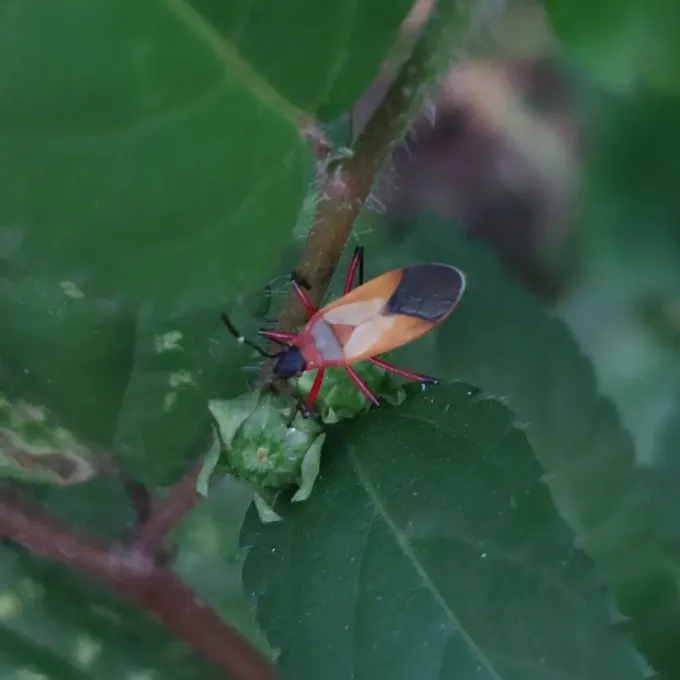
The cotton stainer belongs to the family Pyrrhocoridae (firebugs), order Hemiptera. Adult insects are easily recognized by their striking red and black coloration, which serves as an aposematic signal, warning potential predators of their toxicity.
The insect body is oval-shaped and measures between 10 and 15 mm. The head and pronotum are usually contrasting in color, while the hemelytra (forewings) often feature specific dark markings or bands characteristic of the Dysdercus genus.
Nymphs in early stages of development are bright red and lack the complex black patterns seen on adults, as their wing pads are not yet developed. As they mature, their coloration becomes more complex and the body size increases significantly.
These insects are thermophilic and prefer open, well-lit fields. They possess specialized piercing-sucking mouthparts, which are perfectly adapted for penetrating the shells of seeds and ripening fruits.
The life cycle undergoes incomplete metamorphosis: egg, nymph (several instars), and adult (imago). Optimal conditions for reproduction occur during periods of high temperature and sufficient humidity.
What it damages
The primary food sources for this species are plants from the Malvaceae family, particularly cotton. The bugs feed by extracting juice from developing bolls, which causes significant underdevelopment of the fiber.
The pest attacks both commercial cotton varieties and wild plants from related families. In the absence of cotton, it may migrate to other agricultural crops, causing secondary damage to these plantations.
The harm is caused not only by direct sap extraction but also by the transmission of fungal and bacterial pathogens (specifically causing fiber staining and rot). This results in the darkening and decay of the boll contents.
Seeds damaged by the bugs lose their germination capacity and oil content, which is a critical issue for seed-producing farms. The fiber inside the boll becomes brittle, harsh, and loses its commercial quality.
Mass outbreaks of cotton stainers can lead to yield losses of 30% to 50% if effective management practices are not implemented during the boll-ripening stage.
When it appears
The appearance of the pest in fields is synchronized with the budding and boll formation phases of the cotton plant. Imago activity increases sharply with the onset of consistently hot weather.
The pest can produce several generations per season under favorable climatic conditions. Adults overwinter in plant debris, under fallen leaves, or in the topsoil layer, where they are protected from low temperatures.
In spring, as the soil warms to specific temperatures, the bugs emerge from diapause and begin actively searching for host plants. Initial foci often form on weed vegetation along the field margins.
The highest population density is observed when cotton bolls reach the milk-wax maturity stage. This is the period when significant migration of the pest to cultivated crops typically occurs.
In autumn, as average daily temperatures decrease, the insects gradually move into overwintering sites, ceasing both feeding and reproduction.
Signs of infestation
The first visual sign of pest presence is the sighting of the bugs themselves on the plants, particularly clusters of nymphs on the bolls. They often congregate, making them easily detectable against the green foliage.
Characteristic dark spots—puncture marks from the insect's proboscis—appear on the surface of the bolls. In feeding areas, premature dropping of young squares may occur.
- Yellowing and gradual wilting of individual leaves near damaged bolls.
- Presence of insect excrement on the surface of the fruit.
- Development of secondary infections in puncture sites.
- Poor boll opening during the harvest season.
When bolls are opened, the fiber inside appears soiled, with characteristic brown or yellowish stains, which are a direct consequence of the insect's feeding activity.
Control measures
Protection systems include agrotechnical methods, such as the thorough removal of plant debris after harvest, where the pest completes its overwintering cycle. It is crucial to eliminate Malvaceae weeds that serve as reservoirs for the pest.
The use of biological control methods, such as utilizing natural entomophagous insects that attack eggs and nymphs, allows for a significant reduction in population density without excessive chemical load.
Chemical control is justified when the economic threshold of damage is reached. Insecticides from the organophosphorus group or pyrethroids registered for cotton use should be applied.
It is critically important to perform applications during early morning or evening hours when the bugs are less active, ensuring maximum coverage of the plants with the product.
Adhering to crop rotation and spatial isolation of new crops from previously infested areas help significantly reduce the probability of mass colonization by the cotton stainer in the following season.
Taxonomy
- Latin name
- Dysdercus ruficollis
- Order
- Hemiptera (bugs, aphids, leafhoppers)
- Family
- Pyrrhocoridae
- EPPO code
- DYSDRF
Discussion
No discussions yet — be the first.