
Oak mirid bug
Dryophilocoris flavoquadrimaculatus
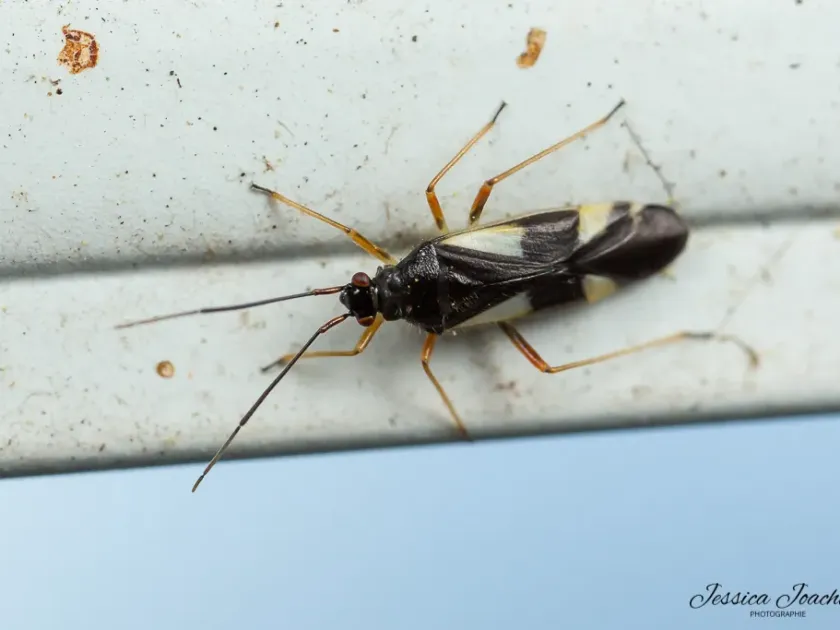
Description
How to identify
The Oak mirid bug Dryophilocoris flavoquadrimaculatus is a species of true bug belonging to the family Miridae. Adults are typically 6–8 mm long and display a yellowish or brownish coloration with distinct dark patterns.
These insects possess elongated bodies and long, thin antennae, which are key features for identifying this species within the diverse Miridae family.
Their wings often have translucent sections with dark markings, aiding in camouflage against the rough texture and variegated colors of oak bark and leaves.
Nymphs share a similar morphology to adults but lack functional wings, and they undergo several molting stages, increasing in size as they progress through the spring.
They are mobile insects, and while they primarily remain within the canopy of their host tree, they are capable of flight to navigate between adjacent oak trees.
What it damages
As their name suggests, these bugs primarily feed on various oak species, including the pedunculate oak and sessile oak, utilizing them as both a food source and a habitat.
Both nymphs and adults feed by piercing the plant tissues and extracting sap, focusing particularly on young shoots and expanding leaves during the early growing season.
The extraction of sap causes localized cellular death, which manifest as chlorotic spots on the leaves, ultimately hindering the tree's overall photosynthetic efficiency.
In cases of heavy infestation, the damage can lead to leaf curling, premature browning, and even significant leaf drop, which puts additional stress on the tree during dry spells.
Beyond direct feeding damage, the punctures created by the bugs may facilitate the secondary entry of fungal spores, potentially contributing to localized necrosis or disease development.
When it appears
The life cycle is closely synchronized with the phenology of the host tree; the overwintered eggs hatch just as the oak buds begin to burst in early spring.
Nymphs are most active throughout May and June, taking advantage of the high nutrient content in newly developed foliage to grow and reach their adult stage.
Adult bugs typically emerge by mid-summer, focusing their energy on reproduction and finding suitable sites to lay their eggs, which will remain dormant until the following spring.
This species is univoltine, meaning it completes only one generation per year, ensuring that the population density typically remains within manageable ecological bounds.
By late summer, adult activity tapers off significantly as the insects complete their biological cycles and prepare for the winter period of diapause.
Signs of infestation
The primary symptom of an infestation is the appearance of small, pale spots or 'stippling' on the leaf surface, caused by the bugs sucking sap from individual cells.
Distorted leaf shapes and curling edges are frequently observed on branches with high bug concentrations, as the structural integrity of the leaf is compromised early on.
Observant gardeners or foresters can find the nymphs on the underside of leaves or near the leaf axils, where they often retreat to avoid high temperatures or direct sunlight.
Black or dark brown spots of frass (excrement) on the leaf surface are a strong indicator of an active population feeding in the canopy above.
In severe instances, these punctures can merge, resulting in large, unsightly necrotic patches that reduce the aesthetic and functional quality of the foliage.
Control measures
Maintaining a healthy ecosystem by encouraging natural predators, such as predatory spiders and various ladybird species, is the most sustainable approach to long-term control.
In nursery settings or high-value landscapes, chemical control using systemic or contact insecticides may be utilized if population thresholds threaten the tree's health.
Proper silvicultural practices, including adequate watering and fertilization, help trees build stronger defenses against sap-feeding insects and recover faster from minor infestations.
Early-season monitoring is crucial; inspecting young leaves during the bud-burst period allows for early detection of nymphs before they cause widespread leaf damage.
Regular maintenance pruning during the dormant season helps eliminate potential egg-laying sites, which contributes to a natural reduction in the pest population for the following year.
Taxonomy
- Latin name
- Dryophilocoris flavoquadrimaculatus
- Order
- Hemiptera (bugs, aphids, leafhoppers)
- Family
- Miridae
- EPPO code
- DPHIFL
Discussion
No discussions yet — be the first.