
Spotted wing drosophila
Drosophila suzukii
Description
How to identify
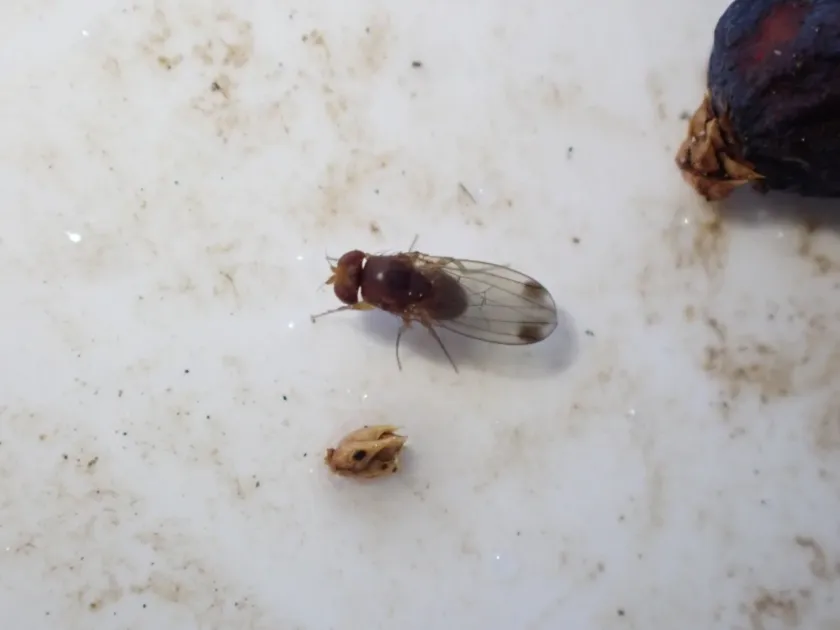
The Spotted wing drosophila (Drosophila suzukii) belongs to the order Diptera and the family Drosophilidae. Unlike common fruit flies, this species features a highly sclerotized ovipositor with sharp, serrated teeth.
Adult flies measure 2 to 3 millimeters in length and range in color from light yellow to brown, which provides excellent camouflage on ripening fruits.
Males are easily identified by a distinct dark spot on each wing, making them recognizable during field monitoring activities.
The eyes are bright red, and the females are generally larger than males. Their specialized ovipositor allows them to pierce the skin of firm, ripening fruit, distinguishing them from native Drosophila species.
The lifecycle is extremely rapid, with multiple generations possible within a single season, leading to exponential population growth under favorable conditions.
What it damages
This pest affects a wide range of berry and stone fruit crops, including strawberries, raspberries, blackberries, blueberries, grapes, cherries, and stone fruits.
The primary damage is caused by the larvae, which feed internally on the pulp, rapidly breaking down the fruit tissue from the inside out.
Affected fruit becomes soft, develops sunken areas, and is frequently rendered unmarketable due to both larval damage and secondary infections.
Fungal pathogens such as grey mold often colonize the puncture sites, leading to the rapid decay of berries and potential contamination of entire batches.
The pest's ability to attack fruit before it is fully harvested results in severe economic losses, sometimes reaching total crop failure in untreated plots.
When it appears
Activity begins in early spring as temperatures rise, typically when conditions become consistently above 10-12 degrees Celsius.
Peak infestation periods coincide with the ripening of soft-skinned berries throughout the summer and into the early autumn months.
High humidity and moderate temperatures provide the ideal environment for the fly to reproduce and expand its population across farms and home gardens.
As winter approaches, adult flies seek shelter in protected areas, under plant debris, or in forest undergrowth to survive until the following spring.
Continuous monitoring starting early in the season is vital to detect the arrival of the pest and implement control measures before significant damage occurs.
Signs of infestation
The first visual indication of an infestation is the presence of tiny, pin-prick scars on the skin of the fruit, created during the egg-laying process.
As the larvae mature inside, the fruit loses its firmness and exhibits localized softening, which often leads to skin collapse and deformation.
Dissecting a suspect fruit will reveal small, legless, white larvae feeding within the pulp, eventually turning the internal structure into a mushy consistency.
Surface mold development around the oviposition site is a reliable indicator that the fruit has been heavily infested for some time.
Adult flies can be detected using monitoring traps filled with apple cider vinegar or yeast-based baits, which help confirm their presence in the orchard.
Control measures
The cornerstone of effective control is sanitation, which involves the rigorous collection and destruction of all infested or overripe fruit to disrupt the breeding cycle.
- Exclusion netting with a fine mesh size to prevent adults from accessing the fruit.
- Deployment of baited traps for mass trapping and population monitoring.
- Optimizing harvest timing to ensure fruit is picked immediately upon maturity to reduce the window of exposure.
- Application of registered insecticides during peak risk periods, adhering strictly to pre-harvest intervals.
Integrated pest management strategies should include alternating between different insecticide classes to prevent the development of resistance within the population.
Maintaining a clean orchard floor and removing alternative host plants near the crop can significantly reduce the local pressure of this invasive pest.
Taxonomy
- Latin name
- Drosophila suzukii
- Order
- Diptera (flies)
- Family
- Drosophilidae
- EPPO code
- DROSSU
Discussion
No discussions yet — be the first.