
Drosophila phalerata
Drosophila phalerata
Description
How to identify
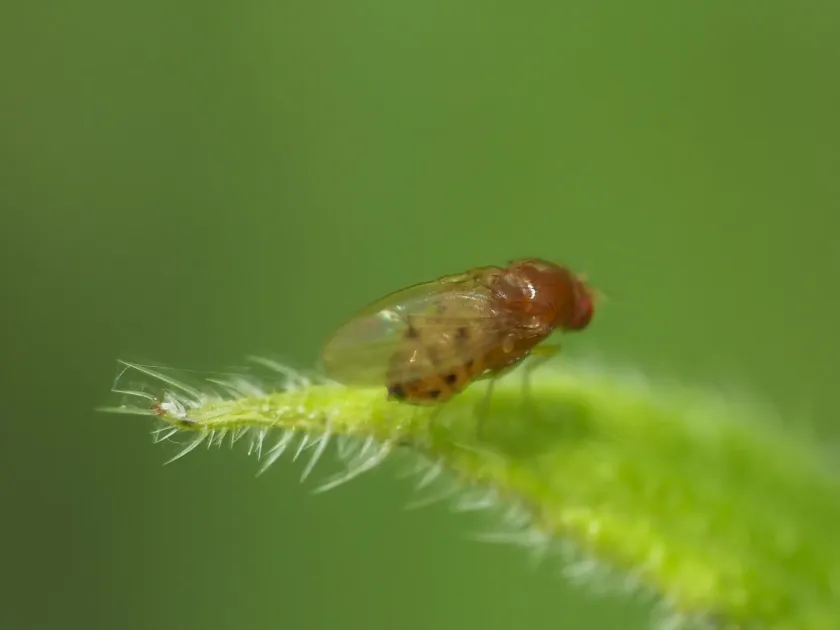
Drosophila phalerata is a species of small fruit flies belonging to the family Drosophilidae, order Diptera. Adults are characterized by their yellowish-brown body and distinct dark spots on the tips of their wings, which is a key identification marker.
The biology of this species is closely linked to decomposing plant matter and overripe fruits. It is a highly adaptable insect capable of rapid population growth under favorable environmental conditions.
Females deposit their eggs just beneath the skin of soft or ripening fruits. The larvae emerge shortly after and begin consuming the fruit pulp, which facilitates rapid microbial colonization and decay.
They are commonly found in gardens and forested areas where they feed on wild fungi and various types of berries, showing a strong preference for humid, shaded microclimates.
Adult flies are crepuscular, meaning they are most active during dawn and dusk. Their ability to fly enables them to colonize new orchard sites quickly when suitable food sources become available.
What it damages
The primary hosts for Drosophila phalerata include various soft fruits and berries such as strawberries, raspberries, blackberries, and grapes, particularly those nearing full maturity.
Damage is characterized by the internal feeding of larvae, which ruins the fruit texture and renders the product unmarketable for both fresh consumption and industrial processing.
Beyond physical consumption, the pest plays a significant role in vectoring fungal spores. Their feeding sites serve as entry points for secondary infections like gray mold, which can destroy entire yields.
Infested berries lose their structural integrity and show signs of fermentation. In vineyards, the infestation can trigger vinegar rot, leading to a significant loss of harvest quality.
Economic damage is often severe due to the rapid spread of the pest; one infested fruit can attract more adults, leading to an exponential increase in larval density within a cluster.
When it appears
The activity of Drosophila phalerata is temperature-dependent. Adults begin to emerge when temperatures exceed 15°C, typically spanning from late spring through late autumn.
Peak populations are usually observed during the harvest season in late summer and early autumn when host fruits provide an abundance of fermenting sugars for egg-laying.
During the onset of cold weather, adults seek protected areas for overwintering, such as plant debris, storehouses, or greenhouses, where they may remain active if temperatures are sufficient.
Drought conditions often suppress their activity, but the presence of irrigation systems can maintain a favorable microclimate, allowing the pest to persist throughout the summer months.
The life cycle is short, sometimes completed in under two weeks, allowing for multiple generations to occur in a single season, significantly increasing pressure on late-ripening crops.
Signs of infestation
The first signs of infestation are tiny puncture wounds on the surface of the fruit skin, which are often invisible without close inspection or magnification.
Infested fruits typically become soft and watery, often emitting a distinct fermented or vinegar-like odor even before they show visible external signs of decay.
Adult flies can often be seen hovering around damaged fruit clusters, especially during the early morning or late evening hours, indicating an active population in the vicinity.
When an infested fruit is opened, small, white, legless larvae are usually visible inside the pulp, indicating that the damage is well advanced.
The rapid development of localized soft rot spots on berries or grapes, which quickly spread to adjacent fruits, is a classic indication of an active Drosophila infestation.
Control measures
Sanitation is the most critical management strategy. Timely harvest and the removal of all overripe or damaged fruits from the field are essential to eliminate food sources.
Destroying dropped or rotten fruit prevents the larvae from completing their life cycle and reduces the number of adults in subsequent generations.
Monitoring populations using vinegar or wine-based traps allows for early detection, enabling farmers to apply control measures before the infestation becomes widespread.
If population levels exceed economic thresholds, insecticides labeled for fruit crops may be used, provided that pre-harvest intervals are strictly followed to ensure food safety.
Cultural practices such as pruning to improve canopy aeration and light penetration lower the local humidity, making the garden environment less attractive to the flies.
Taxonomy
- Latin name
- Drosophila phalerata
- Order
- Diptera (flies)
- Family
- Drosophilidae
- EPPO code
- DROSPH
Discussion
No discussions yet — be the first.