
Shore fruit fly
Drosophila littoralis
Description
How to identify
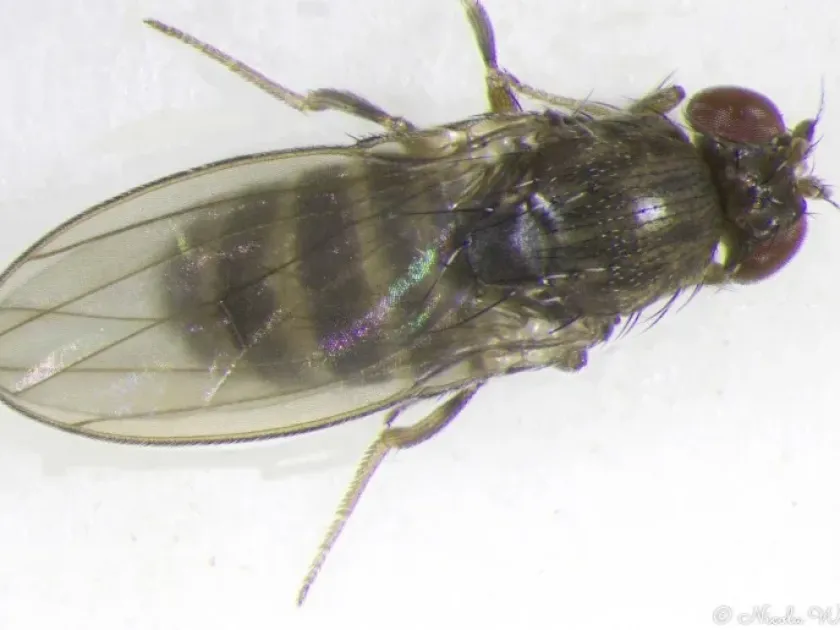
The shore fruit fly (Drosophila littoralis) is a small dipteran insect belonging to the Drosophilidae family, often found in humid environments near water bodies.
Adults typically measure between 2 and 3 millimeters in length and possess the characteristic red eyes and yellowish-brown to dark coloration common to the genus.
Identification often requires careful inspection of the male genitalia and an understanding of the specific ecological niche this species occupies compared to other fruit flies.
The larvae are small, cream-colored, and maggot-like, equipped with mouthparts specialized for processing organic matter in advanced stages of decay.
Its life cycle follows a complete metamorphosis: egg, three larval stages, pupa, and adult, with the development speed heavily dictated by local humidity and temperature.
What it damages
While primarily a saprophage, the shore fruit fly can become a significant pest when it transitions to feeding on ripe or overripe commercial fruits and berries.
The main crops at risk include raspberries, strawberries, and other soft fruits, especially those that have already sustained minor injuries or bruising.
The fly thrives in high-humidity areas, making orchard sections near ponds or poorly drained sites particularly susceptible to mass colonization.
Damage occurs when larvae infest the fruit, accelerating decay, inducing fermentation, and rendering the harvest completely unmarketable.
Additionally, these flies serve as vectors for various microorganisms, including yeasts and bacteria that exacerbate fruit rot and secondary fungal diseases.
When it appears
The peak activity of the shore fruit fly occurs during the summer and autumn months, corresponding with the ripening phases of most horticultural fruit crops.
Mass emergence typically aligns with the availability of sugar-rich food sources, as decaying fruit provides the necessary nutrients for the fly to reproduce rapidly.
As autumn approaches, the population often reaches its maximum size, posing a serious threat to late-season fruit varieties currently being harvested.
Overwintering takes place at the adult stage, with flies seeking refuge in sheltered areas like plant debris, leaf litter, or crevices in tree bark.
Mild and rainy weather conditions during the growing season serve as a catalyst for population growth, potentially leading to multiple generations in a single year.
Signs of infestation
A noticeable increase in small fly activity around harvested or ripening fruit is the most immediate indicator of an infestation.
Visual signs on fruit include tiny puncture wounds on the skin, which quickly become soft, sunken lesions indicating the start of internal degradation.
Upon cutting open an infested fruit, small white larvae can often be seen feeding within the pulp, showing signs of active consumption.
A sharp, acidic odor of fermentation or vinegar is frequently detected near the affected crops, indicating the presence of large colonies of fruit flies.
Evidence of secondary mold growth and moisture seepage from punctures on the fruit surface are reliable diagnostic signs of advanced larval damage.
Control measures
Integrated pest management (IPM) is essential for controlling the shore fruit fly, with an emphasis on strict orchard sanitation and hygiene.
- Regular removal and deep burial of all fallen or decaying fruit.
- Installation of attractant-based traps to monitor population levels and reduce adult numbers.
- Maintaining a rigorous harvesting schedule to prevent fruit from becoming overripe on the vine.
- Ensuring proper orchard drainage to limit humidity levels that favor fly development.
- Using biological insecticides or organic-certified controls to manage outbreaks during the harvest window.
Given the proximity to harvest time, it is critical to prioritize control methods with minimal residue profiles to ensure food safety for consumers.
Taxonomy
- Latin name
- Drosophila littoralis
- Order
- Diptera (flies)
- Family
- Drosophilidae
- EPPO code
- DROSLI
Discussion
No discussions yet — be the first.