
Drosophila hydei
Drosophila hydei
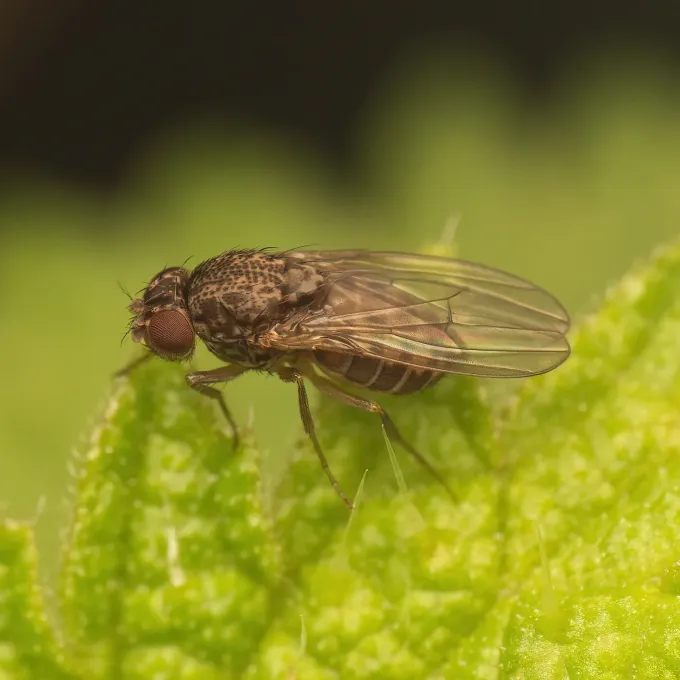
Description
How to identify
Drosophila hydei, commonly known as a type of fruit fly, belongs to the family Drosophilidae, order Diptera. Adult flies have a yellowish-brown coloration and reach approximately 3 mm in length, appearing slightly larger than the more common Drosophila melanogaster.
The wings of the insect are transparent with distinct venation patterns typical for the family. The eyes are bright red, and the body exhibits clear dark stripes, which are key diagnostic features for identifying this species in field conditions.
The larvae grow up to 4–5 mm, appearing white or cream-colored with a segmented body structure. They possess specialized respiratory structures at the posterior end that allow them to thrive in liquid and semi-liquid environments of decaying organic matter.
The life cycle is highly temperature-dependent, usually ranging from 7 to 14 days under optimal conditions. They thrive in warm, humid environments rich in fermenting sugars and yeasts, which are essential for their rapid reproduction.
The species displays a high reproductive rate, with a single female capable of laying up to 500 eggs in her lifetime. The development proceeds through egg, three larval instars, pupa, and adult stages.
What it damages
Drosophila hydei primarily feeds on and lays eggs in damaged, cracked, or overripe fruits and vegetables. Preferred hosts include tomatoes, grapes, peaches, strawberries, figs, and other sugar-rich produce.
The pest does not always initially attack healthy fruits but colonizes areas already damaged or affected by fungal infections. Once established, they can act as vectors for various molds, significantly accelerating the rate of decay.
In commercial settings, this pest is a major issue in warehouses and processing facilities where sanitation protocols and temperature controls are compromised. Affected produce rapidly loses its market value due to cosmetic and structural damage.
Larvae feed within the fruit tissues, destroying the pulp and promoting the growth of secondary bacterial infections. This leads to the rapid collapse of fruit structure, rendering it completely unsuitable for consumption or processing.
Infestation causes significant economic losses both in the field during ripening and post-harvest during storage and transit. Damages include direct crop loss and increased costs for warehouse fumigation and cleaning.
When it appears
The active population period begins when fruits start ripening in the field and continues through late autumn. Peak infestation levels are typically observed during warm, humid months when fermentation processes occur most rapidly.
In enclosed environments such as greenhouses, warehouses, or food processing plants, Drosophila hydei can maintain continuous activity throughout the year, provided temperatures remain above 15-18 degrees Celsius.
Survival in moderate climates during winter is restricted; however, these flies successfully overwinter in insulated storage areas, waste containers, and compost piles where organic residues provide constant food sources.
Spring warming triggers the emergence of adults from diapause, followed by rapid colonization of available food sources. The speed of spread correlates strongly with the availability of decaying organic debris in the surrounding environment.
Monitoring for the presence of this pest should commence as soon as produce begins to mature, utilizing sticky traps and pheromone baits to assess population density and the need for control measures.
Signs of infestation
The primary sign of infestation is the presence of small fruit flies swarming around containers of produce or areas with accumulated plant waste. When the storage bin is disturbed, a cloud of flies usually rises.
Microscopic punctures can often be seen on the fruit surface where eggs have been deposited. These spots quickly develop into soft, discolored areas that serve as primary entry points for yeast and bacteria.
A distinct sour, fermented odor is a reliable sign of active larval development within the fruit tissues. This smell indicates that the decomposition process has already advanced significantly.
Upon close inspection, tiny white pupae or larvae may be visible on the surface of the produce. Affected areas typically darken and become covered with a moldy, slimy residue characteristic of fruit fly damage.
An indirect sign is the presence of sticky fruit juices on containers and surrounding surfaces, which attracts more flies and promotes the spread of pathogens throughout the storage area.
Control measures
The cornerstone of control is strict sanitation: regular removal of decaying produce, cleaning of organic debris from fields, and frequent sanitizing of storage areas to eliminate food sources for the larvae.
Insecticide use during the ripening stage is restricted due to short pre-harvest intervals; therefore, biological controls or mass trapping with food-based attractants are often preferred for management.
For storage facilities, fumigation and the use of specialized traps containing vinegar or yeast solutions are effective at reducing adult populations and disrupting the breeding cycle.
Agronomic measures include harvesting produce before it becomes overripe and ensuring rapid cooling post-harvest. Temperatures below 10 degrees Celsius significantly slow down larval metabolism and population growth.
Warehouse protection also includes installing fine-mesh screens on ventilation openings, preventing the migration of flies from external sources into areas where sensitive produce is being stored.
Taxonomy
- Latin name
- Drosophila hydei
- Order
- Diptera (flies)
- Family
- Drosophilidae
- EPPO code
- DROSHY
Discussion
No discussions yet — be the first.