
Hawaiian fruit fly
Drosophila heteroneura
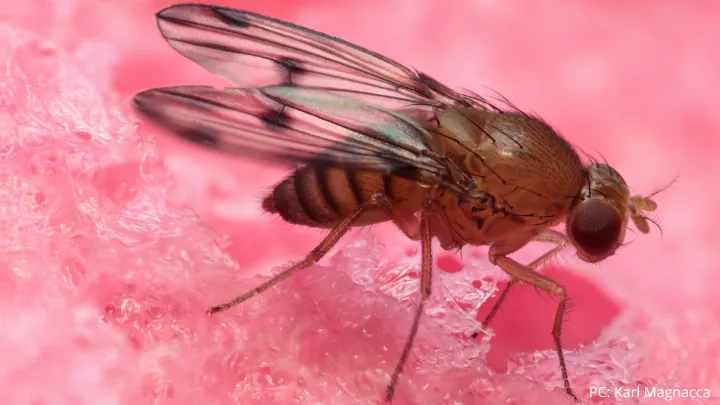
Description
How to identify
The Hawaiian fruit fly (Drosophila heteroneura) is a remarkable species endemic to the Hawaiian Islands, belonging to the Drosophilidae family. It is widely recognized for its unique sexual dimorphism, which is a subject of significant interest in evolutionary research.
The males of this species are distinguished by their unusually wide, "hammer-shaped" heads, serving as a primary visual marker for entomologists. Adults typically measure between 3 and 5 millimeters in length, with body coloration ranging from light yellow-brown to dark brown.
The wings of adult flies often display distinct dark patterns at the tips, which can be observed under close inspection. Males also perform complex courtship displays that are specific to this species.
Larvae are typical of the genus: cylindrical, whitish in color, and possess a tapered anterior end with specialized mouthparts for feeding. Their development occurs predominantly within decomposing or soft plant tissues.
Due to its status as an endemic species within specialized Hawaiian ecosystems, identification often requires professional expertise to distinguish it from introduced or cosmopolitan drosophilid species.
What it damages
The economic damage is caused primarily during the larval stage. Larvae bore into soft, fleshy plant tissues or decaying fruit, feeding on the internal structures and causing rapid decomposition.
This feeding activity compromises the integrity of the fruit or plant tissue, making it highly susceptible to secondary infections, particularly soft-rot bacteria and various fungal pathogens.
While Drosophila heteroneura is not a primary pest for large-scale industrial monocultures, it can cause significant losses in local fruit cultivation and community gardens within its native range.
Infested produce loses its market value and palatability. The presence of larvae within the fruit pulp makes it unsuitable for fresh consumption or further processing.
The species also plays a ecological role in breaking down organic matter, but its presence near human-managed gardens necessitates careful monitoring to prevent outbreaks.
When it appears
Population density and activity are strongly correlated with periods of high humidity and rainfall, which provide optimal conditions for reproduction and larval survival.
Adults remain active throughout the year in the mild Hawaiian climate, but peak abundance is observed during seasons with regular rainfall that promotes fruit maturation.
In controlled environments, such as greenhouses or research laboratories, the life cycle is continuous, provided that temperature and humidity levels remain within the preferred range for the species.
The fly's activity levels usually rise in tandem with the ripening cycles of its host plants, making them more apparent during specific harvest seasons.
Dry, drought-prone weather conditions significantly inhibit the development of the fly, forcing the population to concentrate in moist, shaded micro-habitats.
Signs of infestation
Small, puncture-like holes on the skin of the fruit are the most common sign of infestation, indicating where the female has deposited eggs into the tissue.
Localized softening and discoloration of the fruit surface suggest that larvae are actively feeding beneath the skin. Over time, these areas may become sunken and emit a fermentation-like odor.
Upon slicing an infested fruit, one can find whitish larvae or their dark-colored frass (excrement) within the pulp. The presence of these larvae is a definitive indicator of infestation.
Adult flies are frequently observed aggregating around damaged or fermenting fruit. Using bait traps can help confirm their presence in an orchard or garden.
A sudden increase in fruit drop, especially when the fallen fruit shows signs of rapid decay, is a reliable field signal for growers to inspect their crops for Drosophila activity.
Control measures
Sanitation is the cornerstone of control: the prompt collection and destruction of all fallen, overripe, or damaged fruit is essential to remove breeding sites and break the life cycle.
Trapping adults using fermentation-based attractants (e.g., wine, apple cider vinegar, or commercial fruit fly lures) is a highly effective method for monitoring and reducing population pressure.
Biological control methods, including the use of beneficial insects or entomopathogenic fungi, offer safe alternatives to chemical pesticides, which are generally not required for this species.
Strict adherence to quarantine measures when moving plant material is vital to prevent the unintentional spread of this species to new environments where it could become invasive.
- Regular removal and disposal of rotting plant material.
- Deployment of yellow sticky traps or bait traps in tree canopies.
- Use of food-grade lures to monitor adult fly numbers.
- Proper ventilation and moisture control in greenhouses.
- Avoidance of importing untreated fruits into vulnerable regions.
Taxonomy
- Latin name
- Drosophila heteroneura
- Order
- Diptera (flies)
- Family
- Drosophilidae
- EPPO code
- DROSHE
Discussion
No discussions yet — be the first.