
Giant mango mealybug
Drosicha mangiferae
Description
How to identify
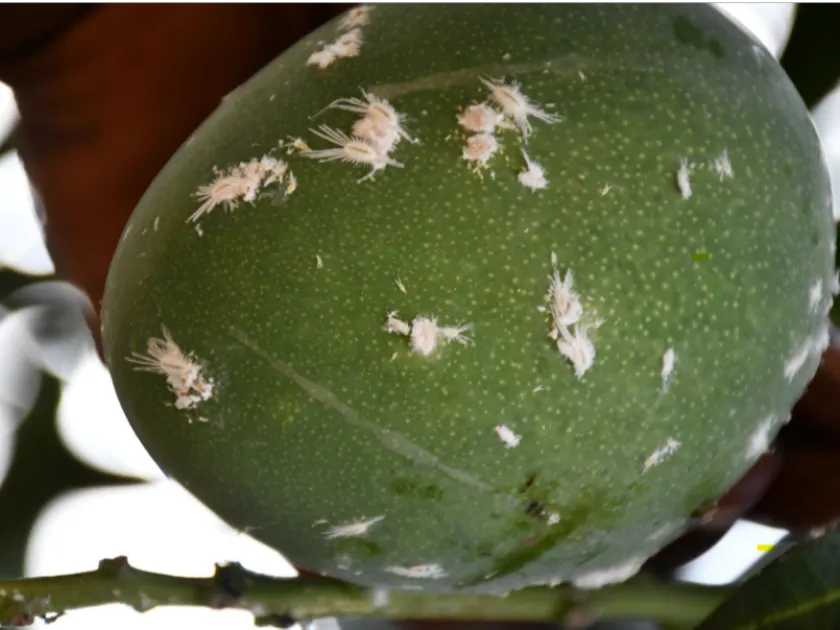
The giant mango mealybug (Drosicha mangiferae) is a member of the family Monophlebidae. These insects are characterized by their significant size, with adult females reaching lengths of up to 20 mm and possessing a distinct oval body covered in white, powdery wax.
The life cycle involves a dramatic transformation. While the females remain relatively sedentary after reaching maturity, the winged males are highly mobile, facilitating reproduction across the orchard.
First-instar nymphs, commonly called crawlers, are the primary dispersal stage. They are highly active and utilize wind or physical contact to spread from the soil to the canopy of the host trees.
Females produce ovisacs made of a cotton-like waxy secretion to protect their eggs. These are typically deposited in soil crevices around the base of the trunk to ensure the survival of the next generation.
Identification is aided by the presence of these distinctive white cottony masses found on the bark, twigs, and leaf petioles during the early spring months.
What it damages
This pest is a major threat to mango trees (Mangifera indica) and can also affect citrus, guava, and litchi. It causes direct injury by piercing plant tissues and extracting nutrient-rich sap.
Heavy infestations lead to stunted growth, yellowing of foliage, and a significant drop of flowers and fruit, which directly reduces the yield potential of the orchard.
The excretion of honeydew is a significant secondary damage factor. This sugary substance coats leaves and branches, creating a perfect medium for the growth of sooty mold, which suppresses photosynthesis.
Continuous feeding causes severe stress to the host, resulting in the drying and dieback of young shoots and branches. In severe cases, particularly with young trees, it can lead to total plant collapse.
Beyond the physiological damage, the physical presence of the mealybugs and the associated sooty mold makes the fruit unmarketable and unattractive to consumers.
When it appears
The activity of the giant mango mealybug is seasonal, starting when the overwintering eggs in the soil hatch in response to increasing spring temperatures.
The migration of crawlers to the tree canopy usually aligns with the critical blossoming phase of the mango tree, making this period the most crucial for monitoring and control interventions.
Development is continuous throughout the warmer months, but the pest typically completes only one generation per year, though this can vary based on local climatic conditions and host availability.
As temperatures begin to drop and the mango season concludes, adult females migrate downward to the base of the trunk to burrow into the soil for egg-laying.
Understanding these seasonal movements is vital for timing the application of physical barriers and chemical controls to minimize the population density in the following year.
Signs of infestation
The most visible sign of infestation is the presence of large, white, cottony masses on the branches, stems, and leaf junctions, which protect the mealybug colonies.
The development of a sticky, black coating on leaves and fruit, known as sooty mold, is a classic indication of a severe mealybug infestation in the upper canopy.
Increased ant activity around the tree trunk is a strong indicator of mealybug presence, as ants feed on the honeydew produced by the mealybugs and actively protect them from predators.
Leaf curling, chlorosis, and the premature shedding of blossom panicles are physiological responses to the intense sap-sucking activity of the insects.
Careful inspection of the soil near the trunk base in autumn may reveal the presence of egg-laden ovisacs, which is a clear warning sign of a potential outbreak for the next season.
Control measures
Effective management requires an integrated pest management (IPM) approach. One primary method involves the installation of sticky bands or grease barriers around the trunk to stop crawlers from ascending.
Sanitation practices, such as scraping away loose bark from the trunk, destroy the sheltered locations where mealybugs tend to congregate and hide from environmental stressors.
Biological control agents, including various species of ladybird beetles (such as Rodolia cardinalis), have proven effective in reducing mealybug numbers in natural and orchard settings.
Systemic insecticides should be applied during the early stage of crawler emergence to ensure maximum impact on the population before they reach the higher canopy areas.
Pruning and removal of heavily infested branches, followed by their immediate destruction, are essential to limit the spread of the pest within the orchard and prevent re-infestation.
Taxonomy
- Latin name
- Drosicha mangiferae
- Order
- Hemiptera (bugs, aphids, leafhoppers)
- Family
- Monophlebidae
- EPPO code
- DROCMA
Discussion
No discussions yet — be the first.