
Balsam woolly adelgid
Dreyfusia piceae
Description
How to identify
The balsam woolly adelgid (Dreyfusia piceae) is a destructive sucking insect of the family Adelgidae. It is a tiny, aphid-like pest that specializes in infesting various species of true firs.
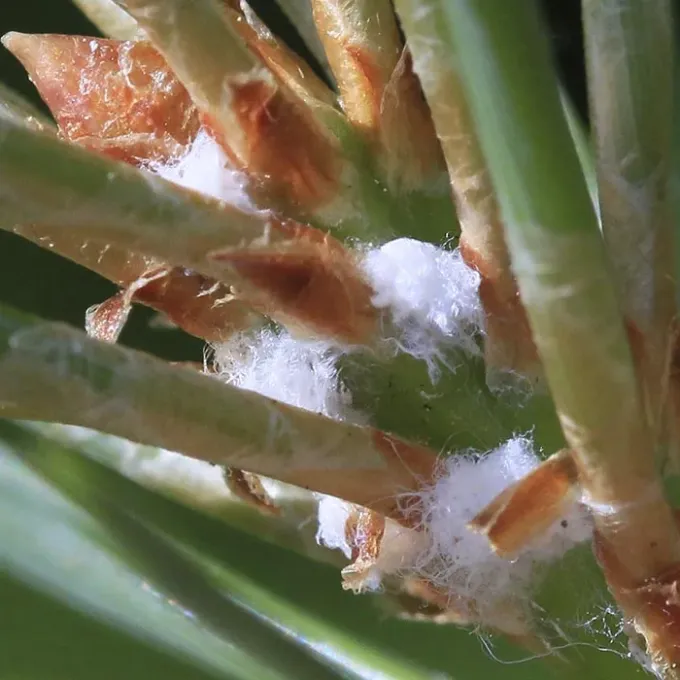
The insect is characterized by its white, woolly, or cottony wax filaments, which it secretes for protection. These white tufts are often the only visible sign of the insect's presence on the tree bark.
Adult females are wingless, sedentary, and about 1 mm in length. They undergo a complex life cycle, primarily reproducing parthenogenetically, which allows populations to expand rapidly.
The mobile stage of the insect, known as the 'crawler', is brownish and microscopic. These crawlers actively disperse to new locations on the tree or to nearby hosts via wind or birds.
Due to its cryptic nature, the insect often goes unnoticed until the tree shows significant symptoms of stress or decline, making early detection a critical challenge.
What it damages
The primary hosts of the balsam woolly adelgid are true firs (Abies spp.). The insect feeds by inserting its long stylets into the bark, reaching the sap-conducting tissues.
As the pest feeds, it injects saliva that contains toxins. This triggers an abnormal growth response in the tree's vascular tissue, known as 'gouting' or swollen nodes on twigs.
This physiological reaction disrupts the tree's ability to transport water and nutrients, leading to a slow decline. The foliage eventually turns chlorotic, and the tree may die from the top down.
Severe infestations can lead to tree mortality within a few years. Stressed trees are particularly vulnerable, but healthy, mature stands can also be decimated if the population density is high.
The damage is cumulative; repeated annual attacks severely deplete the tree's energy reserves, reducing its resistance to other secondary pests and pathogens.
Signs of infestation
The most distinctive symptom is the presence of white, woolly wax on the bark, particularly in bark crevices, around the base of buds, and on the lower branches.
Look for swelling or 'gouting' of the twigs and branch nodes, which indicates long-term feeding activity. These swellings can deform the tree's natural growth pattern.
Foliage symptoms include needle discoloration, yellowing, and eventually shedding. The crown may appear thin or sparse, especially if the infestation has persisted for several seasons.
Top-dieback is a classic late-stage symptom. When the top of the fir tree begins to die while the lower branches remain green, it is often a sign of advanced adelgid damage.
The presence of sooty mold on the bark, growing on the sticky honeydew excreted by the adelgids, is another common secondary indicator of a significant infestation.
Control measures
Management of Dreyfusia piceae is difficult due to the insect's protective wax layer. Integrated Pest Management (IPM) is essential for effective control in nurseries and landscapes.
Systemic insecticides, particularly those containing imidacloprid or dinotefuran, are the standard for chemical control. These are applied as soil drenches or trunk injections to reach the feeding insects.
Cultural practices, such as removing and destroying heavily infested trees, help reduce the local population. Maintaining tree vigor through proper irrigation and fertilization is also crucial.
Horticultural oils can be used to manage the crawler stage by smothering the insects. However, timing is critical, and thorough coverage of the entire tree is required for success.
- Regular monitoring during the crawler emergence period.
- Quarantine of nursery stock to prevent spread.
- Conservation of natural predators like ladybird beetles.
Taxonomy
- Latin name
- Dreyfusia piceae
- Order
- Hemiptera (bugs, aphids, leafhoppers)
- Family
- Adelgidae
- EPPO code
- ADLGPI
Discussion
No discussions yet — be the first.