
Caucasian fir aphid
Dreyfusia nordmannianae
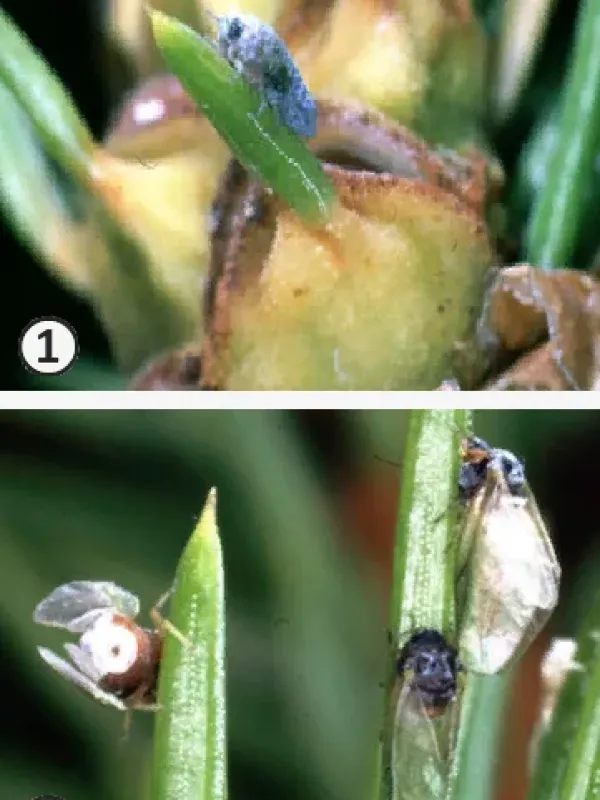
Description
How to identify
The Caucasian fir aphid, scientifically known as Dreyfusia nordmannianae, belongs to the Adelgidae family. It is a specialized pest that primarily targets fir species, particularly Abies nordmanniana.
The insect is characterized by a complex life cycle. During its development, it produces a distinctive white, woolly, wax-like secretion. This fluffy covering is the most visible sign of an infestation, often obscuring the small insects underneath.
These pests are typically sessile, meaning they attach themselves to specific parts of the host tree, such as the base of the needles or the bark of young shoots, where they remain to feed.
Reproduction is largely parthenogenetic, allowing populations to explode in numbers rapidly. The insects are minute, and without the white secretion, they are extremely difficult to spot with the naked eye.
The biology of this species is perfectly adapted to the host, ensuring it survives throughout the year, even during dormancy periods, by hiding in protected crevices of the tree's structure.
What it damages
The primary host is the Nordmann fir, which is widely used in forestry and as a popular Christmas tree. Damage is caused by the aphid inserting its mouthparts into the tree tissue to suck sap.
This feeding process removes essential nutrients and moisture from the tree. As a result, the tree loses vigor, growth rates drop significantly, and the overall aesthetic value of the fir tree is compromised.
In forest nurseries, high infestations can cause significant economic loss, as affected saplings often become stunted or malformed, failing to meet quality standards for sale or outplanting.
Mature trees that are consistently infested for several years may exhibit branch dieback. This makes them highly susceptible to secondary attacks by bark beetles or wood-boring insects, which can lead to tree mortality.
The stress caused by the aphid makes the trees more vulnerable to environmental factors, such as drought or frost, which would otherwise be tolerated by a healthy, uninfested specimen.
Signs of infestation
The presence of white, cotton-like wax clusters on the underside of needles or at the base of buds is the primary diagnostic sign. These spots are usually stationary and easy to spot once established.
Needle yellowing and premature needle drop are common symptoms. The foliage loses its natural deep green color, becomes brittle, and eventually falls off, leaving the branches looking sparse.
Shoots often show signs of distortion. Growth may be twisted or stunted, and in severe cases, the terminal buds may die, leading to an irregular and unattractive tree shape.
Sooty mold growth is often observed on the honeydew excreted by the aphids. This black, fungal coating covers the needles and stems, further hindering the tree's ability to perform photosynthesis.
- White, woolly wax patches on needles and bark.
- Yellowing and premature shedding of fir needles.
- Stunted or distorted shoot growth.
- Black sooty mold accumulation on the foliage.
Control measures
Systemic insecticides are the most effective method for controlling Dreyfusia nordmannianae. These treatments are absorbed by the tree, making the sap toxic to the aphids as they feed.
Implementing strict phytosanitary measures is crucial when selecting nursery stock. Always inspect trees thoroughly before planting to ensure that no aphids are present on the stems or buds.
For ornamental trees, physical removal by spraying the tree with a strong jet of water can help dislodge some of the wax and insects, providing temporary relief and reducing the initial population.
Pruning out and burning heavily infested branches is a recommended cultural practice. This prevents the spread of the colony to other parts of the same tree or to nearby healthy trees.
Monitoring the trees during the spring and early summer is essential. Detecting an infestation early allows for targeted intervention, which is far more successful than trying to manage a large-scale outbreak.
Taxonomy
- Latin name
- Dreyfusia nordmannianae
- Order
- Hemiptera (bugs, aphids, leafhoppers)
- Family
- Adelgidae
- EPPO code
- DREYNU
Discussion
No discussions yet — be the first.