
Fir-spruce adelgid
Dreyfusia abietis-piceae
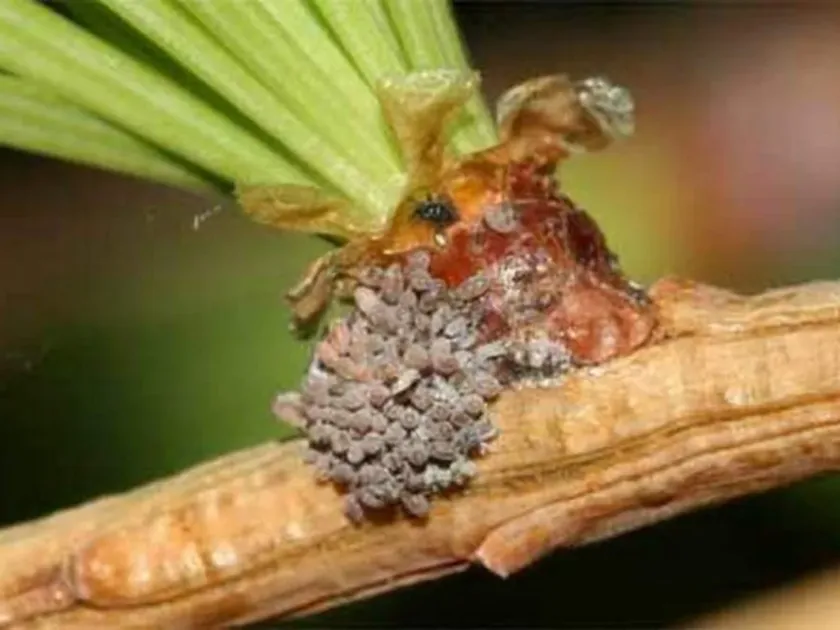
Description
How to identify
The Fir-spruce adelgid (scientific name: Dreyfusia abietis-piceae) is a destructive sucking insect belonging to the family Adelgidae. These pests are specialized to live on various coniferous species, primarily causing significant damage to fir and sometimes spruce trees.
These insects are characterized by their small size and complex life cycle. In their adult stage, females are often covered with a white, woolly secretion that protects them from environmental stressors and predators, making them resemble tiny patches of cotton on the tree bark or needles.
The life cycle involves several generations, often characterized by high mobility in the larval stage, known as "crawlers." These crawlers are responsible for spreading the infestation across the tree canopy and to neighboring plants via wind or biological vectors.
Reproduction is largely parthenogenetic, allowing for rapid population explosions under favorable weather conditions. Because they lack wings for most of their development, their natural dispersal is gradual, but they can easily be introduced into new areas through infested nursery stock.
Taxonomically, they are closely related to aphids but have evolved highly specialized biological adaptations to thrive on the sap of coniferous hosts, which often makes traditional pest control methods less effective if not applied at the right time.
What it damages
The primary hosts of this adelgid are fir species (Abies), with some infestations observed on spruce (Picea). The damage occurs when the insects insert their piercing-sucking mouthparts into the plant tissue to feed on sap.
As they feed, the insects inject salivary enzymes into the plant. These secretions cause physiological stress, which often results in the formation of galls, tissue necrosis, and the disruption of nutrient and water transport within the tree.
Severe infestations lead to a noticeable loss of tree vigor. The foliage becomes yellow or bleached, and the overall growth rate of the tree significantly declines. In younger trees or nursery stock, heavy feeding can result in stunted development or death.
The physical damage caused by the adelgids often creates entry points for secondary pathogens, such as bark beetles or wood-decaying fungi. This makes the tree significantly more susceptible to environmental factors like drought or winter injury.
The aesthetic value of the tree is severely compromised as the infestation progresses. Persistent feeding leads to needle drop and crown thinning, eventually resulting in the "stag-headed" appearance of mature trees that is typical of long-term adelgid stress.
When it appears
The activity of the Fir-spruce adelgid is synchronized with the phenology of the host trees. The overwintering larvae typically become active in early spring, as soon as temperatures rise, signaling the start of the sap flow.
Spring and early summer represent the period of peak reproductive activity. During these months, the "crawlers" emerge in large numbers, making it the most important time for monitoring and management, as the insects are highly vulnerable before they develop their protective wax coating.
Throughout the growing season, multiple generations may occur depending on the local climate. Warm, humid summers generally promote faster development and higher survival rates for the adelgid colonies, leading to larger populations by late summer.
As autumn approaches, the insect development slows down. The late-season generations transition into a dormant stage, seeking refuge in crevices of the bark or around the buds, where they can survive the winter months until the cycle restarts in the spring.
Regular monitoring should be conducted bi-weekly throughout the growing season. Special attention must be paid to the undersides of branches and needle bases, as these are the preferred feeding sites for the adelgid colonies.
Signs of infestation
The most distinctive diagnostic sign of an infestation is the appearance of white, woolly, cotton-like masses on the bark, twigs, or at the base of the needles. These masses are clusters of adelgids and their protective waxy secretions.
Needle discoloration is another hallmark of damage. Needles may turn pale, yellow, or drop prematurely. In some instances, the infestation causes the needles to twist or bend abnormally, leading to a distorted appearance of the entire branch.
On the trunk and larger branches, the bark may show signs of cracking or swelling in response to the insect feeding. Resin flow or "bleeding" from these spots is a common defensive response by the tree to manage the localized tissue injury.
Infested trees often look generally unhealthy or "dusty" due to the presence of the white waxy debris. Over time, the tree canopy may appear thin, and in advanced cases, the loss of foliage results in significant crown dieback.
In cases of heavy infestation, the insects excrete a sugary substance known as honeydew. This substance can cover the needles and become a substrate for sooty mold growth, which gives the tree a dark, charcoal-like appearance.
Control measures
Controlling the Fir-spruce adelgid requires an integrated approach. The primary strategy involves maintaining tree health through proper watering and fertilization, as stressed trees are significantly more susceptible to infestations.
Chemical control is most effective using systemic insecticides. Products containing imidacloprid or acetamiprid are widely used, as they are absorbed by the tree and provide long-lasting protection against sucking insects feeding on the sap.
Application timing is crucial; treatments should be performed when the crawlers are active and before they have fully formed their waxy coverings. Thorough coverage of the canopy, particularly the inner branches, is necessary for success.
Cultural practices include the pruning and removal of heavily infested branches or individual trees if the population level poses a threat to the rest of the planting. This helps reduce the overall pest pressure in the immediate area.
- Inspect all new nursery stock thoroughly before introducing it to the landscape.
- Encourage natural biological control by supporting populations of lady beetles, lacewings, and predatory mites.
- Use horticultural oils in early spring to smother overwintering stages of the pest.
- Avoid over-fertilizing with nitrogen, which creates soft, succulent growth that is highly attractive to adelgids.
Taxonomy
- Latin name
- Dreyfusia abietis-piceae
- Order
- Hemiptera (bugs, aphids, leafhoppers)
- Family
- Adelgidae
- EPPO code
- DREYAP
Discussion
No discussions yet — be the first.