
Cocoa mirid bug
Distantiella theobroma
Description
How to identify
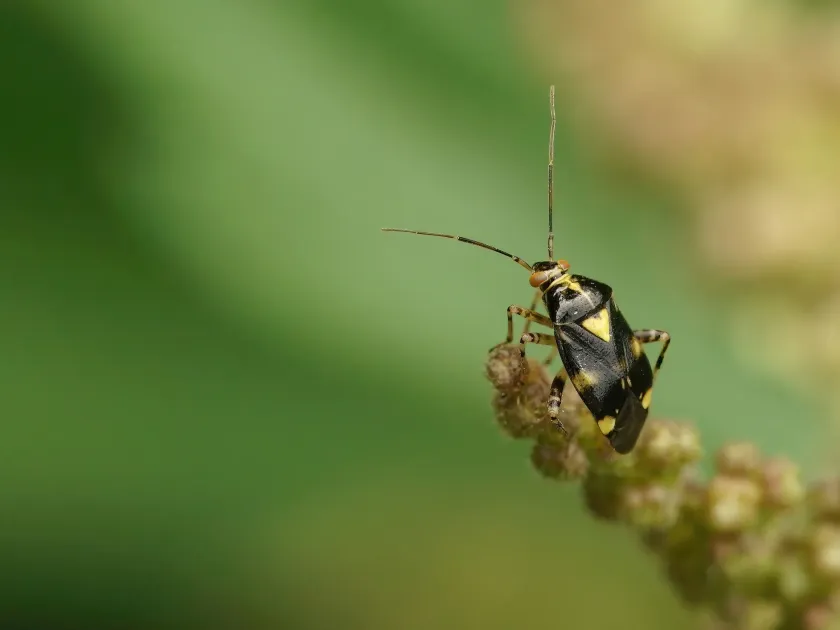
The cocoa mirid bug (Distantiella theobroma) is a notorious insect pest belonging to the Miridae family. Adults typically measure between 7 and 10 mm in length and exhibit a brownish-black coloration with distinct markings on the pronotum.
These insects are primarily nocturnal, spending daylight hours hidden within the dense canopy or deep inside crevices of the cocoa tree bark, which makes them difficult to spot during routine inspections.
The life cycle involves an egg stage, five nymphal instars, and the adult phase. Females lay eggs directly into the soft tissues of young cocoa shoots, effectively shielding the offspring from many contact-based control measures.
Their development is highly influenced by tropical environmental conditions. Warm temperatures and high humidity promote rapid population growth, allowing for overlapping generations throughout the year.
Despite their elusive nature, they are highly destructive, and their ability to thrive in managed cocoa plantations makes them one of the most significant threats to cocoa production in Africa.
What it damages
The primary host for Distantiella theobroma is the cocoa tree (Theobroma cacao). The pest feeds by piercing the plant tissues and extracting sap, simultaneously injecting toxic saliva into the tree.
This feeding mechanism causes localized necrosis on young shoots, stems, and pods. The injected toxins disrupt the tree's vascular system, leading to dieback of the infested plant parts.
Young seedlings are particularly vulnerable, as even a small population of these bugs can cause severe stunting, permanent deformation of the main stem, and high mortality rates in nursery settings.
The damage caused by the bugs often serves as an entry point for secondary fungal pathogens, such as Phytophthora, which can cause far more severe damage than the insect feeding alone.
In mature trees, repeated attacks lead to a loss of vigor, significantly reduced pod production, and in extreme cases, the total death of the tree crown due to chronic stress.
Signs of infestation
Initial signs of infestation appear as small, water-soaked brown lesions on young shoots, which rapidly turn into black, necrotic patches as the tissue dies.
Leaves on damaged branches often wilt, turn yellow, curl, and eventually drop off, leaving the affected branches completely bare, a condition frequently referred to as "dieback."
Physical inspection of the bark reveals distinct puncture marks, often accompanied by the exudation of gum or resin as the tree attempts to seal the wounds caused by the bug's mouthparts.
Developing cocoa pods may exhibit dark, sunken spots or scars on the surface, which affect the overall quality and may lead to uneven ripening or pod rot.
A high density of dead, blackened twigs across the plantation canopy is a classic indicator of a severe mirid infestation requiring urgent management attention.
Control measures
Cultural control involves systematic pruning and removal of infested twigs to reduce the localized population density and prevent the spread of the pest across the plantation.
Chemical control focuses on the use of systemic or contact insecticides applied during the peak periods of insect activity, ensuring thorough coverage of the stems and branches.
Biological control methods involve fostering natural predators, such as predatory ants (e.g., Oecophylla longinoda), which are effective in hunting and limiting mirid numbers on cocoa trees.
Integrated Pest Management (IPM) strategies, including regular field monitoring using pheromone traps, are essential to timing control actions efficiently and minimizing chemical use.
- Regular sanitation pruning of infested branches
- Application of targeted systemic insecticides
- Encouraging natural predatory ant colonies
- Pheromone trap monitoring for population density
Taxonomy
- Latin name
- Distantiella theobroma
- Order
- Hemiptera (bugs, aphids, leafhoppers)
- Family
- Miridae
- EPPO code
- DISTTH
Discussion
No discussions yet — be the first.