
Giant velvet mite
Dinothrombium
Description
How to identify
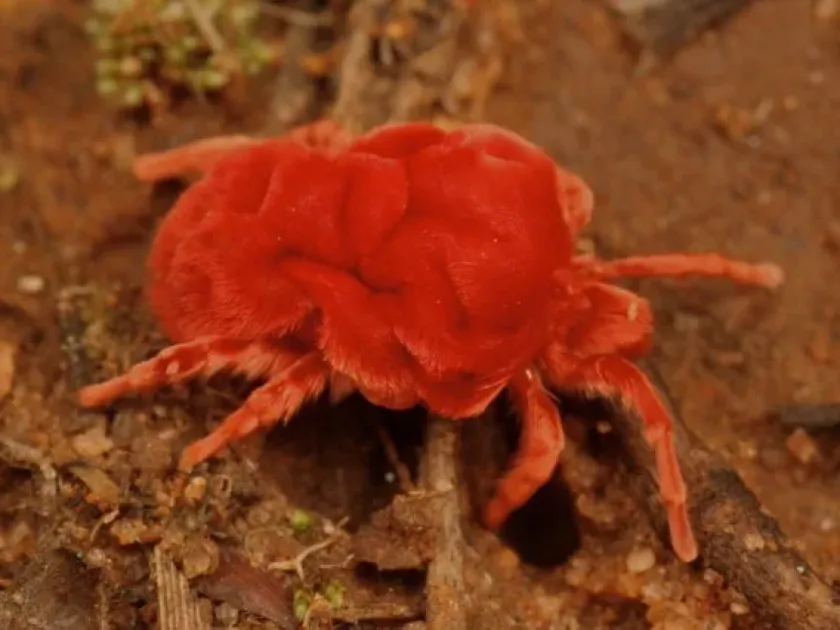
The giant velvet mite, belonging to the genus Dinothrombium, is one of the most recognizable members of the order Trombidiformes. These large terrestrial mites are renowned for their intense scarlet or orange coloration and a dense covering of fine, velvety hairs.
Adult mites can reach several millimeters in length, making them giants among the mite world. Their body is clearly divided into a gnathosoma and an idiosoma, and they possess four pairs of well-developed legs adapted for movement through loose soil particles.
Taxonomically, they are members of the family Trombidiidae. They are known for their complex life cycle, which involves a transition from a parasitic larval stage that feeds on insects to a free-living, predatory adult stage.
They are frequently observed on the soil surface shortly after rainfall, appearing as bright red specks moving across the ground. This appearance is often a result of their need for moisture to facilitate movement and reproductive activity.
While they may appear intimidating due to their size and bright color, they are harmless to humans and plants. Their morphology is perfectly adapted for a soil-dwelling predatory lifestyle rather than a herbivorous one.
What it damages
The giant velvet mite is not a plant pest. It is an active predator that feeds on various small invertebrates and insect eggs found within the soil, meaning it has no negative impact on crop production or plant health.
They do not consume plant tissues, sap, or roots. Consequently, they do not cause any form of mechanical injury, chlorosis, or stunted growth in crops, effectively making them neutral or even beneficial inhabitants of the agricultural landscape.
There is no recorded economic damage attributed to this genus. Treating them as a pest is a common misconception that can lead to unnecessary application of chemical pesticides, which in turn harms the beneficial biodiversity of the soil.
In the context of agriculture, the presence of these mites serves as an indicator of a healthy and diverse soil community. Their predatory habits assist in keeping populations of smaller ground-dwelling pests in check, acting as natural regulators.
Farmers should be encouraged to recognize these mites as allies rather than enemies. Their role in the ecosystem is strictly that of a predator, and they pose zero threat to any commercial crop species.
When it appears
The activity of Dinothrombium is strictly governed by soil moisture levels. They are highly seasonal, typically emerging on the surface only after significant rain events that provide the necessary humidity for their survival.
During prolonged dry periods, these mites undergo a state of dormancy or retreat deep into the soil profile to avoid desiccation. This adaptation allows them to survive in harsh arid or semi-arid environments where other organisms might struggle.
The life cycle is tightly synchronized with these periods of rainfall. Eggs are laid in moist soil, and subsequent developmental stages await the arrival of water to progress, ensuring that the mites remain active only when environmental conditions are optimal.
Temperature plays a secondary role compared to water availability. Even during extreme heat, the mites can emerge if the soil surface is dampened by rain or irrigation, though they quickly return to cover as the moisture evaporates.
A typical observation period for these mites occurs during spring or summer following wet weather, as they capitalize on the abundance of food sources that also thrive in these conditions.
Control measures
No control measures are necessary for the giant velvet mite, as it is a beneficial predator and not a crop pest. Any attempt to eliminate them would be ecologically counterproductive and a waste of agricultural resources.
Integrated Pest Management (IPM) guidelines advocate for the preservation of such species. Maintaining soil biodiversity helps prevent outbreaks of true pests, as natural predators like Dinothrombium contribute to the overall balance of the agroecosystem.
Should their presence be undesirable in specific areas, such as greenhouse floors or nursery pathways, controlling local moisture levels is the most effective approach. Reducing water logging will naturally encourage them to retreat deeper into the soil.
Chemical intervention should be strictly avoided. The use of broad-spectrum insecticides or acaricides to control a harmless organism will deplete the soil of helpful predators and disrupt the biological equilibrium of the field.
- Avoid the use of non-selective pesticides.
- Promote natural soil health and diversity.
- Monitor soil moisture levels to influence local populations naturally.
- Educate field workers on the identification of beneficial soil mites.
Taxonomy
- Latin name
- Dinothrombium
- Order
- Mites
- Family
- Trombidiidae
- EPPO code
- DINTSP
Discussion
No discussions yet — be the first.