
Allothrombium
Allothrombium
Description
How to identify
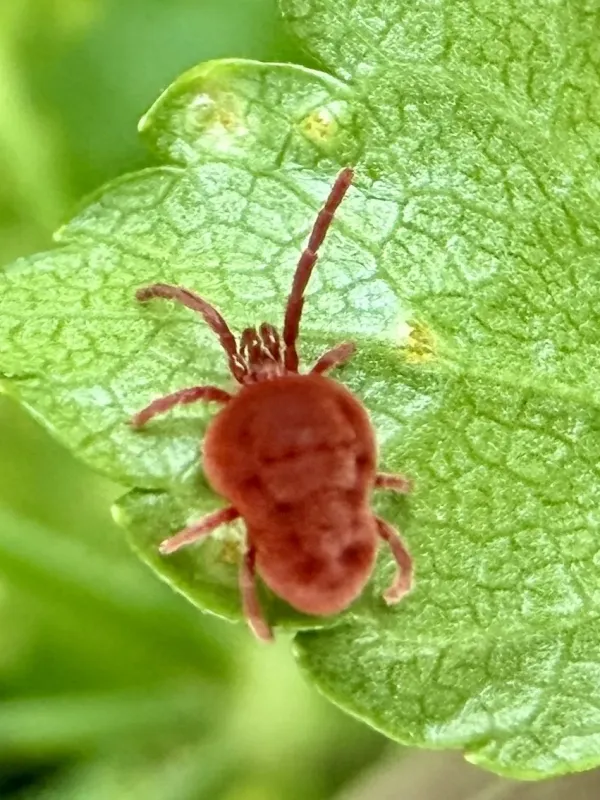
Allothrombium belongs to the family Trombidiidae, commonly known as velvet mites. These mites are recognized by their bright red color and a velvety appearance due to the dense covering of setae on their body.
Adult mites are free-living and are typically found in the top layers of soil or leaf litter. They have an oval-shaped body and are highly mobile, making them easy to spot in the field.
The life cycle of these mites is complex and includes a parasitic larval stage. Unlike adults, the larvae attach themselves to various insects, which is a key biological adaptation for dispersal and development.
They are classified under the order Trombidiformes. Their morphology differs significantly between the larval and adult stages, requiring careful observation for accurate identification in a laboratory setting.
It is important for agronomists to note that Allothrombium is not a typical phytophagous mite. Its role in the ecosystem is primarily that of a predator or a parasite of other arthropods.
What it damages
Allothrombium mites do not directly damage crops. They do not feed on plant tissues, meaning they do not cause wilting, leaf chlorosis, or any significant reduction in plant health.
There is minimal economic concern regarding these mites in agricultural settings. Because they do not target crops as a food source, they are generally not listed among significant economic pests.
Some concerns exist regarding their larval stage, which parasitizes beneficial insects. While this might theoretically reduce the population of entomophages, it rarely impacts crop yields.
Their presence on various horticultural crops is strictly incidental. They may crawl on plants to move between different soil areas or in search of suitable insect hosts.
The impact of these mites should be considered neutral. In many cases, they may even contribute to the control of other small soil-dwelling pests, though their overall impact remains largely unquantified in large-scale agriculture.
When it appears
The activity of Allothrombium is highly dependent on environmental moisture and temperature. They are most commonly observed during the spring months following the thaw.
A second period of activity typically occurs in late summer or early autumn. During these times, the soil moisture provides the necessary conditions for their mobility and reproduction.
Adult mites overwinter in the soil, often seeking refuge in protected areas such as dense plant residue, compost piles, or deep soil crevices to survive winter temperatures.
The development cycle is slow and synchronized with the availability of hosts for the larvae. Preferred temperatures for their activity generally range between 15°C and 25°C.
Seasonal patterns are dictated by local climate conditions. In regions with very dry summers, activity levels may drop significantly as these mites prefer damp microclimates.
Signs of infestation
The primary sign of their presence is the observation of tiny, fast-moving bright red dots on the soil surface or the lower parts of plant stems.
An absence of plant damage is a key sign confirming that the observed mites are not phytophagous. If plants appear healthy despite the presence of mites, Allothrombium is a likely candidate.
Upon closer inspection, particularly in spring, one might observe tiny larvae attached to the bodies of other insects found in the field or garden beds.
These mites do not build webs. This is the most crucial visual characteristic to differentiate them from spider mites (Tetranychidae), which are major agricultural pests.
Diagnosis is performed by examining soil samples or directly observing the mites during early morning hours when they are most likely to be active on the surface.
Control measures
No specific control measures are recommended for Allothrombium. Their lack of direct damage to crops makes any chemical application unnecessary and ecologically counterproductive.
Integrated Pest Management (IPM) practices, such as maintaining healthy soil structure and avoiding unnecessary insecticide use, naturally regulate their populations.
Promoting a healthy environment for beneficial insects is the best way to ensure the natural balance of the soil ecosystem, preventing any single species from becoming dominant.
If concern persists, simple physical monitoring of soil moisture and plant health is sufficient. No thresholds for action exist because the economic impact is negligible.
Always prioritize biological methods of control and sustainable agricultural practices over the broad-spectrum pesticide application to protect the soil biodiversity, including harmless or beneficial mites.
Taxonomy
- Latin name
- Allothrombium
- Order
- Mites
- Family
- Trombidiidae
- EPPO code
- ALLTSP
Discussion
No discussions yet — be the first.