
Dicheirotrichus obsoletus
Dicheirotrichus obsoletus
Description
How to identify
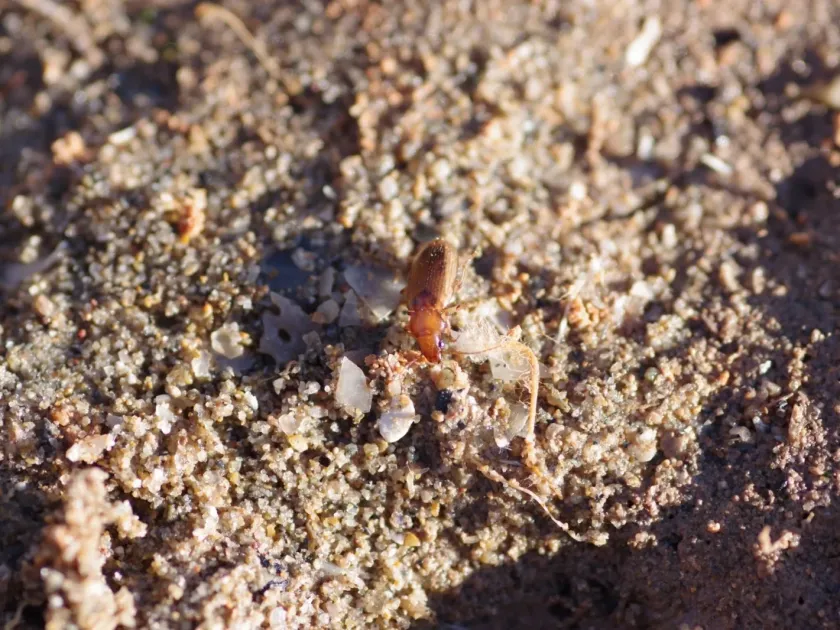
Dicheirotrichus obsoletus is a species belonging to the ground beetle family (Carabidae) within the order Coleoptera. These beetles are relatively small, typically measuring between 5 to 7 millimeters in length.
The insect possesses a typical carabid body structure, though it is distinguished by a specific coloration, ranging from yellowish-brown to dark brown tones.
The beetle’s body is slightly convex with clearly marked punctation on the elytra. The antennae and legs are usually colored in lighter, ochre shades compared to the main color of the chitinous cover.
This species is a typical halophilous ground beetle, frequently found in coastal zones, salt marshes, and areas with high soil salinity levels.
The development of the insect follows a complete metamorphosis cycle, passing through the stages of egg, larva, pupa, and imago, which is characteristic of all beetles in this group.
What it damages
Although many ground beetle species are primarily entomophagous, Dicheirotrichus obsoletus can exhibit phytophagous tendencies under certain environmental conditions.
This species is most frequently identified in cereal and vegetable crops grown in saline soils, where natural food sources for the beetle are limited.
Damage occurs when the beetles feed on the tender tissues of young shoots, seeds in the soil, or seedlings, which significantly reduces germination rates and crop stand density.
The primary risk involves damage to the root collar of seedlings, which leads to wilting and subsequent death of weakened plants during the spring season.
During periods of mass outbreaks, these beetles can cause tangible damage to sugar beet, sunflower, and cereal grain crop fields.
When it appears
The active life cycle of the imago begins in early spring, as soon as the top layer of the soil warms up to optimal temperatures.
The highest population density is recorded in late spring and the first half of summer, coinciding with the active growth phase of most agricultural crops.
During the summer period, the beetles may decrease their activity, moving into deeper soil layers or hiding under plant debris in search of humid micro-conditions.
The autumn generation is often less pronounced as the majority of adult individuals prepare for diapause or migrate to overwintering sites.
Overwintering of adult individuals takes place within the soil or under dense plant residues, allowing them to successfully withstand low winter temperatures.
Signs of infestation
The primary indicator of the pest's presence is the existence of eaten areas on the basal part of the stems, located directly at the soil surface level.
During visual field inspections, the beetles themselves can be detected in the evening or night hours, as they lead a predominantly crepuscular and nocturnal lifestyle.
Finding the pest during daylight is difficult: it hides in soil cracks or under dirt clods, which is why pitfall traps are used for monitoring purposes.
Thinning of seedlings, where clear signs of gnawing mouthparts are visible around the root collar, serves as a strong indicator of infestation.
The gradual yellowing and wilting of individual plants in rows often point to localized colonization of the fields by this species of ground beetle.
Control measures
Effective soil cultivation, which disrupts the beetle's hiding places, is of key importance for managing Dicheirotrichus obsoletus population levels.
Adhering to crop rotation is an effective agrotechnical method that limits the food base available to the pest during the critical phases of plant development.
Upon reaching the economic damage threshold, it is recommended to apply contact-stomach action insecticides during the evening hours.
An essential practice is the timely removal of weeds along field borders, which serve as a natural reservoir for this species.
- Deep autumn plowing
- Application of insecticidal seed treatments
- Timely sowing to ensure rapid seedling emergence
- Monitoring using light and pitfall traps
Taxonomy
- Latin name
- Dicheirotrichus obsoletus
- Order
- Coleoptera (beetles)
- Family
- Carabidae
- EPPO code
- DICSOB
Discussion
No discussions yet — be the first.