
Velii walking stick
Diapheromera velii
Description
How to identify
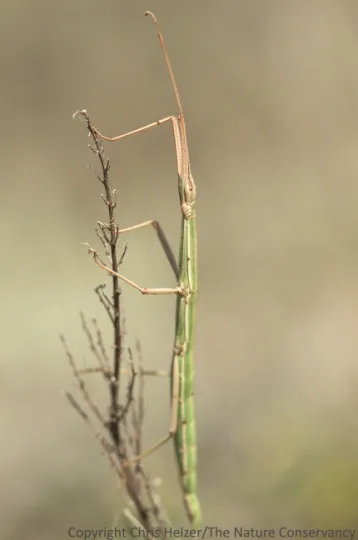
The Velii walking stick (Diapheromera velii) belongs to the order Phasmatodea and the family Diapheromeridae. This insect possesses a characteristic long, thin body that perfectly mimics dry twigs or plant stems, making it extremely difficult to detect.
Adult specimens typically reach 6–8 centimeters in length. Their coloration ranges from greenish-brown to dark brown, allowing the insect to blend in with surrounding vegetation. The walking stick's legs are long and grippy, adapted for moving along plant stems.
The head features mouthparts of the chewing type, typical for phytophagous insects. The antennae are quite long, serving as sensory organs for locating host plants during the night.
Males are usually slimmer than females, and females have an ovipositor at the end of the abdomen. The development occurs via incomplete metamorphosis, bypassing the pupal stage, which is characteristic of all members of this order.
This species is a typical representative of North American entomofauna, preferring meadow ecosystems and agricultural lands bordering wild vegetation.
What it damages
The primary food source for the Velii walking stick is members of the legume family (Fabaceae). They are capable of causing significant damage to wild grasses and certain agricultural crops.
The pest prefers leaves and young shoots. During mass outbreaks, walking sticks can significantly reduce the leaf surface area of plants, leading to a disruption of the photosynthesis process.
Damage to the growth points leads to stem deformation and retardation of the overall development of the plant's vegetative mass. Under intensive farming conditions, such damage reduces potential seed yield.
Although walking sticks rarely cause total crop failure, their activity weakens the plant, making it more vulnerable to secondary fungal infections and other pests.
The greatest damage is observed on the edges of fields adjacent to hedgerows or abandoned plots, from where the insects migrate to cultivated plantations in search of food.
When it appears
The life cycle of the Velii walking stick is closely linked to seasonal temperature regimes. Eggs overwinter in the soil or plant debris, and nymph emergence occurs in late spring.
The peak of adult activity occurs in the summer months — July and August. It is during this period that the insects feed most actively and begin reproduction, laying eggs in the leaf litter.
Developing one generation requires a warm period of at least 3–4 months, so the life cycle is rigidly tied to the region's climatic conditions.
The daily activity of walking sticks is predominantly nocturnal. During the day, the insects remain motionless on branches, adopting a stick-like posture, which significantly hinders their detection during planned monitoring.
In autumn, with the onset of frost, adults perish, leaving behind eggs that remain viable throughout the winter until the next season.
Signs of infestation
The main sign of pest presence is the presence of skeletonized or ragged leaf margins on legume crops, while the stems often remain untouched.
A characteristic trace is the insect's frass (excrement), which can be found on the soil surface or the lower leaves of plants. It is shaped like small, dark granules.
Detecting the insects themselves is extremely difficult due to their perfect mimicry. Often, the pest is found accidentally during crop inspection or while performing agricultural work in the evening.
When inspecting plants, one should pay attention to areas with "immobile twigs" that turn out to be insects upon closer inspection. It is also worth checking leaf axils.
In case of mass infestation, a specific pattern of grazing is observed, which looks like irregular eaten areas, differing from damage caused by leaf-eating caterpillars.
Control measures
Effective protection against the Velii walking stick is based on agronomic methods. It is important to observe crop rotation and eradicate weeds from the legume family that serve as pest reservoirs.
Mechanical destruction of plant residues after harvest contributes to the death of eggs located in the soil layer, which reduces the insect population for the following season.
If the pest population is high, the use of broad-spectrum insecticides is justified. Preparations based on pyrethroids show high efficacy against adults and nymphs.
It is important to carry out spraying during evening hours when the insects are at their most active, which significantly increases the contact efficacy of the applied chemical protection agents.
The use of biological methods, such as attracting natural entomophages or applying biopesticides, requires further research but may be promising in organic farming.
Taxonomy
- Latin name
- Diapheromera velii
- Family
- Phasmatidae
- EPPO code
- DIAHVE
Discussion
No discussions yet — be the first.