
Northern walking stick
Diapheromera femorata
Description
How to identify
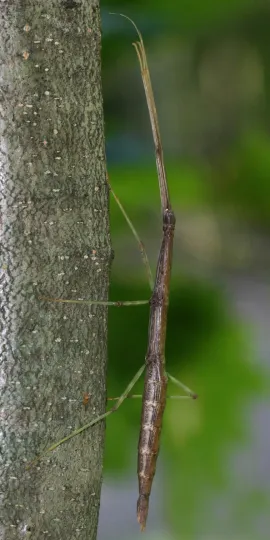
The northern walking stick (Diapheromera femorata) is a member of the order Phasmatodea, family Diapheromera. These insects are masters of camouflage, possessing elongated bodies that perfectly mimic the twigs of the trees they inhabit, making them extremely difficult to detect.
Adult insects typically measure 7 to 10 cm in length. Males are generally smaller and more slender than females. Both sexes are wingless, relying entirely on their specialized legs to navigate the canopy of host trees throughout their life cycle.
The life cycle involves a single generation per year. Eggs are dropped by females from the canopy onto the forest floor during autumn. These eggs are capable of overwintering, and some may remain dormant for up to two years, allowing the population to survive unfavorable seasons.
Nymphs hatch in the spring, typically synchronized with the budding of host tree leaves. They undergo several instars, gradually increasing in size and shedding their exoskeleton before reaching sexual maturity in late summer.
Their behavior is characterized by daytime inactivity, during which they remain motionless to blend in with their environment. They become active during the evening or night, when they consume leaf tissue to support their growth and reproduction.
What it damages
This species is a significant foliage feeder, preferring deciduous trees such as oaks (Quercus), basswood, cherry, and hazel. They act as defoliators that can cause severe damage when populations surge to outbreak levels.
At high densities, walking sticks can strip a tree of its entire foliage. This complete defoliation forces the tree to use its stored energy reserves to produce a second flush of leaves, which significantly weakens the tree's overall health and vigor.
Repetitive defoliation over consecutive years often results in crown dieback, reduced annual growth rings, and increased susceptibility to secondary attacks by wood-boring insects and root pathogens, ultimately leading to tree death.
The feeding pattern starts from the leaf margins, progressively consuming the leaf blade until only the major veins remain. This results in an uneven, skeletal leaf appearance, which is a hallmark of northern walking stick infestations.
The economic impact on forestry and urban arboriculture is substantial. Beyond the loss of biomass, the degraded aesthetic and ecological value of damaged forests poses challenges for land managers in affected regions.
Signs of infestation
Visible signs of infestation include the progressive thinning of the upper canopy in mid-to-late summer. As leaves are consumed, the trees appear sparse, even when they should be at the peak of their seasonal growth.
A distinctive auditory sign is the rain-like sound caused by the constant dropping of frass (fecal pellets) onto the understory vegetation. This sound can often be heard in heavily infested stands during calm weather.
The presence of small, dark, granular frass on the ground is a strong indicator of an active population overhead. Finding these droppings can help identify which specific trees are currently hosting the insects.
Careful inspection of the lower branches may reveal the nymphs or adults. Because they remain still during the day, scanning the twigs for slight irregularities in shape or texture is the best way to locate individual insects.
In late summer, the presence of adult insects becomes more obvious. Their increased size makes them more visible against the remaining foliage, especially if the infestation has reached a moderate level of intensity.
Control measures
Chemical control is effective when timed correctly. Application of appropriate insecticides should be targeted at the early nymph stages, as they are the most vulnerable to treatment before they reach maturity and cause extensive damage.
Biological control options include the use of entomopathogenic fungi, such as Beauveria bassiana. These natural agents can significantly reduce walking stick populations without posing the risks associated with broad-spectrum chemical pesticides.
Encouraging natural predators, such as insectivorous birds and parasitic wasps, is a viable long-term strategy. Maintaining a diverse forest ecosystem helps keep walking stick numbers in check through natural regulatory mechanisms.
Management practices also include sanitation efforts in high-risk areas. Removing infested branch material or managing the leaf litter can reduce the number of overwintering eggs, thereby lowering the population density for the following season.
- Monitoring canopy density starting in June.
- Timing insecticide applications to the peak nymph hatch.
- Promoting biodiversity to support natural population control.
- Conducting tree health assessments to identify early damage.
Taxonomy
- Latin name
- Diapheromera femorata
- Family
- Phasmatidae
- EPPO code
- DIAHFE
Discussion
No discussions yet — be the first.