
Anisomorpha
Anisomorpha
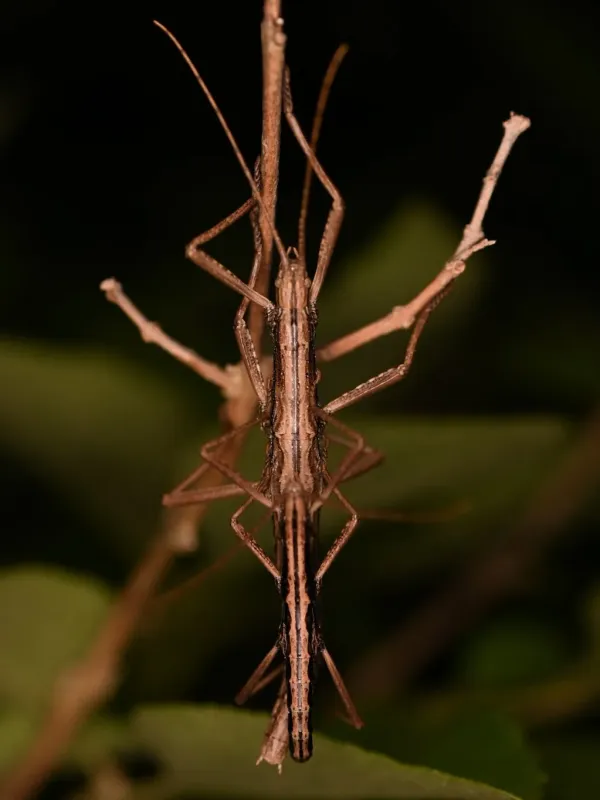
Description
How to identify
Anisomorpha is a genus of insects belonging to the order Phasmatodea, family Pseudophasmatidae. These insects are commonly known as walking sticks, characterized by their elongated, stick-like bodies that provide exceptional camouflage among plant branches.
Their coloration ranges from dark brown to black, often featuring longitudinal light stripes that further mimic plant stems. Females are significantly larger than males, a typical trait for the sexual dimorphism observed within this genus.
A notable defense mechanism of Anisomorpha is the presence of specialized glands capable of spraying a caustic secretion at potential threats. This chemical defense can cause severe irritation to the eyes and skin of animals and humans.
Adults are primarily nocturnal, spending daylight hours hidden within thick foliage or tree bark. Their morphology is perfectly adapted to arboreal life, making them difficult to detect during standard daytime inspections.
The life cycle involves incomplete metamorphosis, with nymphs appearing as miniature versions of the adults. The development period from egg to adulthood varies significantly based on environmental temperatures and regional climates.
What it damages
This pest primarily attacks various deciduous trees and shrubs. In nursery and garden settings, Anisomorpha may feed on the foliage of both ornamental and wild plant species, depending on local availability.
Damage is caused by the consumption of leaf tissue, which can lead to significant defoliation if population numbers are high. Weakened plants become increasingly susceptible to fungal infections and secondary pest attacks.
Although massive outbreaks are relatively rare, in peak population years, they can cause visible harm to young plantations. Continuous consumption of new shoots stunts the growth and development of young trees.
The harm caused goes beyond mechanical leaf loss; it results in the exhaustion of the plant's energy reserves. This is particularly critical for young plants that need resources for active growth during the vegetation season.
Because these insects are so elusive, their presence often goes unnoticed until extensive damage has already occurred, highlighting the need for regular and careful monitoring.
When it appears
The peak activity of Anisomorpha occurs during the warmer months, when temperatures favor rapid population growth. Insects are most visible in late summer when they reach sexual maturity.
Breeding takes place in the summer, followed by the female laying eggs in the soil or leaf litter under host plants. These eggs are highly resistant to adverse weather conditions, ensuring survival throughout the winter months.
Nymphs emerge in the spring and immediately begin feeding on fresh leaves. Population dynamics are closely linked to temperature fluctuations and humidity levels throughout the spring and summer season.
Activity gradually declines in the autumn as adults complete their life cycle. Overwintering occurs primarily at the egg stage, providing a robust survival strategy for the species to persist into the following year.
For effective monitoring, agronomists recommend night inspections using flashlights, as this is the period of highest insect activity, making them easier to locate on branches.
Signs of infestation
The primary visual sign of Anisomorpha presence is the characteristic jagged or chewed appearance of leaf edges. Unlike caterpillars, which may consume entire leaves, walking sticks often leave distinctively rough patterns.
The presence of insect frass (droppings) on leaves or on the ground beneath the canopy is another clear indicator of active feeding. In some cases, shed exoskeletons from molting can be found on stems.
Locating adults requires careful observation due to their excellent mimicry. Often, their presence is only detected when they are accidentally disturbed or shaken from the branches.
Damage often spreads in localized clusters, moving from the center of the plant or tree canopy outward. It is important to distinguish these signs from those of other leaf-eating insects.
In cases of heavy infestation, one might hear a faint clicking or rustling sound during quiet nights, which can serve as a diagnostic indicator that intervention is necessary.
Control measures
The primary control method involves the application of contact insecticides during periods of peak nymph activity. Products based on pyrethroids have proven effective against these insects in nursery settings.
Agricultural measures include the regular removal and destruction of leaf litter under host plants, where eggs may remain dormant. This practice significantly reduces the risk of population recurrence.
Biological control can be enhanced by encouraging natural predators, such as birds and certain predatory insects, which actively consume walking sticks in their natural habitat.
- Apply insecticides during evening hours when insects are active.
- Manual collection of individuals for smaller garden areas.
- Clearing weeds and debris from around susceptible plantings.
- Using light traps to monitor population spikes.
As research on pheromone-based traps for this specific genus is limited, chemical treatment remains the standard approach for immediate mitigation of heavy infestation hotspots.
Taxonomy
- Latin name
- Anisomorpha
- Family
- Phasmatidae
- EPPO code
- ANIOSP
Discussion
No discussions yet — be the first.