
Indian stick insect
Carausius
Description
How to identify
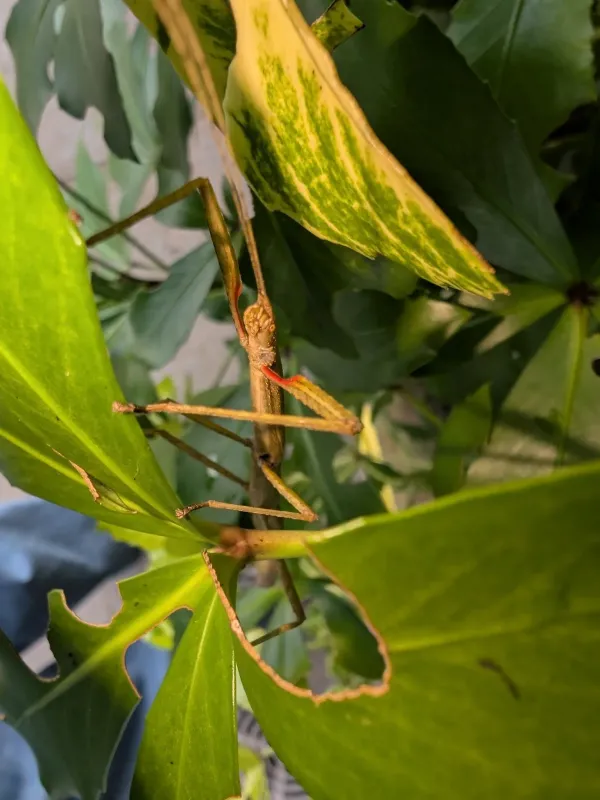
The Indian stick insect (Carausius morosus) is a member of the order Phasmatodea, family Diapheromeridae. These insects are masters of camouflage, evolving to look exactly like twigs.
Adult females grow to approximately 7–10 cm in length. Their coloration ranges from green to brown, which changes based on environmental factors like humidity and lighting.
The species reproduces primarily through parthenogenesis, meaning females do not require males to produce fertile eggs. A single female can lay hundreds of eggs in her lifetime.
The eggs are incredibly resilient and can remain dormant in the soil for months, making it very difficult to eradicate the population once they become established.
Being nocturnal, these insects remain motionless on plant branches during the day, which helps them evade detection by greenhouse workers and predators alike.
What it damages
This insect is a generalist herbivore (polyphagous) that thrives in greenhouse conditions, where it feeds on a wide range of decorative and ornamental plants.
Common hosts include hibiscus, fuchsia, ivy, and various citrus species, which are frequently damaged by the feeding activity of both nymphs and adults.
The insects feed on leaves, chewing from the edges inward, which can lead to significant defoliation if the population density is high enough.
Young, tender growth is particularly susceptible; damage to these growing points can stunt the plant and affect its overall aesthetic and structural integrity.
Severe infestations can lead to substantial biomass loss, weakening plants and making them more susceptible to secondary infections or environmental stress.
Signs of infestation
The presence of frass (droppings) underneath the plants is a tell-tale sign of an infestation, appearing as small, dark, granular pellets.
Irregular, chewed edges on leaves are the primary symptom of feeding, often leaving only the main veins behind in cases of heavy infestation.
Finding the insects themselves is difficult; however, they can be spotted by examining stems at night or looking for their shed skins (exuviae) near the soil.
Plants may show unexplained retardation in growth or physical damage to new shoots that cannot be attributed to fungal or bacterial pathogens.
Looking for motionless "twigs" that are positioned in unusual places on the plant or move when touched is a definitive way to confirm their presence.
Control measures
Manual inspection at night is the most effective way to manage small populations, as the insects are active and visible during these hours.
Sanitation is critical; all soil should be treated or replaced to ensure no dormant eggs remain in the growing media when resetting the greenhouse.
Biological controls, including predatory insects or nematode applications, may be utilized to suppress population growth in larger greenhouse environments.
If chemical controls are necessary, targeted applications of contact insecticides should be used during the night when the insects are most active.
- Implement a strict quarantine for new plant arrivals
- Perform regular manual removal of observed insects
- Sterilize soil to destroy hidden eggs
- Remove and destroy severely infested plant material
Taxonomy
- Latin name
- Carausius
- Family
- Phasmatidae
- EPPO code
- CAAUSP
Discussion
No discussions yet — be the first.