
Diachromus
Diachromus
Description
How to identify
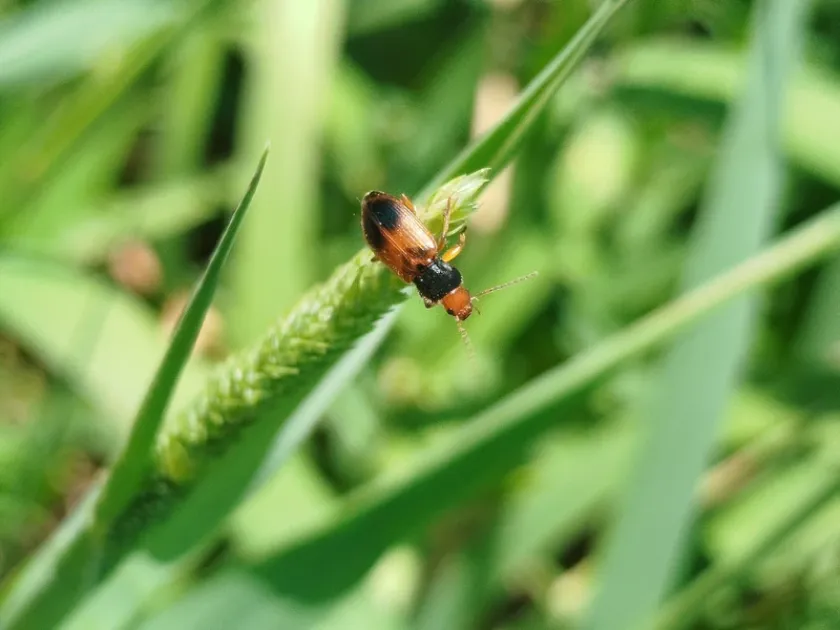
Diachromus (Diachromus germanus) is a member of the ground beetle family (Carabidae). Unlike most of its carnivorous relatives, this species has developed herbivorous feeding habits, making it a recognized pest in various agricultural regions.
The adult beetle typically measures between 7 to 10 mm in length. It is easily identified by its distinct appearance: the elytra possess a metallic blue-green sheen, contrasting sharply with the bright yellow or reddish-brown pronotum and legs.
The beetle’s body is oval and somewhat convex, featuring well-defined punctures on the wing covers. Its mouthparts are robust, evolved for processing various plant tissues and seeds, which distinguishes it from many other carabids.
Larvae are campodeiform and highly mobile, equipped with well-developed thoracic legs. They are generally light-colored and segmented, capable of thriving in soil environments where they consume both organic matter and other small organisms.
This species is widely distributed across Europe and temperate Asia, preferring open habitats such as meadows and crop fields where environmental conditions support their rapid proliferation and survival.
What it damages
Diachromus primarily affects cereal and grain legume crops. While adults can damage vegetative parts of plants, their most significant impact occurs during the grain ripening stage, specifically when kernels are in the milk-waxy stage.
The beetles penetrate the outer shell of the grains and consume the starchy endosperm. This results in significant quantitative yield losses and compromises the germination quality of the seed stock.
Beyond cultivated crops, these beetles readily feed on the seeds of various common weeds. This adaptability allows them to maintain stable populations in agricultural landscapes even when primary crops are not available.
During periods of high population density, adults may also damage young seedlings by feeding on the stem base. This can lead to the death of young plants and significant thinning of the crop stand.
The economic impact of Diachromus is largely determined by its population levels; in favorable years, untreated fields may experience notable grain loss, necessitating proactive monitoring.
When it appears
The seasonal activity of Diachromus is driven by soil temperature and moisture. Adults emerge from overwintering sites in the spring as soon as soil conditions become favorable for movement and feeding.
The peak of damage occurs during the summer months. This period aligns with the development of the new beetle generation and the maturation of cereal crops, which are most vulnerable at this time.
The life cycle involves a complete metamorphosis: egg, larva, pupa, and adult. Each stage has specific environmental requirements, which determines the population’s seasonal shift and overall prevalence in the field.
As autumn approaches and temperatures drop, the beetles seek shelter to enter a state of dormancy. They typically burrow into the soil or aggregate under dense plant debris to survive the winter.
Understanding the timing of these life stages is crucial for effective pest management. Monitoring efforts should focus on identifying adult activity levels just before and during the grain-filling stages.
Signs of infestation
One of the primary signs of infestation is the presence of hollowed-out grains within the ears of cereal crops. These marks are often visually distinct from damage caused by other grain-feeding insects.
Visual inspection during early morning or late evening hours often reveals the beetles themselves, as they hide within the leaf sheaths or congregate on the ears during periods of high activity.
Infested seedlings may show signs of wilting or collapse, characterized by chewed areas at the base of the stem, which effectively severs the plant's connection to the root system.
The presence of Diachromus in soil pitfall traps used for monitoring is a reliable indicator of potential infestation pressure and warrants immediate field evaluation.
High weed density within or along the borders of the field serves as a major sign of potential habitat suitability, as these weeds provide the essential food source needed to maintain the beetle population.
Control measures
Integrated Pest Management (IPM) is essential for controlling Diachromus. Crop rotation is one of the most effective strategies, as it prevents the continuous buildup of pest populations in a single area.
Deep plowing during the fall season is a critical mechanical control method. By turning the soil, farmers can disrupt the overwintering sites of the larvae and adults, significantly reducing the starting population for the next year.
Effective weed management, particularly focusing on fields with high weed seed bank activity, limits the food supply for the beetles and reduces their overall reproductive success in the agroecosystem.
When monitoring data indicates that the economic injury level has been exceeded, targeted application of approved insecticides can be used to mitigate further damage to the harvest.
Seed treatments with high-quality systemic insecticides provide early-season protection for seedlings, reducing the risk of stand loss and shielding the crop from initial beetle pressure.
Taxonomy
- Latin name
- Diachromus
- Order
- Coleoptera (beetles)
- Family
- Carabidae
- EPPO code
- DIAKSP
Discussion
No discussions yet — be the first.