
Millipedes
Dervishiya
Description
How to identify
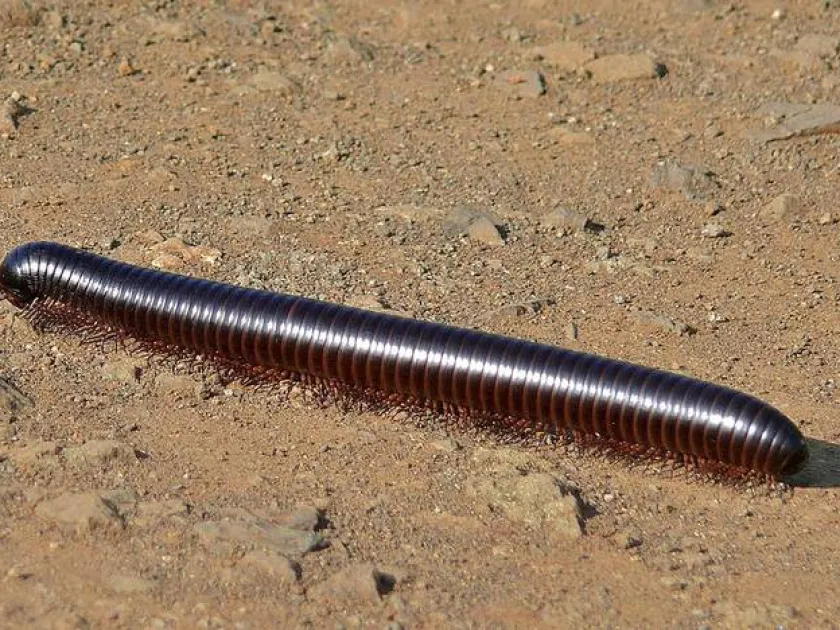
Millipedes (class Diplopoda) are arthropods characterized by having two pairs of legs on most of their body segments. They have a cylindrical or slightly flattened body covered by a hard exoskeleton.
These organisms range in size from a few millimeters to several centimeters. Their color is typically dark, ranging from brown to black, which helps them blend into the soil environment.
Millipedes are primarily nocturnal and moisture-loving creatures. They avoid direct light and spend most of their time in damp soil, under debris, or inside rotting organic matter.
When disturbed, they exhibit a defensive behavior of curling into a tight spiral. This protects their softer underbelly and legs from potential predators and environmental stress.
Their life cycle is closely linked to soil moisture and the availability of decaying plant material, which serves as both their food source and their habitat throughout the year.
What it damages
Millipedes are polyphagous, meaning they feed on a wide variety of plant tissues. While they prefer decaying matter, they readily attack healthy plant parts when their natural food supply is scarce.
Root systems, tubers, and bulbs are the most frequent targets. Potatoes, carrots, and beets are particularly vulnerable to millipede feeding, which results in deep, ugly cavities.
Seedlings and young transplants often suffer from root damage, leading to stunted growth or total plant loss. This is a common issue in greenhouses where conditions are consistently damp.
Strawberries are frequently damaged, as the fruit resting on moist soil provides an easy meal for millipedes, which bore holes into the flesh and cause rapid rot.
Feeding injuries often serve as entry points for secondary infections. Fungi and bacteria introduced by these wounds further deteriorate the plant, making it unmarketable or completely dead.
When it appears
Millipede activity is dictated by soil temperature and moisture. They become active in the spring as soon as the soil warms up and moisture levels remain high.
The most critical damage occurs during the planting season in late spring and early summer. Young, tender plants are highly susceptible to their feeding during this initial establishment phase.
Throughout the summer, they remain active in the top layers of the soil, especially after irrigation or rain. During hot, dry periods, they retreat deeper into the soil profile to maintain moisture.
Autumn is another period of peak feeding as they build reserves before winter. This can cause significant aesthetic and economic damage to maturing root crops left in the ground.
They overwinter as adults or larvae, hiding in the soil, compost piles, or deep under garden mulch. They remain dormant in these protective environments until the following spring.
Signs of infestation
The primary symptom of infestation is the presence of irregular, deep holes and pits on tubers and root vegetables, often with jagged edges characteristic of their chewing mouthparts.
Wilting plants that do not respond to watering often indicate root damage. Excavating the soil around the base of such plants usually reveals the presence of millipedes.
On strawberries, look for small, round entry holes in the fruit. These holes often lead to larger internal cavities filled with decaying pulp, which is a clear indicator of millipede activity.
Large numbers of millipedes can often be found under damp wood, stones, or thick mulch layers near the base of the affected plants, especially during the early morning hours.
A foul, pungent odor sometimes released by millipedes when they are handled or crushed is a secondary sign of their high density in a specific garden area.
Control measures
Management starts with cultural practices. Reducing soil moisture through improved drainage and avoiding excessive organic mulch near plant stems helps deter them.
Trapping is a highly effective, non-chemical method. Burying pieces of raw potato or carrot near affected crops attracts the millipedes, allowing for easy collection and destruction.
Amending the soil with lime to reduce acidity can make the environment less favorable for millipedes, as they generally prefer slightly acidic, moist soil conditions.
Maintaining a clean garden by removing dead plant debris and leaf litter eliminates their primary food source and shelters, significantly lowering their survival rates.
In cases of severe infestation, targeted soil insecticides may be used. However, these should be applied cautiously, following all label instructions to protect beneficial soil life.
Taxonomy
- Latin name
- Dervishiya
- Order
- Lepidoptera (butterflies)
- Family
- Cossidae
- EPPO code
- DERVSP
Discussion
No discussions yet — be the first.