
Human botfly
Dermatobia hominis
Description
How to identify
The human botfly (Dermatobia hominis) belongs to the order Diptera and the family Oestridae. It is a large, hairy insect that visually resembles a bumblebee, although it is taxonomically a fly.
Adult specimens measure between 12 and 18 millimeters in length. They possess a metallic blue or black abdomen and a distinct head with large compound eyes, adapted for aerial navigation.
A notable characteristic of the adults is that they do not feed, as they lack functional mouthparts, and their short lifespan is devoted entirely to finding a mate and reproducing.
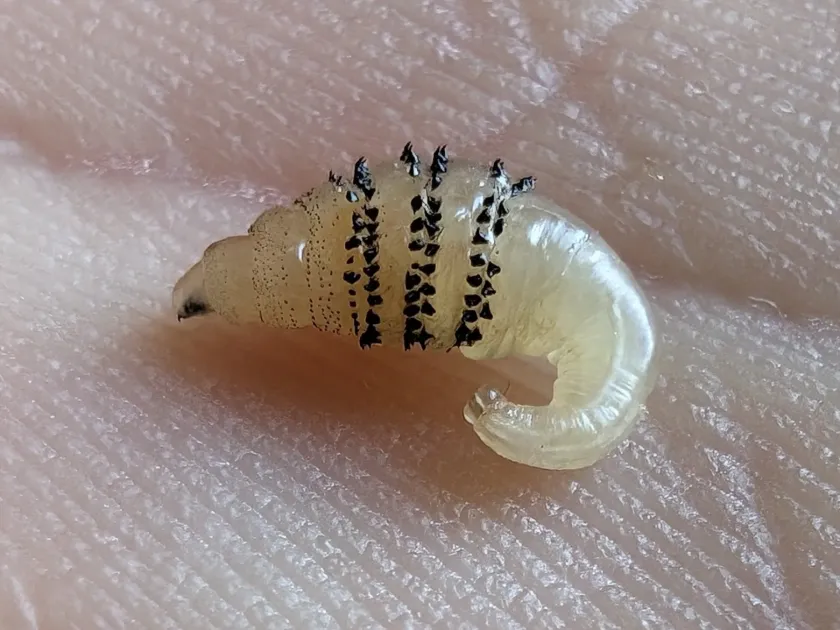
The larvae are specialized for parasitic existence within vertebrate skin. They feature a barrel-shaped body covered in backward-pointing hooks that prevent the host from dislodging them.
This species is biologically unique because it utilizes other insects, such as mosquitoes or houseflies, as carriers to transport its eggs onto the skin of a potential host.
What it damages
It is critical to note that the human botfly is not a pest of plants or crops. It is an obligate parasite of warm-blooded animals, including livestock and humans.
For agriculture, the botfly is primarily a veterinary concern. Infestation, known as myiasis, causes severe distress to cattle, leading to significant drops in milk production and weight gain.
The presence of larvae causes deep, painful furuncular lesions on the skin. These lesions can become sites for secondary bacterial infections, complicating the health of the affected animal.
The value of livestock products is decreased, as the hides of infested animals are often rendered unusable due to the perforations left by the larvae.
Consequently, while this insect does not affect crop yields, its management is a crucial aspect of farm animal health and production economics in regions where the pest is endemic.
When it appears
The activity of Dermatobia hominis is strictly seasonal and climatically defined. In warmer regions, they can be active throughout the year, but their population peaks during humid, warm months.
Temperature serves as a key regulator for the metamorphosis of larvae and the emergence of adults. Optimal development occurs in subtropical and tropical climates with high moisture levels.
Adult botflies are most active during the daylight hours, particularly in the morning or late afternoon, when environmental conditions are most conducive to finding carriers.
The life cycle includes a pupation stage in the soil, which makes the soil moisture and temperature significant factors for the survival of the next generation.
Environmental management, such as monitoring seasonal weather patterns, helps farmers predict periods of high risk and implement preventative measures accordingly.
Signs of infestation
The most prominent sign of infestation is the appearance of raised, swollen, and tender skin lesions on the host. Each lesion typically features a central breathing pore for the larva.
Animals affected by botflies exhibit extreme behavioral changes, including restlessness, nervousness, and constant attempts to scratch or rub against structures to relieve irritation.
Serous or purulent discharge from the central opening of the lesion is a common observation. Occasionally, the breathing end of the larva may be visible within the opening.
General unthriftiness and loss of weight in the herd, despite adequate feeding, often serve as early indicators of a parasitic burden that requires veterinary investigation.
- Raised, boil-like skin lesions with central openings.
- Restlessness and scratching behaviors in livestock.
- Presence of fluid discharge from skin sores.
Control measures
Effective control relies on disrupting the life cycle. Managing populations of biting insects that serve as vectors for botfly eggs is the first line of defense.
Regular use of insecticides and repellents on livestock can prevent the vectors from landing on the animals, thereby reducing the chances of egg deposition.
Sanitation of the livestock environment is essential to prevent pupation. Keeping areas clean and preventing the accumulation of wet, organic matter can reduce local botfly populations.
Veterinary intervention, including the administration of systemic antiparasitic drugs (such as ivermectins), is highly effective in killing larvae during their developmental stages.
Early identification of infested individuals and mechanical removal of larvae by a professional veterinarian are recommended to prevent further complications and secondary infections.
Taxonomy
- Latin name
- Dermatobia hominis
- Order
- Diptera (flies)
- Family
- Cuterebridae
- EPPO code
- DEMTHO
Discussion
No discussions yet — be the first.