
Cuterebra fly
Cuterebra tenebrosa
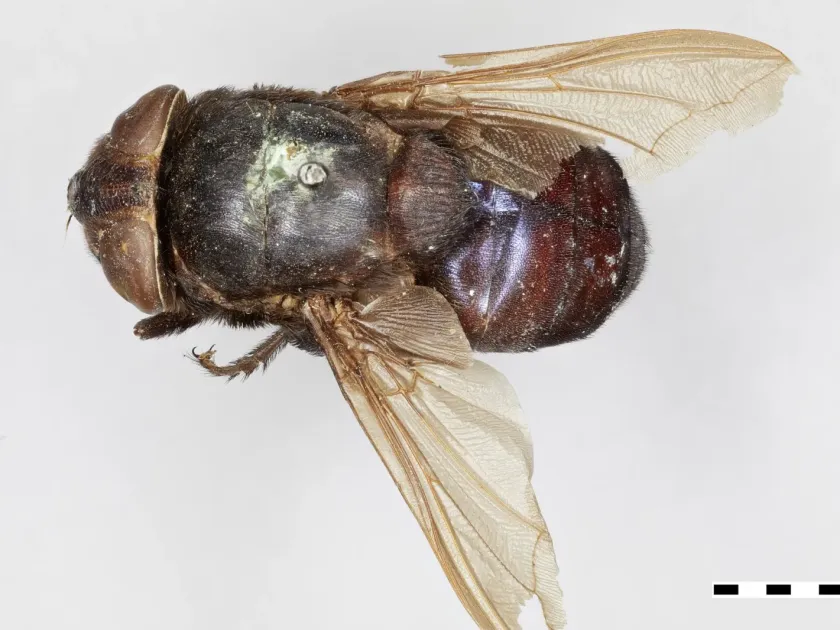
Description
How to identify
The Cuterebra tenebrosa, commonly known as a botfly, belongs to the family Oestridae. Adults are large, robust insects often resembling bumblebees, with hairy bodies and vestigial mouthparts.
Adult botflies do not feed and live only for a short time to find a mate and lay eggs. Their life cycle is highly specialized, depending on specific hosts for larval development.
The insects are rarely seen in flight, as they are elusive and spend most of their short adult lives near the nesting sites of small mammals.
Larvae pass through three stages, characterized by growth in size and the development of hardened, spiny cuticles used to anchor themselves within the host's tissues.
This species is not a plant pest; it is an obligate parasite of animals, specifically targeting rodents, lagomorphs, and sometimes pets.
What it damages
The damage caused by Cuterebra tenebrosa is strictly medical rather than agricultural. It does not feed on crops, but its larvae parasitize small mammals.
The larvae create subcutaneous cysts (warbles) that cause localized inflammation. The physical presence of the parasite causes stress and skin tissue degradation in the host.
Severe infestations can lead to systemic illness, secondary infections, and weight loss in the host animal due to the constant irritation and toxic metabolites.
While the fly has no impact on crop yields, it is significant in veterinary medicine, requiring awareness from pet owners and wildlife conservationists.
There are no known reports of this species damaging plant tissues or interacting with agricultural commodities in a way that impacts crop health.
When it appears
Botflies are most active during warm months, which corresponds to the breeding and developmental cycles of their primary rodent hosts.
The emergence of adults is synchronized with the time when young rodents are most frequently outside their burrows, increasing the success rate of egg deposition.
The larval stage inside the host lasts for several weeks, during which the larva completes its metamorphosis while feeding on serum or tissue debris.
After reaching maturity, the larva exits the host to pupate in the soil, entering a state of dormancy until the following season.
Soil temperature and moisture levels are critical factors for the survival of pupae during the overwintering phase in the environment.
Signs of infestation
The most diagnostic sign of infestation is a firm, raised swelling on the skin, which typically features a small hole or fistula for the larva to breathe.
Owners often observe alopecia (hair loss) and crusting around the affected area, caused by the host's grooming and the inflammatory response to the parasite.
If the larva is damaged or dies within the tissue, a significant inflammatory or allergic reaction may occur, leading to swelling and purulent discharge.
Animals may exhibit restlessness or hypersensitivity in the region where the bot is located, as the larva's movement and feeding are disruptive.
The larva itself may occasionally be visible through the breathing hole, especially when it moves to get closer to the surface for oxygen intake.
Control measures
Management of botfly infestations is exclusively veterinary. The standard procedure involves the careful extraction of the intact larva from the skin.
It is strictly advised not to crush or rupture the larva during removal, as this can trigger a life-threatening anaphylactic shock or severe local inflammation.
Once removed, the site must be thoroughly flushed with antiseptic solutions to prevent secondary bacterial infection of the empty cavity.
Prevention relies on keeping pets away from environments frequented by wild rodents, especially in areas where botflies are known to be endemic.
There are no field-level control measures like pesticides or traps that effectively manage botfly populations, as their distribution is sporadic and host-specific.
Taxonomy
- Latin name
- Cuterebra tenebrosa
- Order
- Diptera (flies)
- Family
- Cuterebridae
- EPPO code
- CUTETE
Discussion
No discussions yet — be the first.