
American dog tick
Dermacentor variabilis
Description
How to identify
The American dog tick (Dermacentor variabilis) belongs to the family Ixodidae (hard ticks) and the order Ixodida. It is a large arthropod parasite easily visible to the naked eye.
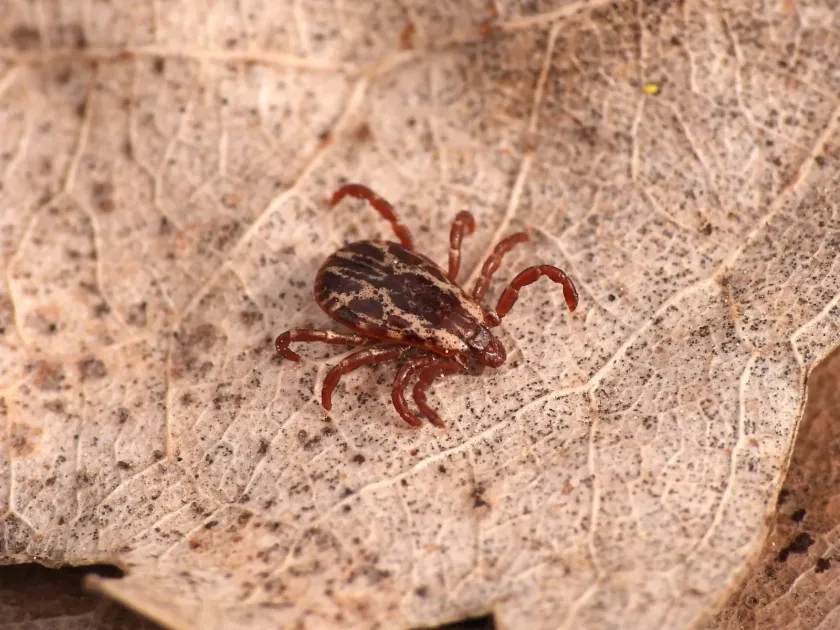
Adults exhibit a brown coloration with a distinct whitish-silver pattern on the dorsal shield, which is prominent in males, while in females, it is restricted to the anterior part of the body.
An unfed tick measures approximately 3–5 mm, but after blood-feeding, the female can swell up to 15 mm, turning into a grayish-brown color.
The tick's life cycle involves four stages: egg, six-legged larva, nymph, and adult, each of which requires a blood meal from a host to progress to the next phase.
Development from egg to adult can take anywhere from a few months to two years, depending on environmental conditions, host availability, and ambient temperatures.
What it damages
It is crucial to note that the American dog tick is not a phytophage; it does not feed on plant tissues. Its direct damage is inflicted upon vertebrates, including livestock.
In an agronomic context, the pest's damage is significant as it acts as a vector for dangerous pathogens, such as tularemia and Rocky Mountain spotted fever, which affect livestock.
The presence of ticks in pastures leads to decreased livestock productivity, as constant biting causes stress, weight loss, and anemia in animals.
Ticks congregate in tall grasses and brush along field borders, where they latch onto animals or humans passing by.
While the tick itself does not eat crops, its presence forces restrictions on pasture usage, which indirectly impacts the efficiency of farm management and land productivity.
When it appears
Peak adult activity occurs during spring and early summer when favorable temperatures trigger their emergence from diapause.
Larvae and nymphs exhibit the highest activity during mid-summer, preferring more humid and shaded areas such as shelterbelts and thick grassy patches.
In autumn, the overall number of active ticks declines significantly, though individual specimens can still be found until the first hard frosts.
Population survival is heavily dependent on the severity of the winter, as ticks overwinter in the top layer of soil or under decaying plant debris.
Seasonal dynamics of tick populations require careful attention when scheduling grazing and fieldwork activities near forested areas.
Control measures
The primary control measure involves regular mowing of tall grass and weeds along the perimeters of agricultural lands and fences.
Removing plant debris and maintaining cleanliness on farm grounds eliminates favorable hiding and breeding sites for the ticks.
The use of acaricidal sprays for pasture treatment should be approached with caution and strictly in accordance with environmental regulations.
Individual animal protection, using specialized collars, sprays, and spot-on treatments containing insecto-acaricides, is critical to reducing infestation risks.
Implementing a rotational grazing strategy is highly recommended to disrupt the tick life cycle by temporarily removing hosts from infested areas.
Taxonomy
- Latin name
- Dermacentor variabilis
- Family
- Ixodidae
- EPPO code
- DERCVA
Discussion
No discussions yet — be the first.