
Great green bush-cricket
Decticus verrucivorus
Description
How to identify
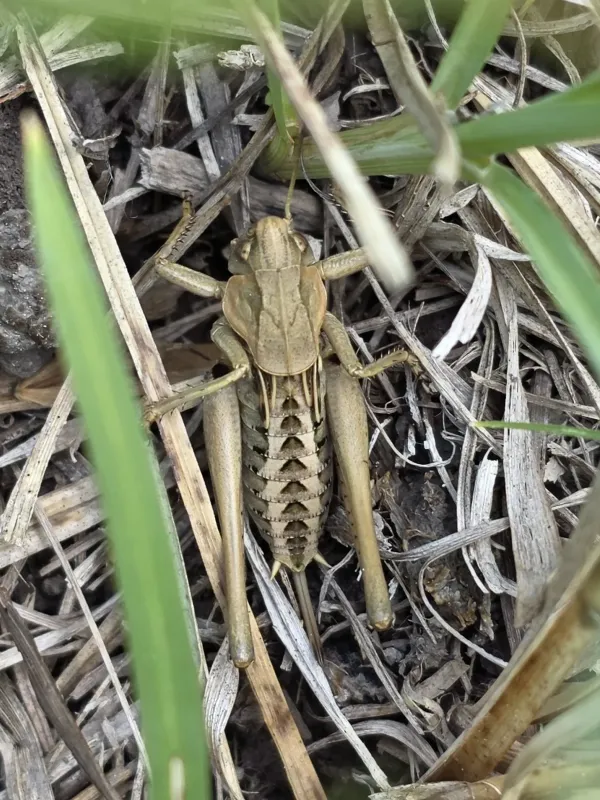
The great green bush-cricket (Decticus verrucivorus) belongs to the order Orthoptera and the family Tettigoniidae. These are large insects, typically measuring between 25 and 40 mm, equipped with strong jaws and powerful hind legs adapted for jumping.
Their coloration is generally green or brownish, often with mottled patterns, providing excellent camouflage within vegetation. They possess well-developed wings that allow them to fly effectively, aiding in their dispersal across agricultural landscapes.
Females are easily distinguished by their long, slightly upturned ovipositor, which they use to insert eggs into the soil. This feature is a primary morphological identifier for the species.
These insects are primarily diurnal, preferring sunny and warm habitats such as meadows, field edges, and open agricultural areas. They are highly active during warm, dry summer days.
The life cycle involves incomplete metamorphosis, where nymphs resemble smaller, wingless versions of the adults. They progress through five distinct nymphal stages before reaching maturity.
What it damages
The great green bush-cricket is a polyphagous insect that can cause significant damage to various agricultural crops, including cereals, legumes, and vegetable crops. They primarily feed on foliage, stems, and reproductive parts of plants.
Both nymphs and adults use their robust chewing mouthparts to consume large sections of leaves, often leaving only the main veins. In severe cases, this defoliation significantly reduces the photosynthetic capacity of the plants.
Cereal crops are particularly vulnerable, as these crickets may consume the ears or panicles, directly impacting grain yield and quality. Such damage is especially prevalent during high-population years.
Vegetable crops, including cabbage and other brassicas, can suffer from large holes chewed into leaves and stems. This damage not only stunts growth but also creates entry points for secondary fungal and bacterial infections.
During dry seasons, when their natural vegetation becomes scarce, bush-crickets are known to migrate into irrigated fields, potentially causing localized but intense economic losses.
When it appears
The species has a univoltine life cycle, meaning it produces one generation per year. Winter is spent in the egg stage, with eggs buried in the soil where they are protected from extreme frost and desiccation.
Nymphs typically emerge in late spring, usually around May, as temperatures rise sufficiently to trigger development. The period from nymph to adult spans approximately 40 to 50 days, depending on environmental temperatures.
Adults become active and reach reproductive maturity by mid-summer, typically in July and August. This is the period when they are most conspicuous and pose the highest risk to maturing crops.
As autumn approaches, adult activity declines, and females focus on oviposition. After laying eggs in the soil, the adult population gradually dies off with the onset of colder temperatures.
Favorable weather conditions, specifically warm and dry springs followed by hot summers, are the primary drivers for significant spikes in bush-cricket populations.
Signs of infestation
The most common sign of infestation is the presence of irregular, ragged holes in leaf margins or center sections. These holes are typically larger and more aggressive than those caused by smaller insect pests.
Damage to cereal heads is distinct, appearing as missing kernels or partially destroyed glumes. This pattern of feeding is a clear indicator that orthopterans are active in the field.
Presence of excrement, which appears as small, dark cylindrical pellets, is often found on foliage or the soil surface beneath heavily infested plants, indicating high feeding activity.
Regular visual inspections of the field during daylight hours will reveal the presence of both nymphs and adults. They are easily disturbed and will jump or fly short distances when approached.
The loud, repetitive stridulation of males during sunny hours is a strong auditory cue indicating a significant population density within the area, signaling the need for immediate crop assessment.
Control measures
A fundamental agricultural practice for control is autumn tillage or deep plowing. This mechanical intervention disturbs the soil and destroys egg batches by burying them too deeply for successful nymphal emergence.
Effective weed management along field borders and in surrounding areas is crucial, as these habitats serve as primary reservoirs for bush-cricket populations before they migrate to crop fields.
If population levels exceed economic thresholds, the application of registered insecticides (such as pyrethroids or organophosphates) is recommended to mitigate further crop destruction.
Applications should be timed to target younger nymphal stages, which are generally more susceptible to chemical treatments and less mobile than the adult population.
In organic farming or integrated pest management programs, the use of biological control agents, such as entomopathogenic fungi, can help keep populations below economic injury levels.
Taxonomy
- Latin name
- Decticus verrucivorus
- Order
- Orthoptera (locusts)
- Family
- Tettigoniidae
- EPPO code
- DECTVE
Discussion
No discussions yet — be the first.