
Cymindis
Cymindis
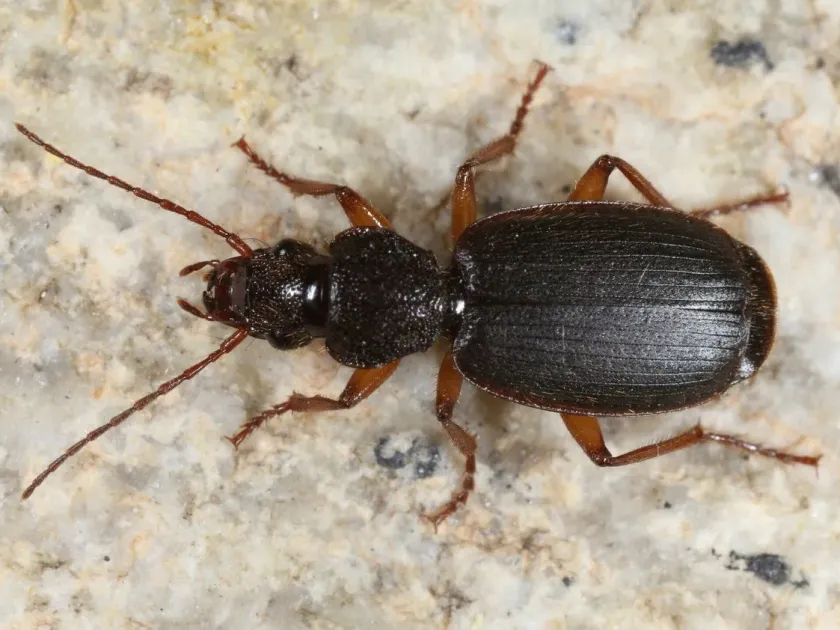
Description
How to identify
The Cymindis genus belongs to the family Carabidae, commonly known as ground beetles. These insects belong to the order Coleoptera and are characterized by their elongated, flattened bodies and powerful mandibles, which are typical for predatory species in this family.
Physically, these beetles are well-adapted for life in soil crevices and under plant debris. Their coloration is usually dark, often featuring a subtle metallic or bronze sheen, which provides camouflage in their natural habitat.
The head of the beetle is relatively large, equipped with well-developed compound eyes, making them efficient hunters. Their antennae are filiform, allowing them to navigate precisely in response to changes in surface temperature and soil moisture.
While many species are capable of flight, their primary mode of movement is terrestrial. They spend most of their time prowling the base of plants, using their speed to hunt for prey or search for resources.
The larvae of this genus are also terrestrial and inhabit the upper soil layers. They possess a characteristic agile body form that allows them to pursue prey within narrow soil tunnels and around root systems.
What it damages
Although many ground beetles are considered beneficial entomophages, species of the Cymindis genus can occasionally exhibit opportunistic feeding habits. During times of prey scarcity, they may feed on the tissues of agricultural crops.
The most significant damage is observed during the early growth stages of cereal crops. Beetles can damage seedlings by consuming tender tissues, which leads to thinning of the stand and a reduction in overall crop yield.
In addition to cereals, these pests can damage vegetable crops by attacking the root collar and lower stems of young plants. This type of damage can weaken the plants, often leading to stunted growth or total plant failure.
The presence of large amounts of crop residue on a field provides an ideal environment for their population to expand. Under such conditions, their density can quickly exceed the economic injury level, necessitating control measures.
These beetles are particularly dangerous during dry years. In their search for moisture, they are more likely to feed on the succulent parts of young green plants, causing significant harm to agricultural productivity.
When it appears
Beetle activity begins in early spring, as soon as soil temperatures reach a level that supports their metabolism. Peak activity usually occurs in May and June, coinciding with their primary reproductive phase.
The life cycle includes the egg stage, three larval instars, pupa, and adult (imago). The larvae feed actively throughout the summer, often coinciding with the rapid growth phase of many field crops.
Adults are primarily nocturnal, which often makes them difficult to observe during standard daytime scouting. This nocturnal behavior is a key biological adaptation that helps them avoid daytime predators and desiccation.
In the autumn, adults seek shelter for hibernation, burrowing into deeper soil layers or beneath thick leaf litter. Overwintering occurs in the adult stage, allowing them to resume activity immediately when conditions improve in the following spring.
Environmental factors, especially rainfall, significantly influence population dynamics. Moderate moisture is ideal for development, whereas extreme conditions may limit their survival or influence their migration to more suitable areas.
Signs of infestation
Visual signs of infestation include irregular holes or notches on the edges of seedling leaves and damaged epidermis at the stem base. These signs are often mistaken for damage caused by other soil-dwelling pests.
To confirm their presence, agronomists use pitfall traps (Barber traps) placed in fields overnight. These traps are highly effective for identifying the species and assessing the current population density.
Daytime inspections may show few active beetles, as they typically hide under soil clods or vegetation. Finding multiple adults during such inspections is a strong indicator of an established population.
Severe infestations lead to patches of thinning or dead seedlings throughout the field. These damaged plants often show signs of wilting and decay due to the destruction of their conductive vascular tissues.
It is crucial to differentiate the damage caused by Cymindis from that of wireworms or other soil pests. Proper identification via entomological analysis is necessary to ensure the correct treatment plan is selected.
Control measures
Crop rotation is the foundation of long-term management. By alternating crops that require different soil conditions, you can significantly disrupt the life cycle of these beetles and prevent population explosions.
Deep autumn plowing is a vital practice for destroying overwintering individuals. By disturbing their shelters before the winter, you increase mortality rates and reduce the number of active adults in the following spring.
Effective weed management both within the field and in neighboring buffer zones is essential. Weeds provide cover and a microclimate that supports these beetles, so keeping fields clean reduces their habitat.
When high populations are detected during the early development of a crop, insecticidal seed treatments are recommended. This provides protection for the seedlings during the most vulnerable period of their life cycle.
In cases where the economic injury level is exceeded, foliar applications of insecticides may be necessary. These applications should be carefully timed and aligned with regional agricultural guidelines to ensure maximum efficacy.
Taxonomy
- Latin name
- Cymindis
- Order
- Coleoptera (beetles)
- Family
- Carabidae
- EPPO code
- CYMISP
Discussion
No discussions yet — be the first.