
Blood-red lady beetle
Cycloneda sanguinea
Description
How to identify
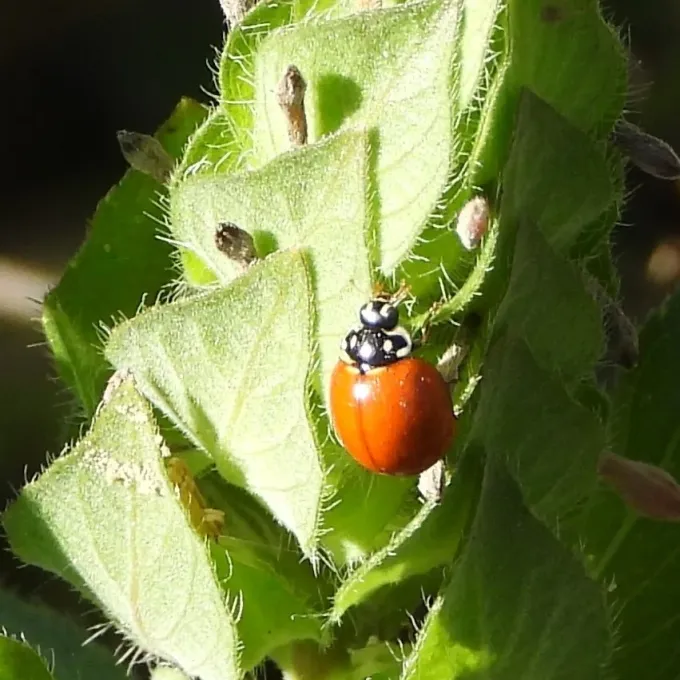
The Blood-red lady beetle (Cycloneda sanguinea) is a member of the Coccinellidae family within the order Coleoptera. Adult beetles are characterized by their smooth, dome-shaped bodies, typically measuring 4–6 mm in length.
Their elytra are a striking, unspotted blood-red or orange color, which serves as a primary identifying trait. The head and pronotum display a distinct, contrasting pattern of black and white or yellowish markings.
Larvae are elongated and covered with small tubercles and setae, usually appearing dark grey or black with bright orange or yellow spots along the segments of their body.
Eggs are typically laid in small clusters on the undersides of leaves, presenting an oval shape and a characteristic yellow-orange hue common among many ladybird species.
Although widely regarded as a beneficial predator, under certain ecological conditions, this species may feed on plant materials, leading to its classification as a pest in specific agricultural settings.
What it damages
The damage caused by Cycloneda sanguinea typically occurs when the insect shifts its dietary focus from aphids to plant tissues, including flower buds, pollen, and young leaves.
Agricultural crops, particularly vegetable and ornamental varieties, may suffer from reduced yield and quality due to the beetle consuming essential reproductive parts of the plants.
Feeding behavior results in irregular holes or ragged edges on flower petals and leaves, which compromises the aesthetic value of ornamental crops and the physiological health of vegetable plants.
Persistent feeding on developing seeds or fruits can lead to deformities and necrosis, creating openings for secondary pathogens like fungi or bacteria to infect the tissue.
In large populations, the impact on crop production can be significant, potentially leading to widespread foliage thinning and stunted growth during the critical flowering stage.
When it appears
Adult beetles typically emerge from their overwintering sites in early spring, synchronized with the onset of the plant growing season and the first appearance of aphid colonies.
Peak activity and population density are usually observed during the summer months when warm, stable weather conditions facilitate rapid development and multiple successful breeding generations.
As temperatures begin to decline and daylight hours shorten in the autumn, individuals seek out protected locations, such as leaf litter or tree bark, to enter diapause for the winter.
The flowering phase of crops remains the most critical monitoring window, as the insects are highly attracted to the nutrient-rich pollen found in floral structures.
Farmers are advised to implement regular field scouting starting from early spring to assess population levels before the insects reach their maximum activity period.
Signs of infestation
The most direct sign of infestation is the presence of adult beetles with distinct red elytra on the plant stems, foliage, or within the flower heads of the crop.
Evidence of feeding is revealed by visible damage on petals and leaves, characterized by small, irregular scrapings or complete perforations in the plant tissue.
The presence of egg clusters on the undersides of leaves serves as an early indicator of a potential population spike and future larval activity on the host plant.
Localized browning or necrotic spots appearing near the feeding sites on leaves often indicate that the plant's vascular tissue has been compromised by the pest.
Specific frass (insect excrement) found on leaves or near floral structures can also confirm the presence of the beetle and its continued feeding activity in the area.
Control measures
Managing Cycloneda sanguinea requires an Integrated Pest Management (IPM) approach that balances the need for crop protection with the preservation of natural biodiversity.
Biological control agents, such as specific entomopathogenic fungi, can be effective in reducing beetle numbers while minimizing negative impacts on non-target beneficial insects.
- Implementing crop rotation to disrupt the life cycle of the pest across seasons.
- Removing weeds and debris that serve as overwintering habitats or alternative food sources.
- Using physical barriers or protective covers in high-value ornamental nursery production.
- Deploying pheromone traps to monitor population density and identify the optimal timing for intervention.
- Applying selective, low-toxicity insecticides only when infestation thresholds are exceeded.
It is essential to maintain an ecological balance in the field, as these beetles often provide valuable aphid control services, and total eradication may lead to a resurgence of other, more destructive pests.
Taxonomy
- Latin name
- Cycloneda sanguinea
- Order
- Coleoptera (beetles)
- Family
- Coccinellidae
- EPPO code
- CYCNSA
Discussion
No discussions yet — be the first.