
Creontiades pallidifer
Creontiades pallidifer
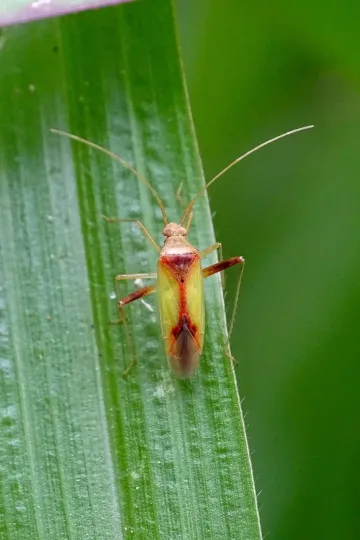
Description
How to identify
Creontiades pallidifer belongs to the Hemiptera order and the Miridae family, commonly known as mirid bugs or plant bugs. These insects are recognized for their distinct slender body shape.
Adult insects are generally pale yellow or brownish in color, which serves as camouflage within the lush green foliage of their host plants.
They possess a specialized piercing-sucking mouthpart designed specifically to penetrate plant tissues and extract vital fluids.
Nymphs undergo several developmental stages, resembling miniature adults but lacking fully developed wings until they reach maturity.
These bugs are highly mobile and tend to inhabit the terminal buds and tender growing points of the host plants.
What it damages
Creontiades pallidifer is primarily known as a pest of cotton, causing substantial damage to the reproductive structures of the plant.
The pest also utilizes various weed species, particularly those in the Malvaceae family, as alternative hosts for population growth.
Feeding damage is most severe during the budding and flowering stages, often leading to significant yield loss.
By extracting plant sap, the insects disrupt the metabolic processes and physiological development of the plant organs.
Persistent feeding results in the shedding of squares, flowers, and small bolls, directly impacting the final crop output.
Signs of infestation
The primary indicators of infestation are small, dark necrotic spots appearing on buds and leaves where the bug has inserted its proboscis.
Distortion of buds and leaves is a common symptom, which often prevents normal development and results in stunted plant growth.
Leaves may show chlorotic lesions or irregular holes as the tissue around the feeding site dies off over time.
During surveys, clusters of bugs can often be found on the youngest, succulent tissues at the top of the plant or near floral structures.
Dark, fecal spots visible on the surface of leaves or buds provide a clear signal of recent feeding activity by the bug population.
Control measures
Effective management requires an integrated approach starting with the systematic eradication of weeds surrounding the crop fields.
Biological control agents, including predatory insects and spiders, play a crucial role in naturally suppressing pest populations in the field.
When infestation levels exceed established economic thresholds, the application of selective insecticides is necessary to minimize damage.
Rotation of insecticides with different modes of action is highly recommended to delay the development of resistance within the insect population.
Frequent field scouting and the use of monitoring tools such as sticky traps help agriculturalists time their control interventions precisely.
Taxonomy
- Latin name
- Creontiades pallidifer
- Order
- Hemiptera (bugs, aphids, leafhoppers)
- Family
- Miridae
- EPPO code
- CREOPL
Discussion
No discussions yet — be the first.