
Cosmocomoidea ashmeadi
Cosmocomoidea ashmeadi
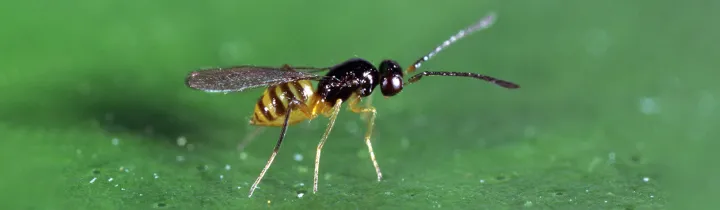
Description
How to identify
Cosmocomoidea ashmeadi belongs to the order Hymenoptera, family Mymaridae (fairyflies). These are microscopic parasitic wasps that are extremely difficult to identify without specialized laboratory equipment.
Adult individuals are very small, often measuring less than one millimeter, making them virtually invisible during standard plant inspections. Their defining characteristic is a highly specialized parasitism on the eggs of other insects, primarily leafhoppers.
The insect's body exhibits the typical morphology of the family, featuring thin, often reduced wings covered in fine setae. Their coloration is typically dark, which assists in camouflage against the background of vegetation in their natural habitat.
Precise identification of the species requires molecular genetic analysis or detailed microscopic examination of genitalia and wing venation. In field conditions, diagnostics are usually limited to confirming the presence of their hosts.
Studying this species is crucial for assessing the balance of the entomofauna, as members of this family act as regulators of harmful species populations, although their activities may require agricultural management under certain conditions.
What it damages
The primary objects affected by the life cycle of this species are the egg clusters of various leafhopper species that damage agricultural and ornamental crops. The insect is an obligate egg parasitoid.
Potential hosts include the eggs of clearwing moths, certain cicada species, and other insects that deposit eggs under the leaf epidermis or within plant stem tissues. The impact manifests as a reduction in the populations of phytoplasma disease vectors.
Crops most at risk of infestation by the hosts of this parasitoid include vineyards, orchards, and various open-field or greenhouse vegetables. Indirect damage may result from the disruption of natural phytosanitary controls.
While the parasite itself does not feed on plant tissues, its reproductive cycle is tightly linked to the development of pests. In agroecosystems where the biological balance is disrupted, this species' activity may be insufficient to contain population outbreaks of leafhoppers.
The impact is particularly significant on crops susceptible to viral diseases transmitted by the hosts of Cosmocomoidea ashmeadi. Thus, the parasite plays a dual role by influencing the populations of disease vectors.
When it appears
The activity of Cosmocomoidea ashmeadi adults is directly correlated with the oviposition period of their primary hosts. This usually coincides with the spring and summer months when ambient temperatures reach optimal levels.
The development cycle consists of several generations within a single season. The emergence of adults is staggered, ensuring a continuous search for suitable egg clusters for parasitization throughout the growing period.
Early in the spring, overwintered individuals emerge to search for fresh host eggs laid on young shoots and leaves. This timing is critical for establishing control over the future generations of leafhoppers.
During the summer, under favorable weather conditions, the rate of metamorphosis increases, leading to population peaks of the entomophage. This naturally suppresses pest development within the agroecosystem.
In autumn, the insect's activity gradually declines as individuals enter diapause or seek overwintering sites, effectively halting the active search for new hosts for egg deposition.
Signs of infestation
Visual signs of plant tissue damage where larvae of this species develop are often subtle. A primary symptom is the discoloration of the host's eggs, which become darker or duller in appearance.
Under careful examination of microscopic damage on the leaf or stem surface, one may detect small exit holes created by the adult wasp upon completion of its development cycle inside the host egg. This is a key indicator of parasitoid activity.
An indirect sign is a significant reduction in the intensity of leafhopper nymph emergence from egg clusters in a specific field section, which confirms successful parasitoid activity.
Laboratory testing of plant samples allows for the detection of parasitism by dissecting eggs and identifying larvae or pupae within the tissues. Such research is conducted as part of phytosanitary monitoring.
The absence of active plant damage by the wasps themselves confirms their specialized lifestyle, which is not associated with phytophagy, unlike their hosts that actively consume plant sap.
Control measures
Protection measures are focused not on the eradication of the species, but on the rational management of its host populations. It is essential to preserve the natural habitats of parasitoids surrounding agroecosystems.
The use of broad-spectrum pesticides is highly undesirable, as they harm beneficial entomofauna, including Cosmocomoidea ashmeadi. A transition to integrated pest management (IPM) methods is recommended.
- Use of selective insecticides that spare beneficial entomofauna.
- Creation of ecological corridors and zones with wild vegetation.
- Optimization of agricultural operation timelines to avoid population peaks.
Biological control methods based on maintaining high populations of natural enemies demonstrate greater long-term effectiveness than total chemical treatment of crops.
Constant monitoring of insect populations in the field helps make timely decisions regarding the necessity of interventions, minimizing negative impacts on beneficial species residing in the soil and on plants.
Taxonomy
- Latin name
- Cosmocomoidea ashmeadi
- Order
- Hymenoptera
- Family
- Mymaridae
- EPPO code
- COSDAS
Discussion
No discussions yet — be the first.