
Cosmocomoidea
Cosmocomoidea
Description
How to identify
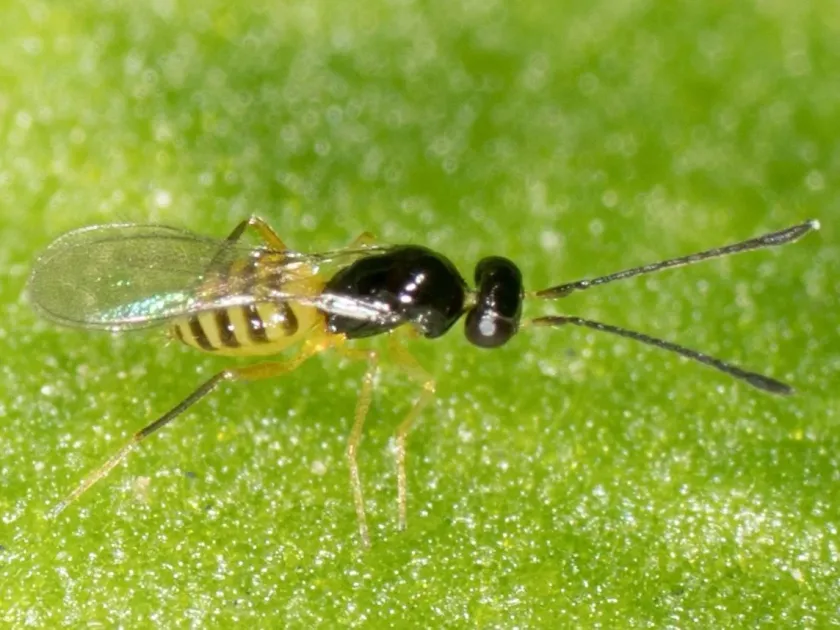
Cosmocomoidea belongs to the Mymaridae family (fairyflies) within the Hymenoptera order. These are microscopic parasitic wasps that often remain unnoticed due to their tiny size, which rarely exceeds 1–2 millimeters in length.
Adult individuals resemble small flies with distinctive long, branched antennae, a hallmark feature of the family. The wings are narrow with reduced venation and long fringes of hairs along the margins, which assists in effective movement through air currents.
Identifying these insects in the field is difficult due to their cryptic lifestyle. For accurate species determination, agronomists are advised to use specialized sticky traps or sweep netting, followed by microscopic examination of the captured specimens.
Their primary biological activity involves parasitizing the eggs of host insects, within which the larval stage of the parasite develops. The female possesses a specialized ovipositor that allows it to penetrate the tough shells of other insect eggs.
It is important to distinguish beneficial entomophages from the Mymaridae family from harmful species; however, Cosmocomoidea is often viewed within the context of ecosystem balance, where excessive activity can impact populations of other beneficial insects.
What it damages
The primary damage caused by Cosmocomoidea is not direct consumption of plant foliage, but rather its parasitism on the eggs of other insect species, which may include both major pests and beneficial insects.
During outbreaks, this genus can significantly reduce the population density of other entomophagous insects that naturally control pest numbers in agroecosystems, thereby indirectly contributing to an increase in crop pest populations.
Crops frequently targeted by these parasites include various agricultural and ornamental plants where host insects (such as leafhoppers) deposit their eggs into leaf or stem tissues.
The harm manifests as a disruption of biological pest regulation. In industrial farming, this necessitates the use of additional chemical insecticides, as the natural biological control agents are suppressed.
Damage is also cryptic in nature: eggs of host insects infected by the parasite become unsuitable for further development, which alters the structure of the entomofauna in specific field sites or orchards.
When it appears
The period of highest Cosmocomoidea activity coincides with the warm season when average daily temperatures exceed 15–18 degrees Celsius.
In temperate climates, mass emergence of adults is observed in mid-summer, coinciding with the peak egg-laying period of major host species. During this time, the parasite actively seeks suitable substrates for reproduction.
The length of the life cycle depends on temperature regimes and the availability of host eggs. In hot summers, the development of one generation can take less than three weeks, allowing the species to produce multiple generations per season.
Activity decreases in autumn, and the insects enter diapause as larvae or pupae within host eggs, overwintering in plant debris or the upper soil layer.
In early spring, as the soil warms up, the first adult individuals emerge to search for offspring sites, making this a critical period for initial population density management.
Signs of infestation
Visual signs of Cosmocomoidea presence are extremely difficult to detect due to the microscopic size of the parasite. Most often, they are diagnosed under laboratory conditions by analyzing the damaged eggs of host insects.
One indicator is the presence of specific exit holes on the shells of pest eggs, which differ in shape from the exit holes left by predators or other parasites.
On host plant leaves, zones of chlorosis or micro-deformations may be observed at the egg-laying sites where Cosmocomoidea larvae develop.
When using pheromone traps or adhesive plastic traps, the presence of specific micro-wasps during microscopic inspection of the catch serves as an indirect sign.
A reduction in the effectiveness of natural entomophages that usually suppress pests can serve as an indirect signal that Cosmocomoidea is actively displacing natural plant defenders.
Control measures
Controlling Cosmocomoidea requires a cautious approach, as the indiscriminate use of broad-spectrum insecticides will eliminate not only the parasites but also the entire beneficial entomofauna of the field.
Integrated pest management (IPM) is recommended, including regular monitoring of pest populations and the application of biopesticides that selectively target specific groups of organisms.
Agrotechnical protection measures include deep autumn plowing, which helps destroy overwintering parasite stages located in plant debris or the topsoil.
- Optimizing planting schedules to avoid the peak activity of the parasite.
- Implementing crop rotation to disrupt the food chains of host pests.
- Utilizing crop varieties resistant to the primary host insects of Cosmocomoidea.
If chemical intervention is necessary, select products with a short pre-harvest interval and low toxicity to beneficial insects, applying treatments strictly based on economic threshold levels.
Taxonomy
- Latin name
- Cosmocomoidea
- Order
- Hymenoptera
- Family
- Mymaridae
- EPPO code
- COSDSP
Discussion
No discussions yet — be the first.