
Dried fruit beetle
Colopterus truncatus
Description
How to identify
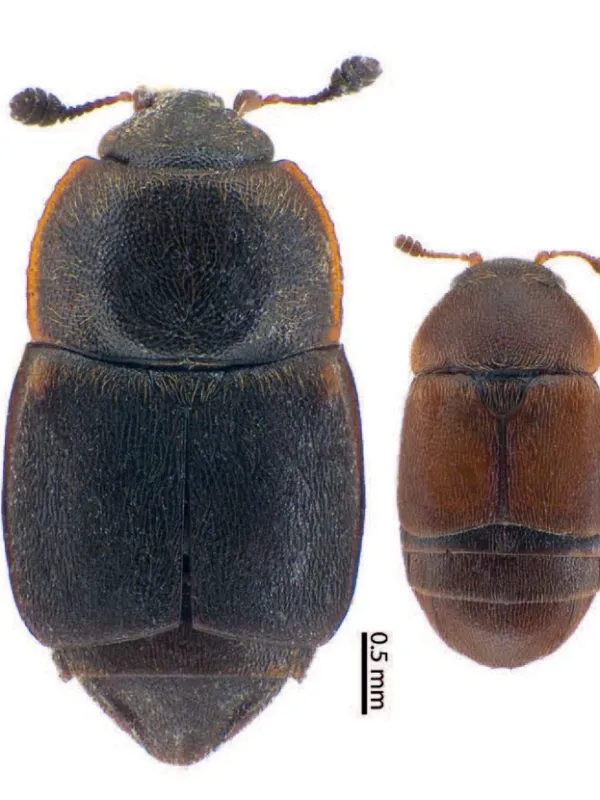
The dried fruit beetle (Colopterus truncatus) is a member of the Nitidulidae family. It is a small insect, typically measuring 2-3 mm in length, with a shiny, dark, or brownish body that is highly recognizable in infested orchards.
Its most distinguishing physical feature is the truncated elytra, which do not fully cover the tip of the abdomen. The head and pronotum are finely punctured, providing a polished, smooth appearance that characterizes the species.
Larvae are cream-colored and cylindrical, adapted for living and feeding within decaying plant tissues. They possess a dark head capsule and are highly active when provided with moisture-rich food sources like ripening or bruised fruit.
Adult beetles are highly mobile flyers, strongly attracted to the odors of fermenting sugars. This behavior makes them capable of migrating rapidly into orchards as soon as fruit begins to ripen or suffer minor damage.
They survive the winter by overwintering in sheltered locations such as leaf litter, soil crevices, or under the bark of trees, emerging when temperatures rise in the spring.
What it damages
This beetle is a significant pest for various fruit crops, including apples, pears, peaches, and stone fruits. It is particularly destructive during the final stages of fruit development and harvest.
The beetles primarily attack fruits that have already been compromised by weather, birds, or other insects. By enlarging these entry points, they accelerate rot and make the entire fruit unmarketable.
A major aspect of the damage caused by Colopterus truncatus is the transmission of fungal pathogens. They carry spores that trigger rapid decay, leading to significant post-harvest losses in storage facilities.
On berry plantations, such as raspberries or strawberries, the beetles can penetrate the fruit, leading to rapid degradation and rejection during the sorting process due to the presence of larvae.
Economic damage is twofold: direct loss of harvest volume and increased costs for sorting, grading, and disposing of infected produce to prevent further spread in storage.
When it appears
The active season begins in mid-spring as temperatures increase, with overwintering adults emerging to feed on decaying organic matter before switching to ripening crops.
The population peaks in late summer, coinciding with the maturation of major fruit varieties. Warm and humid weather conditions significantly accelerate their reproductive cycles.
Multiple generations can occur in warmer climates, leading to a constant threat during the entire harvest season. The timing of their emergence is highly dependent on local climatic trends.
As autumn approaches, the beetles become less active and seek suitable overwintering sites. This migration period is crucial for sanitation efforts to prevent the next year's population from thriving.
Farmers are advised to monitor orchard traps closely during the pre-harvest phase, as this is the period when beetle activity is highest and control measures are most critical.
Signs of infestation
Early signs of infestation include small, deep entry holes in fruit, often surrounded by darkening, softening tissue. These spots represent the onset of rot catalyzed by the beetle's presence.
A distinct sour, yeasty odor is a primary indicator of an infestation. This fermentation smell is produced by the decaying fruit tissue and acts as an attractant for other beetles in the vicinity.
When inspecting the fruit, one may find adult beetles hiding deep within the tunnels. In advanced stages of damage, the pulp turns into a mushy, liquid-like substance, rendering the fruit completely destroyed.
Premature fruit drop is a common symptom in infested orchards. Collected fallen fruit often shows internal colonization by larvae, indicating a systemic problem within the canopy.
The use of food-based monitoring traps serves as a reliable sign of pest presence. High counts in these traps indicate a need for immediate intervention to save the remaining crop.
Control measures
Strict orchard sanitation is the cornerstone of control. Removing fallen fruit and clearing rotting debris drastically limits the beetles' ability to feed and multiply throughout the season.
Mass trapping using bait stations filled with fermenting liquid or fruit-based mixtures is a highly effective way to reduce the population of adult beetles in the orchard.
Integrated pest management requires controlling primary pests like codling moths, which create the initial wounds that allow Colopterus truncatus to enter healthy fruit.
Chemical control should be applied judiciously, focusing on the pre-harvest period only when necessary, while adhering to strict pre-harvest intervals to ensure food safety.
- Monitor populations with yeast or fruit-based traps.
- Remove all rotting fruit from trees and the ground.
- Control secondary pests to limit entry points for beetles.
- Maintain proper orchard hygiene to prevent overwintering.
Taxonomy
- Latin name
- Colopterus truncatus
- Order
- Coleoptera (beetles)
- Family
- Nitidulidae
- EPPO code
- CLPTTR
Discussion
No discussions yet — be the first.