
Clouded sulphur
Colias philodice
Description
How to identify
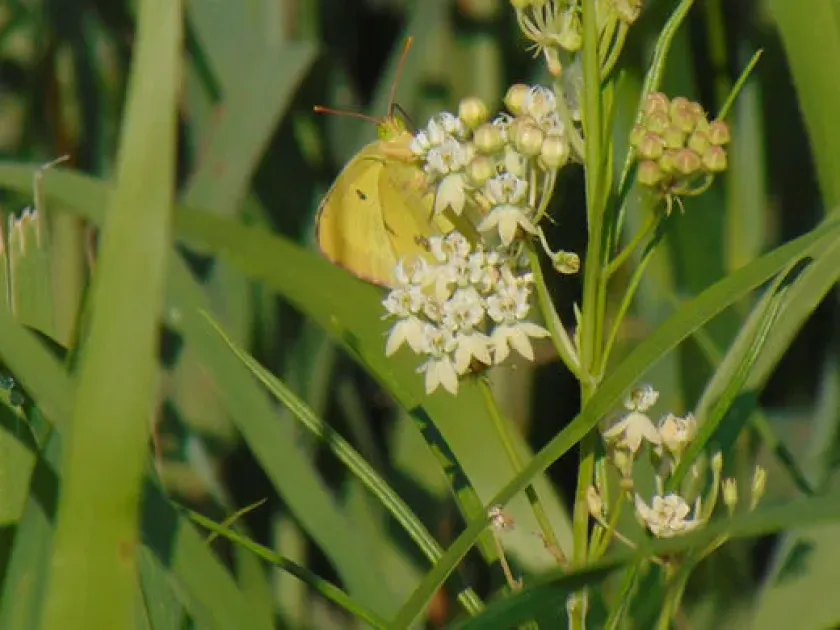
The Clouded sulphur (Colias philodice) is a butterfly species within the family Pieridae. It is a common insect in North American agricultural landscapes, known for its distinct flight patterns.
Adult butterflies exhibit a yellow or pale white wing coloration, with males often displaying a bold black border along the edges of their wings.
The larvae, or caterpillars, are typically velvety green with pale longitudinal stripes, providing excellent camouflage against the foliage of host plants.
The life cycle undergoes complete metamorphosis, consisting of four stages: egg, larva (five instars), pupa (chrysalis), and adult butterfly.
The species is highly adaptable and thrives in open fields where clover, alfalfa, and other leguminous plants are readily available for feeding.
What it damages
This pest primarily targets leguminous crops, with a strong preference for alfalfa (Medicago sativa) and various species of clover (Trifolium spp.).
Larvae are the primary cause of damage, as they possess chewing mouthparts that allow them to consume large quantities of leaf tissue during their development.
Heavy infestations lead to widespread defoliation, which severely reduces the plant's photosynthetic capacity and weakens the overall crop health.
In addition to physical tissue loss, damage to the foliage often results in reduced protein content and yield quality, impacting both hay production and fodder value.
Seed production in alfalfa fields can be particularly affected if larval feeding occurs during the flower and pod-forming stages of the crop.
When it appears
The Clouded sulphur is multi-voltine, meaning it produces multiple generations per year, with the first adults emerging in late spring.
The population peaks typically occur in mid-to-late summer, coinciding with the rapid growth of successive larval generations as temperatures increase.
In temperate regions, the species overwinters primarily as larvae, residing near the base of host plants or within the mulch layer of the field.
Weather conditions, specifically warmth and humidity, play a crucial role in determining the speed of the life cycle and the potential for population outbreaks.
Monitoring the flight activity of adults is essential, as this provides a predictive window for when eggs will hatch and when larvae will be most active.
Signs of infestation
Adult butterflies congregating or fluttering over fields are the primary sign that egg-laying is occurring and that a new generation is imminent.
Early feeding signs include irregular, ragged holes in the leaves, which expand into extensive skeletonization as the caterpillars increase in size.
Frass (caterpillar droppings) accumulating on the leaves or at the base of the plants is a definitive indicator of an active infestation in the field.
During daylight, caterpillars are often hidden on the undersides of leaves or deep within the canopy, making them harder to spot until damage is visible.
Generalized yellowing or thinning of the crop stand may be observed if high larval populations have persisted over an extended period of time.
Control measures
Effective management begins with scouting to determine if the population density exceeds the economic threshold established for the specific crop and region.
Harvesting the crop early, when damage is detected, can effectively remove the larval food source and disrupt the butterfly's reproductive cycle.
Biological control agents, such as parasitic wasps and predatory insects, often play a significant role in suppressing larval populations naturally.
If chemical intervention is necessary, targeted insecticides applied during the early larval stages are most effective and have the lowest impact on pollinators.
- Crop rotation to reduce localized pest buildup.
- Using biological products based on Bacillus thuringiensis.
- Maintaining field edges to support beneficial insect populations.
- Avoiding unnecessary broad-spectrum insecticide applications.
Taxonomy
- Latin name
- Colias philodice
- Order
- Lepidoptera (butterflies)
- Family
- Pieridae
- EPPO code
- COIAPH
Discussion
No discussions yet — be the first.