
Colias lesbia
Colias lesbia
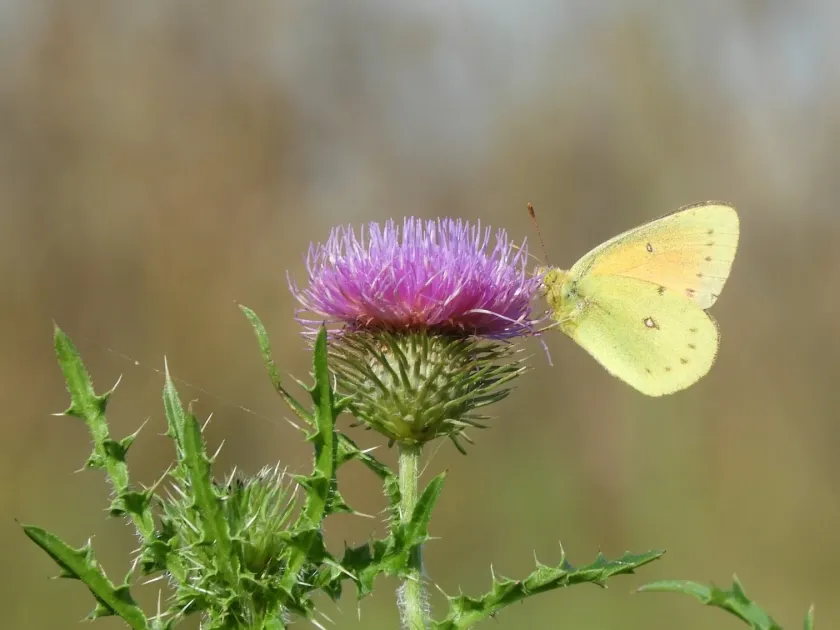
Description
How to identify
Colias lesbia is a butterfly species belonging to the family Pieridae (order Lepidoptera). It is widely recognized as a serious pest of leguminous crops, particularly alfalfa, in South American agricultural regions.
The adult butterfly has a wingspan of approximately 40–50 mm. Males typically display vibrant orange wings with a distinctive wide black border, while females exhibit more muted tones with pale spots within the dark margins.
The larval stage, which causes the most damage, goes through several instars. The mature caterpillar is green with longitudinal light-colored lateral stripes, providing effective camouflage within the foliage.
Pupation occurs on the host plants, where the pupae are attached to stems or leaves by silk threads. The life cycle is entirely dependent on the availability of host vegetation.
This species is highly prolific, and its population density can escalate rapidly under favorable climatic conditions, posing a continuous threat to fodder production.
What it damages
The primary host plant for Colias lesbia is alfalfa (Medicago sativa). It feeds on the leaves, severely reducing the photosynthetic surface area and the overall yield of the forage crop.
Beyond alfalfa, the larvae can infest other leguminous forage crops. This adaptability allows the pest to maintain high population levels throughout the growing season.
Damage is characterized by extensive defoliation. In severe cases, caterpillars can strip entire fields, leaving only the main stems, which destroys the crop's quality for hay production.
Continuous feeding slows plant regrowth after mowing. This impact significantly reduces the number of harvests per season and diminishes the long-term vigor of the alfalfa stand.
Furthermore, the presence of frass and larval remains can degrade the quality of harvested hay, making it less palatable or suitable for high-quality livestock feed.
When it appears
The seasonal activity begins in late spring, triggered by rising temperatures. Adult butterflies emerge from overwintering and begin mating and oviposition on the foliage of host plants.
There are typically three to five generations per year, depending on the climatic zone. Warmer regions often experience more rapid development cycles due to higher metabolic activity.
Peak infestation levels usually occur during the warmer months of mid-summer, when the larval growth rate is maximized and the alfalfa foliage is lush.
The number of generations is highly correlated with the sum of active temperatures. A prolonged, warm growing season can lead to massive larval outbreaks.
Overwintering takes place primarily as larvae in the soil or protected areas near the base of the plants, where they survive until the following spring.
Signs of infestation
The initial signs of infestation include small, irregular feeding holes in the leaflets, commonly referred to as "windowing" before the leaf is entirely consumed.
As the larvae grow, they become easier to spot during field inspections. They often hide in the lower canopy during the hottest part of the day to avoid desiccation.
The accumulation of green or brownish larval excrement on the leaves and at the base of the plants is a reliable indicator of active caterpillar feeding.
Massive flight activity of adult butterflies is a clear warning sign that significant egg-laying is occurring and that larval outbreaks should be expected within days.
A noticeable yellowing or thinning of the alfalfa stand is often mistaken for nutrient or water stress, but it is frequently caused by significant leaf mass loss due to the pest.
Control measures
Integrated Pest Management (IPM) is essential for controlling Colias lesbia. Field scouting using sweep nets to determine the economic threshold is the standard monitoring practice.
Timely mowing of the alfalfa is a highly effective cultural control method, as it disrupts the life cycle by removing the food source and exposing larvae to heat and predators.
Biological control agents, such as Bacillus thuringiensis (Bt) based formulations, are highly effective against young larvae and represent an environmentally sustainable approach.
When infestation levels exceed economic thresholds, selective insecticides may be applied, ensuring that they are labeled for use on forage crops to prevent chemical residues.
- Regular field scouting
- Optimizing mowing schedules
- Encouraging natural parasitoids
- Targeted application of biologicals
Taxonomy
- Latin name
- Colias lesbia
- Order
- Lepidoptera (butterflies)
- Family
- Pieridae
- EPPO code
- COIALE
Discussion
No discussions yet — be the first.