
Pale clouded yellow
Colias hyale
Description
How to identify
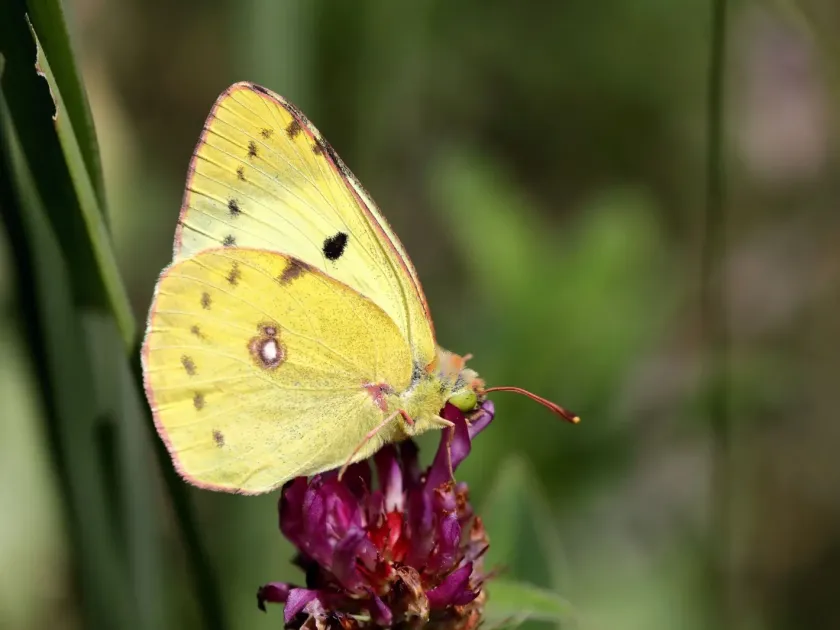
The Pale clouded yellow (Colias hyale) is a butterfly species belonging to the Pieridae family. Its wingspan ranges from 40 to 50 mm, making it a noticeable insect in open field environments.
Males possess lemon-yellow wings, while females are paler, often with a greenish hue. A distinct black border with light-colored spots on the tips of the forewings characterizes this species.
The eggs are spindle-shaped with prominent longitudinal ribs. Initially white, they transition to a yellowish or reddish tone as the larva develops inside the casing.
Larvae are velvety green with pale longitudinal stripes along their sides, providing effective camouflage against the stems of their host plants, such as clover or alfalfa.
The pupa is yellowish-green with dark markings. It attaches to the host plant via a silk girdle, remaining securely fastened in the lower vegetation during the metamorphic stage.
What it damages
The larvae are the primary cause of agricultural damage, feeding voraciously on the foliage of various legume crops. This behavior classifies them as significant pests in forage production.
Key host plants include alfalfa, clover, vetch, and sainfoin. In regions where these crops are heavily grown, the pest can cause extensive leaf loss, reducing the yield of biomass.
Feeding damage disrupts the plant's photosynthetic capacity, leading to weakened plants, reduced root vigor, and decreased forage quality for livestock.
Severe infestations can lead to substantial economic losses, particularly when larvae reach high population densities, causing widespread defoliation in early-stage crops.
The pest typically invades fields from adjacent wild habitats or neglected pastures, where it finds favorable conditions for both oviposition and larval development.
When it appears
This species typically undergoes two or three generations per year, depending on the climate. The first generation of adults usually appears during late spring, around May or June.
The second generation is active throughout July and August. Larvae from this generation are responsible for the most significant crop damage during the peak growing season.
The species overwinters as a larva, often in early or middle instars, sheltered within the leaf litter or the base of forage plants, which allows it to survive colder months.
Warm and dry weather patterns significantly accelerate the development of all life stages, often leading to rapid population surges if environmental conditions remain favorable.
Monitoring efforts should commence as early as the first adult sightings, as timely detection is essential for implementing effective preventative measures.
Signs of infestation
Evidence of infestation is characterized by irregular, ragged feeding patterns on the leaves, known as skeletonization, where soft tissue is consumed while veins remain.
The presence of larval frass (excrement) on the leaves and stems is a reliable indicator of active feeding activity, allowing farmers to confirm the presence of the pest.
In cases of heavy infestation, plants may exhibit stunted growth, yellowing, and eventual wilting, resulting in noticeable patches of thin or damaged vegetation across the field.
Larvae are most easily spotted in the early morning or evening when they move to the upper parts of the plant to feed, as they tend to hide during the hottest hours.
Visual identification of damaged leaf margins provides a quick way for scouts to assess the degree of infestation and determine if control actions are necessary.
Control measures
Effective management begins with good agricultural practices, such as the regular mowing of weeds and wild legumes along field borders to reduce breeding reservoirs.
Crop rotation and maintaining spatial distance between new and old legume stands help limit the ability of the pest to migrate and establish itself in cultivated fields.
Chemical control involving approved insecticides should be applied only when population thresholds are exceeded, ensuring compliance with local safety regulations.
Natural enemies, including various parasitoid wasps and predatory insects, play a crucial role in regulating populations, and conservation of these beneficials is highly recommended.
Biological control agents, such as formulations containing bacteria, offer an environmentally sound alternative for managing larvae without risking chemical residues on the crop.
Taxonomy
- Latin name
- Colias hyale
- Order
- Lepidoptera (butterflies)
- Family
- Pieridae
- EPPO code
- COIAHY
Discussion
No discussions yet — be the first.