
Alfalfa butterfly
Colias eurytheme
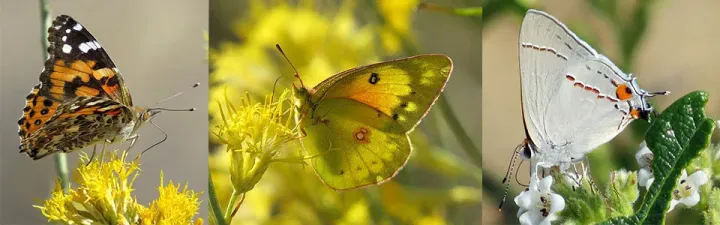
Description
How to identify
The Alfalfa butterfly Colias eurytheme is a member of the Pieridae family. Adult butterflies typically feature bright yellow or orange-yellow wings bordered by wide, dark margins, making them easily identifiable in the field.
The wingspan of this species ranges from 50 to 65 millimeters. Males and females exhibit slight variations in color intensity, and the underside of the hindwings usually displays a prominent light-colored spot encircled by a darker ring.
The larvae, or caterpillars, are cylindrical and vibrant green, providing excellent camouflage against the foliage of host plants. A light-colored longitudinal stripe often runs along the sides of the body, sometimes accented with orange or yellow markings.
The pupae are typical of the Pieridae family, characterized by a girdle attachment to the stems of host plants. The insect undergoes complete metamorphosis, passing through egg, larval, pupal, and adult stages.
This species is highly prolific, and its ability to complete multiple generations within a single season allows for rapid population growth under favorable environmental conditions.
What it damages
The larvae of the Alfalfa butterfly feed primarily on legume crops. Alfalfa (lucerne) is the most economically significant host plant, serving as the main source of nutrition for the caterpillars.
In addition to alfalfa, the pest can attack clover, vetch, peas, and other members of the Fabaceae family. During outbreaks, caterpillars may migrate to wild legumes found along field margins.
Damage is caused exclusively by the larval stage. Feeding begins shortly after the eggs hatch, with larvae consuming the epidermal layers and eventually the entire leaf blade.
High caterpillar densities result in heavy defoliation, which severely reduces the plant's photosynthetic capacity. This retardation in growth is particularly devastating to the yield of the first and second cuttings.
Beyond quantity, the damage affects the quality of the harvested hay by significantly reducing its protein content, thereby diminishing its value as livestock feed.
When it appears
The development of the Alfalfa butterfly is closely tied to ambient temperature. In temperate and warm climates, the species is capable of completing 3 to 5 generations per growing season.
They typically overwinter in the larval or pupal stage, hidden within plant debris or near the crown of host plants. Development resumes with the onset of spring warmth.
The first adult butterflies emerge in late spring or early summer, coinciding with the rapid vegetative growth of alfalfa. Because generations overlap, adult activity is usually continuous throughout the summer.
Peak pest activity generally occurs during the hottest months of July and August, when warmer temperatures accelerate the metabolic rate and developmental speed of the insects.
As daylight hours shorten and temperatures drop in the autumn, larval development slows down, and the final generation enters a dormant state to survive the winter.
Signs of infestation
The most immediate sign of an infestation is the presence of numerous yellow butterflies fluttering across alfalfa fields on sunny days, which indicates active oviposition.
Close inspection of the plants reveals small, cone-shaped eggs deposited on the leaf surfaces. These eggs transition from a light yellow to a darker shade as they prepare to hatch.
Early feeding by young caterpillars creates small "shot holes" or skeletonized patches on the leaves, as they consume the soft tissue while leaving the veins intact.
Older larvae consume entire leaves, often leaving only the midribs behind. In severe infestations, large sections of the crop may appear completely stripped of foliage.
The presence of frass (caterpillar waste) on the remaining leaves and at the base of the plants serves as a definitive indicator of an active and feeding pest population.
Control measures
Timely and early harvesting of the alfalfa crop is the most effective agronomic control method, as it physically removes larvae and eliminates their food source.
Implementing proper crop rotation strategies that include non-leguminous plants helps disrupt the pest's life cycle and prevents the buildup of large localized populations.
Chemical control involves the application of insecticides targeting the larval stage. Treatments should be timed according to the economic injury level, typically when larval counts exceed 10–15 per square meter.
Conservation of natural enemies, such as parasitic wasps (trichogrammatids) and predatory insects, is essential for maintaining natural biological control over the butterfly populations.
- Maintaining spatial isolation between legume fields to reduce migration.
- Utilizing biological pesticides based on Bacillus thuringiensis for environmentally sensitive control.
- Regular field scouting using insect nets to monitor larval population density.
Taxonomy
- Latin name
- Colias eurytheme
- Order
- Lepidoptera (butterflies)
- Family
- Pieridae
- EPPO code
- COIAEU
Discussion
No discussions yet — be the first.