
Eastern pale clouded yellow
Colias erate
Description
How to identify
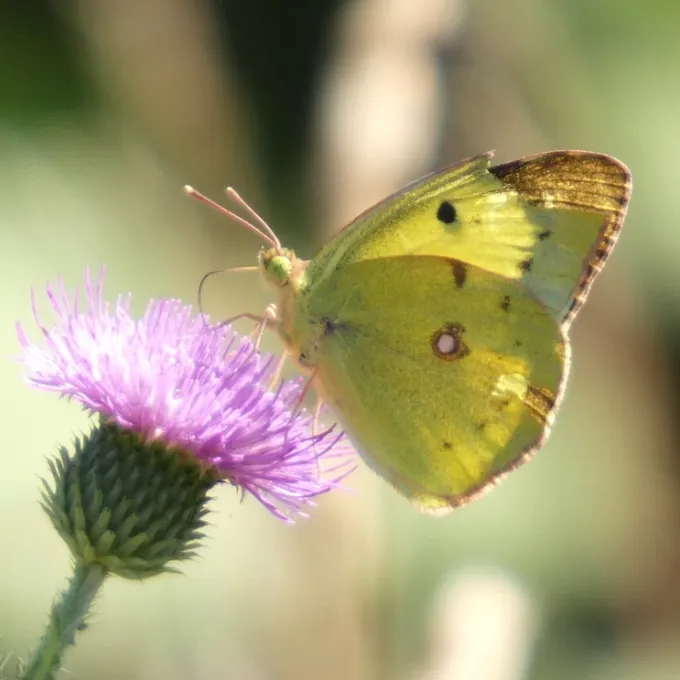
The eastern pale clouded yellow (Colias erate) is a butterfly species belonging to the Pieridae family, commonly found in agricultural areas.
Adult butterflies have a wingspan of 45–60 mm, with wings typically colored bright yellow or gold, bordered by a prominent dark margin.
The larvae are velvet green in appearance, characterized by a lateral yellow stripe that runs along their body length to provide camouflage.
Pupae are generally green with dark spotting, secured firmly to the stems of host plants with a silk girdle to blend into the foliage.
Eggs are elongated and ribbed, usually laid singly or in clusters on the underside of leaves by the female butterfly during the breeding season.
What it damages
Damage is primarily caused by the larvae, which voraciously feed on the foliage of various leguminous crops, including alfalfa and clover.
They begin by skeletonizing the leaf surface, eventually consuming the entire blade and leaving behind only the tough main veins of the plant.
Heavy infestations can lead to significant biomass loss in fields, severely impacting the fodder quality of the harvested hay.
Younger caterpillars often feed in groups, creating distinct patches of damaged foliage that are easy to spot during regular field inspections.
Severe defoliation weakens the plant, reducing its ability to recover after cutting and negatively affecting long-term crop yields.
When it appears
The life cycle of this species is highly dependent on climate, with the ability to produce multiple generations in warmer regions throughout the summer.
Overwintering typically occurs in the larval stage, buried in the soil or protected under thick vegetation and field debris.
Adult activity initiates in early spring, synchronized with the resumption of legume growth after the winter dormancy period.
The duration of the development cycle from egg to adult is relatively short, allowing for rapid population growth under favorable weather conditions.
Peak pest pressure usually coincides with the mid-summer period, requiring vigilant monitoring to prevent substantial economic losses.
Signs of infestation
Observing high numbers of yellow butterflies in and around leguminous fields is the first indication of a potential infestation.
Check for "windowing" on the underside of leaves, which is caused by young larvae feeding without piercing through the upper leaf epidermis.
The accumulation of larval frass on leaves and at the base of plants is a definitive sign of active feeding by the caterpillar stage.
Plants showing signs of stunted growth, chlorosis, or rapid yellowing of the foliage often indicate significant feeding pressure.
Significant gaps or thin spots in the crop canopy are indicative of advanced damage resulting from long-term presence of the larvae.
Control measures
Deep plowing in the autumn is a recommended cultural practice to disrupt the life cycle by burying overwintering larvae in the soil.
Effective crop rotation practices significantly reduce the likelihood of larvae establishing a stable and damaging population in a single area.
Biological control using microbial insecticides, specifically those containing Bacillus thuringiensis, is highly effective against early larval stages.
Chemical intervention should be reserved for scenarios where population levels exceed the economic threshold, using selective, field-approved insecticides.
- Regular monitoring of egg-laying activity during peak flight times.
- Timely harvesting to reduce the available food source for larvae.
- Promoting natural predators and parasitoids within the field ecosystem.
Taxonomy
- Latin name
- Colias erate
- Order
- Lepidoptera (butterflies)
- Family
- Pieridae
- EPPO code
- COIAEP
Discussion
No discussions yet — be the first.