
Clouded Yellow
Colias croceus
Description
How to identify
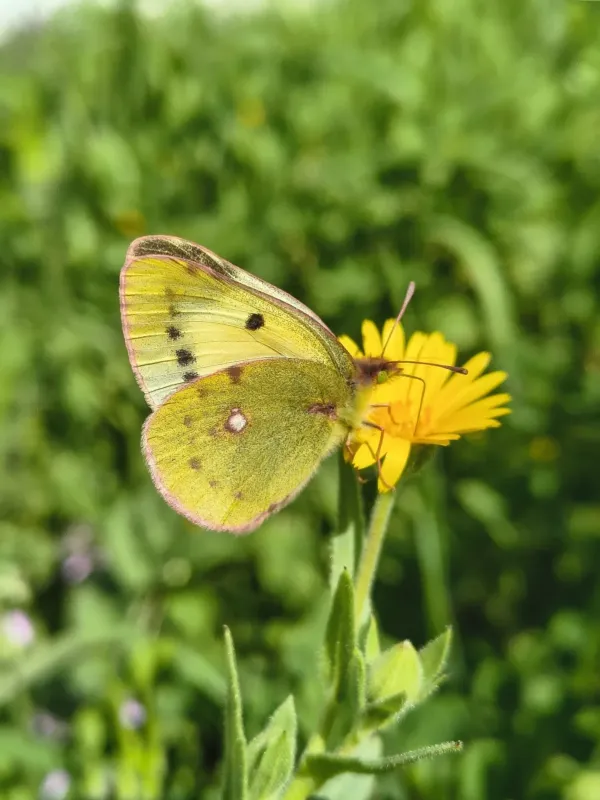
The Clouded Yellow (Colias croceus) is a butterfly belonging to the Pieridae family. Adults are characterized by their distinct orange-yellow wings with prominent black borders, making them easily identifiable in the field.
The larvae, or caterpillars, are velvety green with longitudinal pale stripes and fine hairs, allowing them to blend into the foliage of their host plants, which makes detection challenging.
Pupation occurs on the stems or undersides of leaves of the host plant. The chrysalis is light green with dark markings, providing excellent camouflage against natural predators.
As a highly migratory species, this butterfly can quickly colonize large agricultural areas, moving with prevailing winds during the summer months.
Understanding their life cycle is crucial for farmers, as rapid population growth during warm seasons can lead to significant infestations in legume fields.
What it damages
The primary hosts for the Clouded Yellow are legumes. Major crops such as alfalfa (lucerne), clover, vetch, and sainfoin are most susceptible to larval damage.
Young larvae feed on the epidermis of leaves, causing translucent window-like spots. As they grow older, they consume entire leaves, leaving behind only the central veins.
Heavy infestations can lead to severe defoliation of the crop, significantly reducing biomass production and decreasing the nutritional quality of the forage for livestock.
The larvae are particularly harmful to young seedlings, where extensive leaf consumption can result in stunted growth and, in severe cases, the death of the plant.
By damaging the photosynthetic surface of the plants, the pest reduces the crop's resilience, making it more prone to drought stress and secondary pathogenic infections.
When it appears
Adults typically appear in late spring or early summer, following the warming of temperatures, and immediately begin searching for host plants to lay their eggs.
The species can complete multiple generations in a single growing season, depending on the climatic conditions of the region and the availability of host plants.
Peak larval activity often coincides with the mid-to-late summer growth phase of legumes, which is the most critical period for protecting crop yield.
As autumn approaches, populations typically decline due to cooling temperatures, although some larvae may attempt to overwinter in sheltered locations.
Monitoring the flight activity of adults is a key strategy for predicting the arrival of the next generation of larvae and timing preventative field operations.
Signs of infestation
The most obvious sign of an infestation is the presence of numerous orange-yellow butterflies fluttering over fields, especially during warm, sunny weather conditions.
Close inspection of leaves will reveal characteristic circular or irregular holes, which indicate feeding by young larvae on the lower surface of the leaf blades.
The presence of larval frass (excrement) on the stems or leaves is a reliable indicator that an active population is present and feeding within the canopy.
Wilting, yellowing, or severe defoliation of patches in the field are indicators of more mature larval activity that has gone undetected for several days.
Stunted plant growth and reduced vigor in comparison to neighboring healthy sections can often be traced back to localized pest pressure in the early stages of development.
Control measures
Effective management includes adopting proper crop rotation practices to break the life cycle and reduce the local population density of the pest.
Early harvesting of legume crops, particularly alfalfa, can effectively remove larvae from the field before they reach their most destructive stages of development.
Biological controls, such as applying treatments based on Bacillus thuringiensis, are highly effective against young larvae while preserving beneficial insect populations.
Chemical intervention should be restricted to scenarios where pest populations exceed the established economic threshold, utilizing selective and integrated pest management tools.
- Regular scouting of fields during the critical growth stages.
- Maintaining field margins to support natural predators like parasitic wasps.
- Using trap crops to divert the butterflies from the primary commercial acreage.
Taxonomy
- Latin name
- Colias croceus
- Order
- Lepidoptera (butterflies)
- Family
- Pieridae
- EPPO code
- COIACR
Discussion
No discussions yet — be the first.