
Berger's Clouded Yellow
Colias australis
Description
How to identify
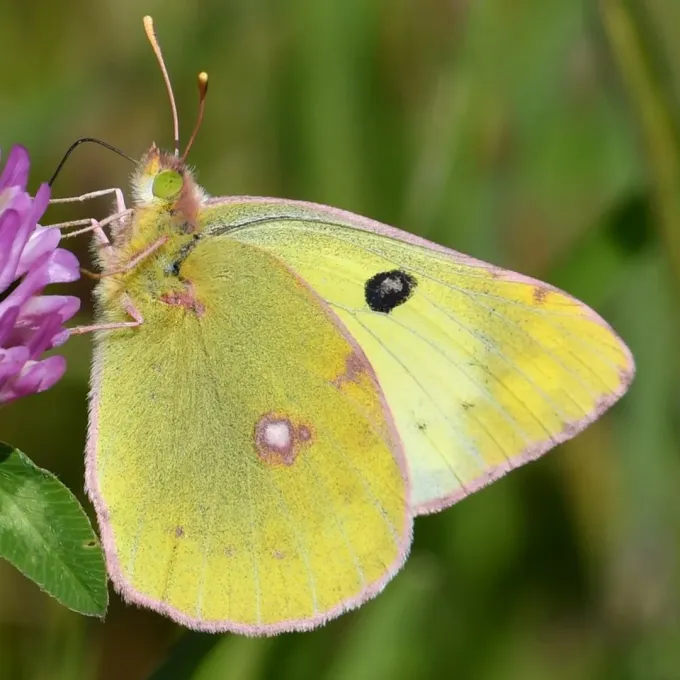
Berger's Clouded Yellow (Colias australis) is a member of the Pieridae family. Adults are medium-sized butterflies, typically sporting a vibrant yellow or orange-yellow wing coloration bordered by dark, charcoal-like margins.
The underside of the hindwings is diagnostic for the species, exhibiting a distinct greenish tinge with a central silvery-white double spot, which helps in differentiating it from similar butterflies in the field.
The larvae are cylindrical and bright green, perfectly adapted to blend in with the foliage of their host plants. They possess fine hairs and subtle longitudinal stripes that mimic the leaf veins of leguminous crops.
Pupae are attached to the stems of plants with a silk girdle, colored in shades of green that match the host's vegetation, providing excellent camouflage against avian predators during their metamorphosis.
Eggs are elongated and ribbed, laid individually by the female on the underside of leaves. They change from pale yellow to a darker shade just before the larva hatches, signaling the start of the life cycle.
What it damages
The primary host plants for Colias australis larvae are members of the Fabaceae family, with commercial alfalfa, clover, and sainfoin being the most frequently impacted crops in agricultural settings.
In addition to these crops, various wild legumes found in field margins and uncultivated grasslands serve as reservoir hosts, enabling the pest to sustain populations throughout the growing season.
Larval feeding causes significant leaf surface area loss, starting with the tender younger leaves and progressing to the more mature foliage, directly impacting the photosynthetic capacity of the plants.
In cases of high infestation, the larvae may feed on the terminal buds and reproductive structures, which significantly reduces the seed yield and vigor of forage crops, causing economic losses for farmers.
Heavy feeding leads to plant stress, making the affected crop more susceptible to environmental stressors like moisture deficiency and diseases, thereby decreasing the overall longevity of the forage stand.
When it appears
Adult butterflies typically emerge in late spring, with the first generation appearing around May. This initial flight period is crucial for setting up the population for subsequent generations throughout the summer.
Depending on the local climate and temperature, this species can complete two or three generations within a single season, leading to potential population explosions in warmer, stable weather conditions.
Larval activity is most intense during the mid-summer months when forage crops are in a phase of rapid vegetative growth, aligning the pest's life cycle perfectly with the crop's development.
The species overwinters primarily in the pupal or late-larval stage, tucked away in plant debris or the upper layers of soil, allowing it to survive the dormancy period until the next spring season.
Monitoring for adult flight patterns and early-season egg-laying is essential for agriculturalists to predict the peak of larval activity and schedule protective interventions effectively.
Signs of infestation
Small, irregular holes in the leaf blades, often starting near the margins, are the earliest visible indicators that larvae have begun feeding on the crop during their initial growth stages.
The presence of fine, granular fecal pellets (frass) scattered on the leaves or the soil surface beneath the plants is a clear sign that larvae are present and actively feeding in the field.
As the larvae mature, they consume larger portions of the leaf, leaving behind only the thicker midribs, a process often referred to as skeletalization, which is highly visible at the field level.
If the crop shows uneven growth or patches of yellowing foliage, farmers should inspect the underside of the leaves for the presence of green larvae that are otherwise well-hidden by their natural camouflage.
Reduced vigor and stunted appearance of the legume plants during the mid-summer cutting season can indicate a significant infestation that has impacted the plant's ability to recover after mowing.
Control measures
Implementing a strict mowing schedule for alfalfa and other legumes is a highly effective cultural control method, as it disrupts the larval development cycle and significantly reduces population numbers.
Maintaining clean field borders by removing wild legume weeds reduces the availability of secondary food sources, thereby limiting the buildup of the pest and its subsequent migration into the main crop.
Biological control through the use of microbial insecticides, such as those based on specific bacterial strains, offers a targeted approach that manages larval populations without harming beneficial insect predators.
Chemical control should be reserved as a last resort, triggered only when the population reaches the economic threshold, using selective pesticides that minimize impact on non-target beneficial organisms.
Encouraging natural biological controls, such as parasitoid wasps and predatory insects, by creating field margins and refugia, helps maintain a sustainable balance in the agroecosystem, preventing outbreaks.
Taxonomy
- Latin name
- Colias australis
- Order
- Lepidoptera (butterflies)
- Family
- Pieridae
- EPPO code
- COIAAU
Discussion
No discussions yet — be the first.