
Clouded Yellow
Colias
Description
How to identify
The genus Colias, commonly known as Clouded Yellows, belongs to the order Lepidoptera and the family Pieridae. The most significant agricultural species include Colias hyale and Colias erate.
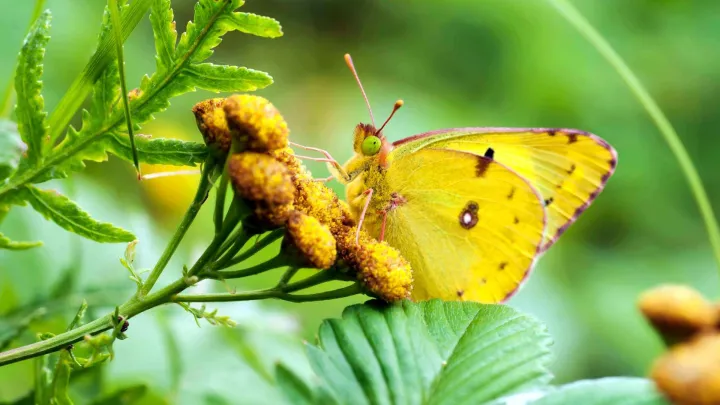
Adult butterflies are easily identified by their bright yellow or orange-yellow wings, which feature a distinct dark border. The wingspan typically ranges from 40 to 60 mm.
The larvae (caterpillars) are velvet-green in color with longitudinal white or pale yellow stripes along the sides of their bodies, covered in short, fine hairs.
The pupae are bright green with dark markings, providing effective camouflage against green foliage during their transformation stage.
The species undergoes a complete metamorphosis, including egg, larva, pupa, and adult stages, with larvae commonly overwintering in the soil or at the base of plants.
What it damages
Clouded Yellows are significant pests of various leguminous crops, often causing severe economic losses in alfalfa, clover, sainfoin, and pea fields.
The larvae feed voraciously on the foliage of these crops, consuming entire leaves and leaving only the primary veins, which significantly reduces plant vigor.
Heavy infestations lead to a substantial decrease in biomass production and a reduction in the nutritional value of the hay or fodder produced from infested fields.
The damage is particularly severe during the active growth phases of the crop, as larvae compete with the plant for nutrients and resources.
Furthermore, weeds belonging to the Fabaceae family often serve as alternative hosts, maintaining the pest population throughout the growing season.
When it appears
Adult activity begins in late spring, typically from April to May, depending on the climatic conditions and the regional spring temperature patterns.
In warmer southern regions, the species can produce multiple generations (up to three per season), leading to a buildup of populations by late summer.
Larval activity peaks during the most rapid vegetative growth phases of legumes, particularly coinciding with the budding and flowering periods.
Temperature plays a crucial role in development; conditions consistently above 20°C accelerate the life cycle, shortening the intervals between generations.
As autumn approaches and temperatures drop, the final larval generation enters diapause, settling in the root zone or plant debris to survive the winter.
Signs of infestation
The primary visual indicator of an infestation is the presence of numerous bright yellow butterflies flying across fields, especially on sunny days.
Feeding damage is characterized by irregular notches and large holes in leaves, which, in extreme cases, results in the complete skeletonization of the leaf canopy.
Careful field scouting allows for the detection of larvae on the undersides of leaves or along stems, especially during the early morning hours.
Localized patches of stunted or severely defoliated plants often indicate feeding hotspots where larval density is highest.
The presence of frass (larval droppings) on leaf surfaces or on the soil below the plants is a clear indication of recent or ongoing feeding activity.
Control measures
Agronomic management focuses on timely mowing, which removes the food source and causes massive mortality of younger larval stages due to desiccation.
Deep autumn plowing of fields is an effective cultural control method, as it disrupts overwintering sites and reduces the subsequent year's initial population.
Chemical control should be implemented only when the economic injury level is exceeded, typically defined by a threshold of 5-10 larvae per square meter.
Biological control methods include the use of natural enemies such as the egg parasitoid Trichogramma, which helps to naturally suppress population spikes.
- Implementation of crop rotation.
- Management of field margins to remove weed hosts.
- Frequent field monitoring during the flight period.
- Application of selective bio-insecticides when necessary.
Taxonomy
- Latin name
- Colias
- Order
- Lepidoptera (butterflies)
- Family
- Pieridae
- EPPO code
- COIASP
Discussion
No discussions yet — be the first.