
Secondary screwworm
Cochliomyia macellaria
Description
How to identify
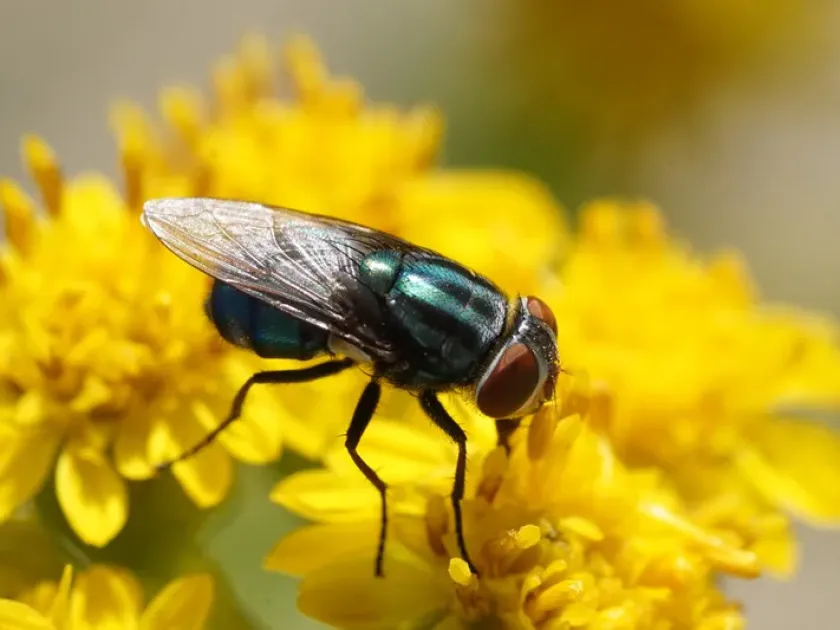
The Secondary screwworm, scientifically known as Cochliomyia macellaria, is a member of the Calliphoridae family, often referred to as blow flies. Adults are easily recognized by their metallic blue-green coloration and three distinct longitudinal dark stripes on the thorax.
The larvae are typical maggots, creamy white in color, and go through three distinct larval instars. They lack legs and possess a specialized hook-like mouthpart used to break down organic matter efficiently.
These flies are highly mobile and are primarily attracted to decaying organic materials, including damaged vegetable crops and livestock waste. They are particularly active during warm, sunny weather conditions.
The biological cycle of this species is temperature-dependent, allowing for rapid reproduction in favorable climates. A single female can lay hundreds of eggs during her lifespan, ensuring high population turnover.
Distinguishing Cochliomyia macellaria from other related species often requires microscopic examination of the larval spiracles and adult thoracic patterns, which are vital for accurate field identification.
What it damages
While primarily saprophagous, the Secondary screwworm acts as a secondary pest in agriculture. It targets vegetable crops such as tomatoes, peppers, and cucurbits that have pre-existing wounds or fungal infections.
The larvae bore into the soft tissue of the fruit, causing rapid liquefaction through the release of digestive enzymes. This process renders the produce completely unmarketable and prone to total decay.
In addition to direct tissue destruction, the movement of flies across fields facilitates the mechanical transmission of various phytopathogens, including bacteria and mold spores, causing secondary rot outbreaks.
Economic damage is often magnified in humid environments where pre-existing rotting conditions create optimal breeding grounds, leading to rapid infestation of entire crop lots if left unchecked.
Early identification of crop damage is essential to prevent the larvae from completing their development and successfully pupating in the nearby soil, which would perpetuate the cycle.
When it appears
The activity of Cochliomyia macellaria typically begins in late spring, following the first sustained warm periods. Their populations reach peak density throughout the summer months.
Multiple generations can occur within a single growing season. The exact number of generations is governed by ambient temperature and the availability of suitable oviposition sites.
As temperatures decline during the autumn, adult activity decreases significantly. The species overwinters in the pupal stage, buried in the soil or protected under organic debris until conditions improve.
The transition from winter dormancy to spring emergence is highly synchronized with soil temperature warming, marking the start of the risk period for agricultural fields.
Monitoring seasonal patterns is crucial for timing preventive measures, as infestations are much harder to control once a high population density is reached.
Signs of infestation
The most immediate sign of infestation is an unpleasant, putrid odor emanating from crop areas. This smell indicates that decay is already underway and attracting the flies.
Visual inspection of damaged fruit often reveals localized soft, discolored patches. Upon closer inspection, one may find egg clusters or actively feeding larvae beneath the fruit surface.
An unusual concentration of metallic-colored flies swarming around piles of cull fruit or compost heaps indicates an active breeding population nearby.
Secondary symptoms include the presence of larval tunneling marks and the rapid spread of soft rot from the point of initial infection to the rest of the fruit or plant.
- Putrid odors in the field.
- Soft, dark, sunken lesions on fruit.
- Visibility of white maggot clusters.
- Rapid decomposition of harvested or bruised produce.
Control measures
Effective management begins with stringent field sanitation. Removing and burying or destroying damaged and fallen fruit is the most important step to eliminate breeding sites.
Integrated Pest Management (IPM) practices should focus on preventing the primary injuries that attract these flies. This includes controlling early-season pests that bite or puncture the fruit epidermis.
The use of bait-based traps containing attractants can significantly reduce the adult population density, especially in greenhouse or localized garden environments.
Tilling the soil at the end of the season can expose overwintering pupae to predators and adverse weather, disrupting the fly's ability to emerge in the following year.
Where necessary, protective netting or physical barriers for high-value vegetable crops can be employed to prevent female flies from accessing the fruits for oviposition.
Taxonomy
- Latin name
- Cochliomyia macellaria
- Order
- Diptera (flies)
- Family
- Calliphoridae
- EPPO code
- COCLMA
Discussion
No discussions yet — be the first.