
Five-spot ladybird
Coccinella quinquepunctata
Description
How to identify
The five-spot ladybird (Coccinella quinquepunctata) is a beetle belonging to the Coccinellidae family, recognizable by its distinct appearance and color pattern.
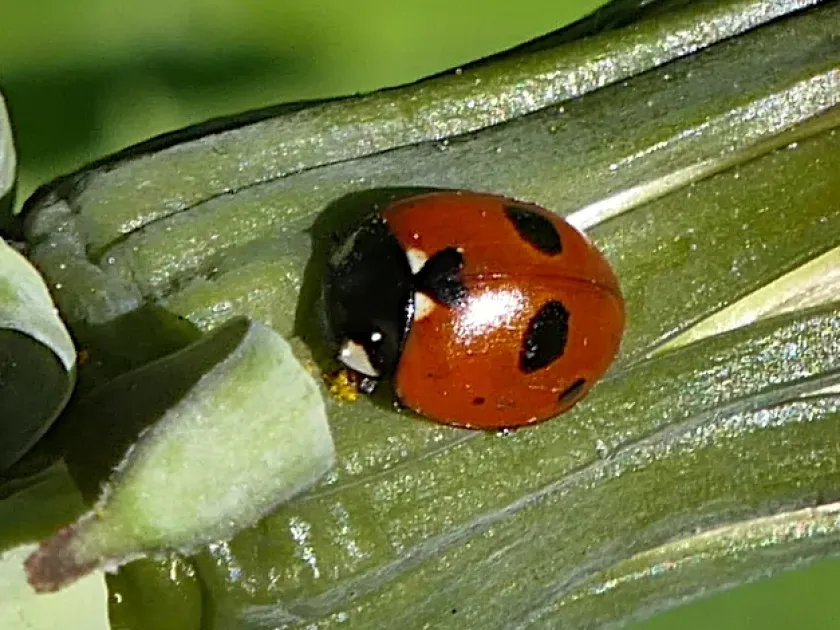
The specific identification feature is the set of five black spots on the bright red or orange elytra: two on each wing case and one common spot near the scutellum.
Adult beetles have a characteristic hemispherical body shape, measuring between 3 and 5 millimeters in length, with a smooth and shiny surface.
The larvae are campodeiform, usually dark-colored with visible spots, and go through several instars before transitioning into the pupal stage.
Understanding these morphological characteristics is essential for distinguishing this specific species from other members of the ladybird beetle family in the field.
What it damages
While primarily known as a predator of aphids, Coccinella quinquepunctata can behave as a pest when aphid populations decline, shifting to plant tissues.
The insects feed on the leaves of various field crops, creating irregular holes and consuming the epidermis, which impairs the plant's ability to perform photosynthesis.
Widespread feeding by adults and larvae can lead to stunted growth and reduced vigor in young plants, significantly impacting the overall biomass production.
Injured plant tissues often serve as entry points for bacterial and fungal pathogens, potentially leading to widespread disease outbreaks within the crop.
In orchards, heavy infestations can result in damage to the surface of fruit, which causes early decay and makes the produce unmarketable for retail.
When it appears
Adults emerge from hibernation in early spring when the air temperature becomes consistently warm, usually starting in April or May depending on the latitude.
The first generation typically appears in late spring, coinciding with the development of the first aphid colonies on wild and cultivated vegetation.
Summer is the period of peak activity, during which the beetles reproduce and deposit eggs in clusters, primarily on the underside of plant leaves.
Depending on local environmental conditions and the availability of food sources, the beetle can produce one or two generations within a single growing season.
As the daylight hours shorten and temperatures drop in the autumn, the adults seek protected areas such as bark crevices or soil debris for winter diapause.
Signs of infestation
The presence of Coccinella quinquepunctata is first detected through the appearance of small, ragged-edged holes in the leaf foliage of host plants.
Visual confirmation involves locating the distinctive beetles on the upper or lower surfaces of leaves, particularly on the succulent parts of young stems.
Clusters of bright yellow eggs attached to the leaf surface are a clear indicator of a breeding population and imminent larval activity in the area.
Yellowing and curling of leaf edges are common physiological responses to feeding damage, often appearing alongside the mechanical injury caused by the beetles.
The accumulation of waste products and shed skins (exuviae) left by larvae on the foliage provides strong evidence of an active infestation within the field.
Control measures
Effective management requires a combination of cultural practices, such as removing weeds that host the pest during its non-reproductive periods.
Crop rotation is a fundamental tool for disrupting the life cycle of the beetle and preventing the accumulation of overwintering populations in the soil.
Integrated Pest Management (IPM) strategies, including the use of pheromone traps or biological predators, are preferred over broad-spectrum insecticides.
When chemical intervention is deemed necessary, selective insecticides should be applied only during the stage of highest vulnerability of the pest.
- Deep plowing in late autumn to bury overwintering adults.
- Maintaining field borders free of debris and dense weeds.
- Monitoring population density using yellow sticky cards for early detection.
Taxonomy
- Latin name
- Coccinella quinquepunctata
- Order
- Coleoptera (beetles)
- Family
- Coccinellidae
- EPPO code
- COCIQU
Discussion
No discussions yet — be the first.