
Spined loach
Cobitis taenia
Description
How to identify
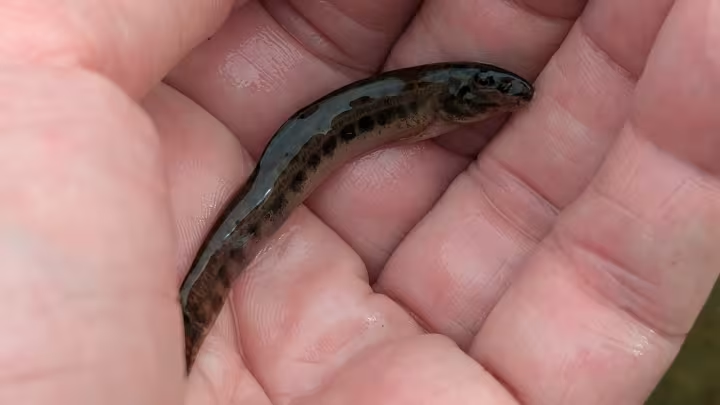
The spined loach (Cobitis taenia) is a small freshwater fish belonging to the Cobitidae family and the order Cypriniformes. It is easily recognized by its elongated, laterally compressed body covered with small scales and a complex spotted pattern that provides excellent camouflage on the bottom.
The fish's name comes from a pair of erectile, bifid spines located under the eyes. These spines are a defense mechanism that the fish deploys when threatened, often causing it to become trapped in fishing nets or animal fur.
Adult specimens typically reach 8–12 cm in length. The mouth is positioned ventrally and is surrounded by six sensory barbels, which are essential for navigating and finding food in the muddy or sandy substrates where the fish dwells.
It prefers clean, flowing waters or well-oxygenated lake bottoms with sand or silt. The spined loach is largely nocturnal, spending the daylight hours buried in the sediment to avoid predators.
As a member of the loach family, the species exhibits high physiological resilience to varying water conditions, including low oxygen levels, which allows it to thrive in diverse aquatic environments.
What it damages
The spined loach is generally not considered an agricultural pest, as it does not affect crops. However, within the context of aquaculture, it is regarded as a nuisance species that competes with commercial fish for food resources.
In stocked ponds, the spined loach feeds on zoobenthos and insect larvae. High populations of this fish can significantly reduce the available natural food supply, thereby hindering the growth rates of commercial species like carp.
Beyond food competition, the presence of the spined loach can complicate pond management. Its habit of burying itself in the sediment makes it difficult to completely clear a pond during harvest cycles.
Furthermore, this fish can act as a vector or intermediate host for certain trematodes and other parasites that can cause health issues in commercial fish populations, impacting their market quality.
Finally, the spined loach often causes mechanical problems during harvesting, as its spines get caught in fine-mesh nets, increasing the time and labor required to process and clean fishing equipment.
When it appears
The activity of the spined loach begins in early spring as water temperatures rise above 10°C. This warmth triggers the fish to emerge from winter dormancy to start feeding and preparing for the spawning season.
The spawning period occurs from late April through June. During these months, the fish move from their deep-water hiding spots to shallower, vegetation-rich areas where they deposit their eggs.
Throughout the summer, the fish are at their most active state, consuming large amounts of nutrients from the pond bed. This is the period when population densities can reach their peak in aquaculture facilities.
As autumn arrives and temperatures drop, the metabolic processes of the spined loach slow down significantly. The fish begin to seek out deeper, safer spots in the substrate to prepare for the winter months.
During the winter, the spined loach remains in a state of semi-dormancy (torpor), buried deep within the mud or sand, conserving energy until the water warms again in the following spring.
Control measures
The most effective management strategy for fish farmers is the routine draining and drying of pond beds in the autumn and winter. This process exposes the substrate to frost and air, effectively eliminating undesired fish populations.
Liming the pond floor is another recommended agricultural practice. It helps improve soil mineral content and water quality while creating an environment that is unfavorable for the survival of small nuisance species.
Biological control is highly recommended; introducing natural predators such as perch or pike into the pond ecosystem helps to naturally regulate the loach population without the need for chemicals.
Ensuring that water intake channels are equipped with fine-mesh screens prevents the migration of wild loach populations into commercial production ponds from external sources.
Regular pond maintenance, combined with precise harvesting techniques using appropriate net gauges, allows farmers to manage population density effectively while protecting the growth of their primary commercial fish stock.
Taxonomy
- Latin name
- Cobitis taenia
- Family
- Cobitidae
- EPPO code
- COBITA
Discussion
No discussions yet — be the first.