
Tasmanian ground beetle
Clivina tasmaniensis
Description
How to identify
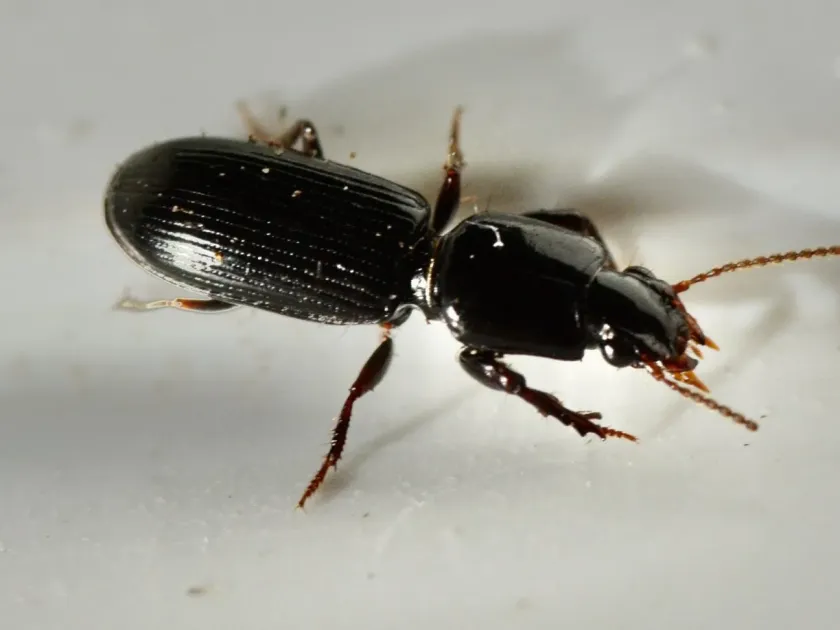
The Tasmanian ground beetle (Clivina tasmaniensis) belongs to the Carabidae family, order Coleoptera. It is a small, elongated beetle adapted for burrowing through soil.
The insect has a dark brown or black appearance, with a smooth, chitinized surface. Its head and pronotum are proportional, allowing the beetle to navigate through soil crevices easily.
The larvae also possess an elongated body characteristic of ground beetles, with well-developed limbs that ensure high mobility within the soil profile.
Unlike many beneficial ground beetles, this species shows a distinct interest in plant tissues, which makes it a significant object of phytosanitary control in specific regions.
Species identification requires microscopic analysis of the pronotum and antennae structure due to its significant similarity to other soil-dwelling beetles.
What it damages
This pest is most dangerous to cereal and grain crops, especially during germination and emergence when soil moisture is high.
Adult beetles and their larvae damage sown seeds by eating the embryonic part, which leads to thinning of crops or complete loss of the stand.
In intensive farming zones, Clivina tasmaniensis can cause significant damage in no-till systems where soil is not deeply cultivated.
Crops suffering from the activity of this pest often exhibit uneven emergence, which complicates maintenance and reduces final yields.
In addition to direct seed destruction, the pest can damage young seedling roots, weakening the plant and making it susceptible to secondary fungal infections.
When it appears
The pest's activity is directly dependent on soil temperature and moisture levels, leading to the appearance of beetles in spring as the ground warms.
Most damage is observed immediately after the sowing campaign when seeds become an easily accessible food source for adults and larvae.
The life cycle includes egg, three larval stages, pupa, and adult, with overwintering occurring primarily as an adult deep in the soil profile.
Migration of the pest to upper soil layers occurs under favorable conditions that coincide with the optimal sowing dates for many agricultural crops.
Summer population decline is associated with drier conditions in the topsoil layer, which forces the insects to move deeper.
Signs of infestation
A primary sign of infestation is the presence of characteristic holes in dug-up seeds, which appear as small, neat eaten cavities.
When inspecting the seed furrow, one may find the beetles themselves or their larvae in close proximity to damaged seedlings.
Sparse emergence despite normal field germination capacity is an indirect indicator of soil pest activity, requiring immediate investigation.
Small entry holes in the soil, approximately 2–3 mm in diameter, may indicate the mass presence of ground beetles in the seedbed layer.
Stunted growth and yellowing of the first leaves in young plants are often accompanied by root system damage, confirming the presence of Clivina tasmaniensis.
Control measures
Effective protection begins with seed treatment using systemic insecticides, which ensures protection during the critical germination phase.
Adhering to optimal sowing dates allows crops to bypass the pest's peak activity, giving seedlings a better chance to take root and strengthen.
Agronomic practices, such as thorough pre-sowing soil cultivation, disrupt the pest's habitual habitat and limit its population.
The application of granular insecticides into the soil during sowing is a radical method, though it requires strict adherence to environmental regulations.
- Regular soil monitoring before sowing.
- Use of high-quality insecticidal seed treatments.
- Implementation of crop rotation to break the development cycle.
- Ensuring high-quality seed placement and depth.
Taxonomy
- Latin name
- Clivina tasmaniensis
- Order
- Coleoptera (beetles)
- Family
- Carabidae
- EPPO code
- CLIVTA
Discussion
No discussions yet — be the first.