
Clivina fossor
Clivina fossor
Description
How to identify
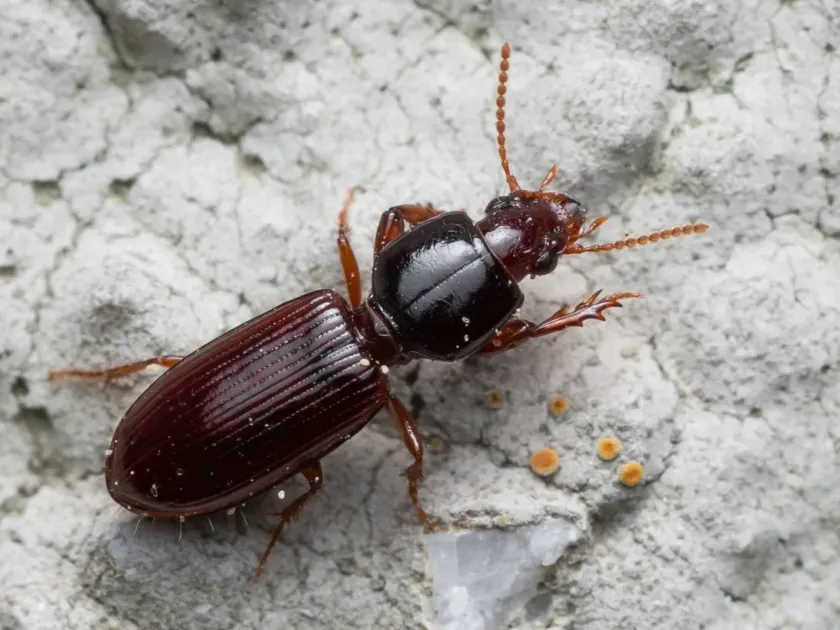
Clivina fossor is a member of the Carabidae family, commonly known as a ground beetle or burrowing beetle. It is a small insect, typically measuring 5 to 7 millimeters in length, with an elongated, cylindrical body that is dark brown or black, often exhibiting a slight metallic luster.
The beetle's morphology is highly specialized for a fossorial lifestyle. It possesses a distinct head and thorax structure and robust legs designed for digging through soil, allowing it to navigate efficiently in the upper soil horizons.
The larvae are thin, white, and worm-like, with well-developed thoracic legs and strong mouthparts. The life cycle consists of egg, larval, pupal, and adult stages, with adults typically overwintering within the soil profile.
These beetles are primarily found in moist, organic-rich environments, including agricultural fields, meadows, and areas near water sources, where they exploit the soil for both shelter and food.
Field identification is crucial, as their presence is often only revealed after significant stand loss has occurred, making early detection a priority for crop protection specialists.
What it damages
Clivina fossor primarily attacks the seeds and young seedlings of various crops, including cereals, sugar beets, potatoes, and other vegetables. Adults cause damage by gnawing into the swollen seeds before they germinate.
The most severe damage occurs during the period of germination and emergence. By feeding on the internal tissues of the seed, the beetles prevent successful germination, leading to bare patches in the field and reduced crop stands.
When seedlings are injured by the beetles, the wounds often become entry points for soil-borne pathogens, such as fungi and bacteria, which can lead to seedling blight and death even if the initial insect damage was minor.
The economic impact of this pest is most pronounced in cool, wet springs when germination is slow, as this provides a longer window for the beetles to feed on the vulnerable seeds.
High population densities, especially in fields with heavy organic matter or excessive moisture, can result in significant yield losses, often necessitating costly replanting efforts.
When it appears
Adult beetles emerge from their overwintering sites in early spring as soil temperatures begin to rise, typically once the soil reaches 8–10 degrees Celsius. This timing aligns closely with the early planting season for many row crops.
The period of maximum damage risk coincides with the time from sowing until the crop reaches the seedling emergence stage. This is when seeds are most attractive and vulnerable to the adult beetles.
During the summer months, as soil surfaces dry out and temperatures increase, the adult beetles tend to migrate deeper into the soil profile to find cooler and more humid conditions, reducing their impact on the crop.
A minor increase in activity may occur in the autumn before the beetles enter winter diapause, though this generally does not result in significant crop damage as the plants are already established.
Monitoring populations with soil-based pitfall traps in early spring allows agronomists to determine the risk level and decide whether protective measures, such as seed treatments, are necessary.
Signs of infestation
The primary sign of a Clivina fossor infestation is the presence of uneven plant stands and distinct patches in the field where seedlings have failed to emerge or have died prematurely.
Excavating the soil along affected rows usually reveals hollowed-out seeds. These seeds will exhibit characteristic jagged feeding marks consistent with the mouthparts of the burrowing beetles.
Locating the adult beetles themselves in the soil near the damaged seeds provides definitive proof that this species is the primary cause of the crop stand issue.
Small, tubular soil tunnels or burrows near the seed zone serve as additional evidence of the insect's movement and feeding activities within the seedbed.
- Reduced emergence and thin crop stands.
- Hollowed-out seeds found during soil excavations.
- Presence of burrowing holes in the seed furrow.
Control measures
Effective management begins with the application of systemic insecticidal seed treatments, which provide a localized chemical barrier that protects the germinating seed from beetle attack.
Proper soil preparation is an essential agronomic tool. Thorough tillage helps disrupt the beetles' habitat and can kill overwintering adults by destroying their soil burrows.
Optimizing planting dates to ensure rapid and uniform crop emergence helps minimize the time seeds are vulnerable, allowing plants to grow quickly past the susceptible stage.
Adopting good crop rotation practices and keeping fields free of weeds can reduce the availability of alternative food sources and shelter, helping to limit beetle population growth.
In cases of severe infestation, the use of soil-applied granular insecticides during planting may be considered as a supplemental control measure to reduce the beetle population density.
Taxonomy
- Latin name
- Clivina fossor
- Order
- Coleoptera (beetles)
- Family
- Carabidae
- EPPO code
- CLIVFO
Discussion
No discussions yet — be the first.