
Clivina collaris
Clivina collaris
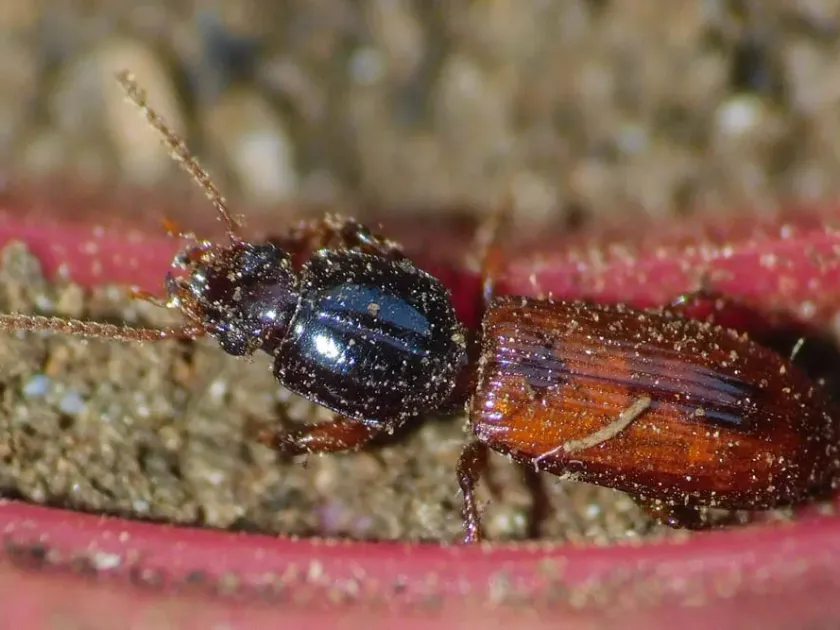
Description
How to identify
Clivina collaris is a small beetle belonging to the Carabidae family, commonly known as ground beetles. The adult insect measures approximately 5–6 mm in length and possesses an elongated, cylindrical body perfectly adapted for movement through soil layers.
The beetle typically exhibits a dark brown or black coloration with a slight metallic luster. It is equipped with a robust head and strong mandibles, which are functional tools for both predatory activity and burrowing.
The larvae are pale, yellowish, and have an elongated shape covered with fine hairs. Due to their subterranean lifestyle, they are rarely seen by farmers unless soil samples are specifically examined for their presence.
Adult beetles have well-developed wings, allowing them to migrate across fields in search of moisture-rich environments that favor their survival and reproduction.
They prefer compact, heavy, or clay-heavy soils, often congregating in low-lying areas where soil humidity remains consistently high during the spring season.
What it damages
While many ground beetles are beneficial predators, Clivina collaris can act as a pest by targeting germinating seeds and young seedlings of various agricultural crops.
The primary economic damage occurs in cereal crops such as wheat, barley, and rye, where adults feed on the germ of the seed, preventing germination and resulting in thin or patchy stands.
In addition to cereals, oilseed rape, sugar beet, and other industrial crops are also at risk, particularly during their initial growth phases when the seeds and stems are most vulnerable.
The severity of the damage is often exacerbated by unfavorable weather conditions that delay germination, prolonging the period during which the seeds remain vulnerable to beetle feeding.
- Consumption of the seed embryo prior to seedling emergence.
- Chewing on the tender stems of young plants at the soil level.
- Significant reduction in crop density and overall stand uniformity.
When it appears
The peak activity of Clivina collaris is observed in early spring, coinciding with the warming of the soil, which triggers their emergence from overwintering sites.
Their life cycle timing is critical as it often overlaps with the sowing season of spring cereals, posing a direct threat to newly planted seeds.
Throughout the growing season, adults may move across the field to find more favorable micro-habitats, particularly in response to changes in soil moisture levels.
Activity levels may fluctuate during the summer, but populations remain within the soil profile, often preparing for subsequent life stages or overwintering.
As temperatures drop in the autumn, the beetles burrow deeper into the soil to enter diapause, where they remain until the next spring.
Signs of infestation
The first indicator of an infestation is the appearance of sparse areas or bare patches in the field shortly after crop emergence, which can often be misidentified as poor seed quality.
A closer inspection of the soil within these patches often reveals small, characteristic tunnels and the remnants of damaged seeds near the plant rows.
Careful excavation of affected seeds will show distinct mandible marks, confirming the feeding activity of the beetle on the embryonic part of the grain.
Due to their nocturnal and subterranean nature, observing the beetles on the soil surface during daylight is highly unlikely, necessitating the use of soil diagnostics.
Pitfall traps or targeted soil sampling are effective methods for confirming the presence of the beetle population before significant damage occurs.
Control measures
Effective management of Clivina collaris relies on integrated pest management practices that prioritize crop vigor and soil health.
Proper pre-sowing soil cultivation is essential, as it disrupts the beetles' tunnels and creates a favorable seedbed that promotes rapid germination and growth.
Seed treatment with systemic insecticides is the most effective chemical control method for protecting young seedlings from soil-dwelling pests during the critical early growth stages.
Optimizing sowing dates to ensure rapid germination can significantly reduce the window of vulnerability for the crop, minimizing the potential impact of beetle feeding.
Maintaining a diverse crop rotation is a key cultural practice that helps prevent the build-up of Clivina collaris populations in the field over successive years.
Taxonomy
- Latin name
- Clivina collaris
- Order
- Coleoptera (beetles)
- Family
- Carabidae
- EPPO code
- CLIVCO
Discussion
No discussions yet — be the first.