
Cleruchoides noackae
Cleruchoides noackae
Description
How to identify
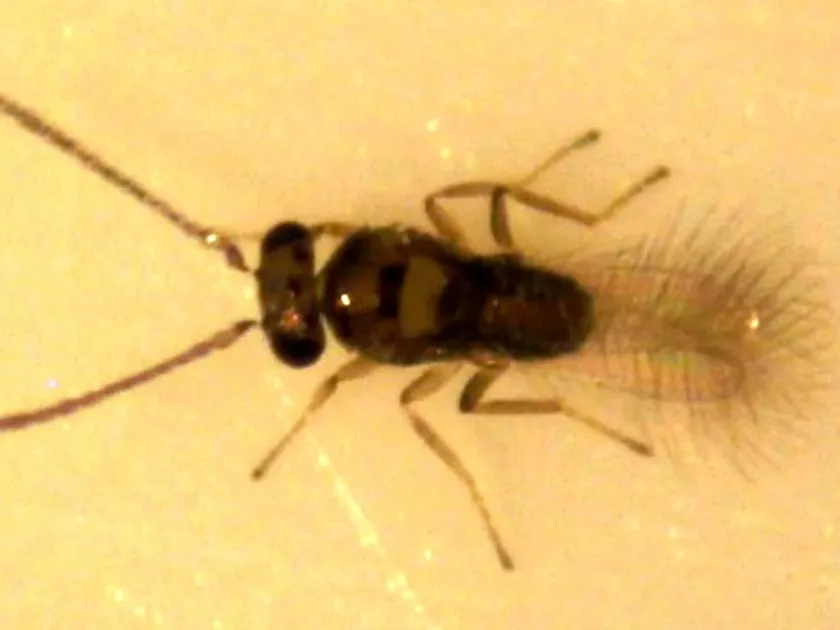
Cleruchoides noackae is a minute parasitic wasp belonging to the family Mymaridae, widely known as fairyflies due to their delicate appearance.
These insects are characterized by their extremely small size and specialized morphological traits, such as long, hair-like fringes on their wings.
Taxonomically, they occupy a crucial niche as egg parasitoids, targeting the eggs of specific coleopteran pests that affect forestry operations.
Identification in the field is impossible without high-powered magnification, as the adults are barely visible to the naked eye.
Research taxonomists rely on specialized microscopic analysis of antennal structures and wing venation to distinguish this species from other Mymaridae.
What it damages
Cleruchoides noackae is not a pest; rather, it is a highly beneficial insect that functions as a natural enemy to eucalyptus-feeding weevils.
The primary host for this parasitoid is the eucalyptus snout beetle (Gonipterus platensis), a notorious defoliator in eucalypt plantations.
By ovipositing inside the eggs of the beetle, C. noackae kills the developing embryo, effectively stopping the infestation before it starts.
In the absence of this biological agent, the beetle population can devastate large forest tracts, causing significant economic losses to timber industries.
Therefore, protecting this species and fostering its population is a cornerstone of sustainable forest management in regions where eucalyptus is grown.
When it appears
The activity of Cleruchoides noackae is strictly synchronized with the egg-laying seasons of its host, the eucalyptus weevil.
In temperate and Mediterranean climates, this synchronization often results in multiple generations appearing during the warm spring and summer months.
Temperature and humidity play a decisive role in the developmental rate of the parasitoid, affecting the overall success of the biocontrol process.
Winter diapause or slowed activity is common in colder regions, with the population recovering rapidly when the host begins its reproductive cycle.
Field studies have shown that the peak efficiency of the parasitoid is achieved during the periods of maximum host egg density on young leaves.
Signs of infestation
Signs of C. noackae activity include a noticeable reduction in the number of larvae hatching from egg capsules on the host plant.
A diagnostic sign for researchers is the discoloration of the beetle eggs, which often turn dark after the parasitoid larva has consumed the contents.
Upon maturity, the adult wasp chews a circular exit hole through the shell of the host egg, leaving behind a characteristic "empty" shell.
Forest health assessments are carried out by collecting egg-bearing leaves and quantifying the percentage of parasitized versus healthy eggs.
Lack of leaf damage in areas heavily infested with weevil eggs is often the most significant indirect sign that C. noackae is active in the canopy.
Control measures
The primary "control" measure for this species involves its conservation and augmentation within the forest ecosystem.
Avoiding the use of non-selective broad-spectrum chemical insecticides is essential, as these can easily wipe out the entire local population of C. noackae.
Integrated Pest Management (IPM) programs often incorporate the introduction of laboratory-reared specimens into new areas to establish a sustainable population.
Maintaining high levels of plant biodiversity around plantations provides essential nectar sources and shelters for the adult wasps.
Continuous monitoring of parasitism rates allows forest managers to evaluate the stability of the biological control system and adjust their management strategies.
Taxonomy
- Latin name
- Cleruchoides noackae
- Order
- Hymenoptera
- Family
- Mymaridae
- EPPO code
- CLERNO
Discussion
No discussions yet — be the first.